
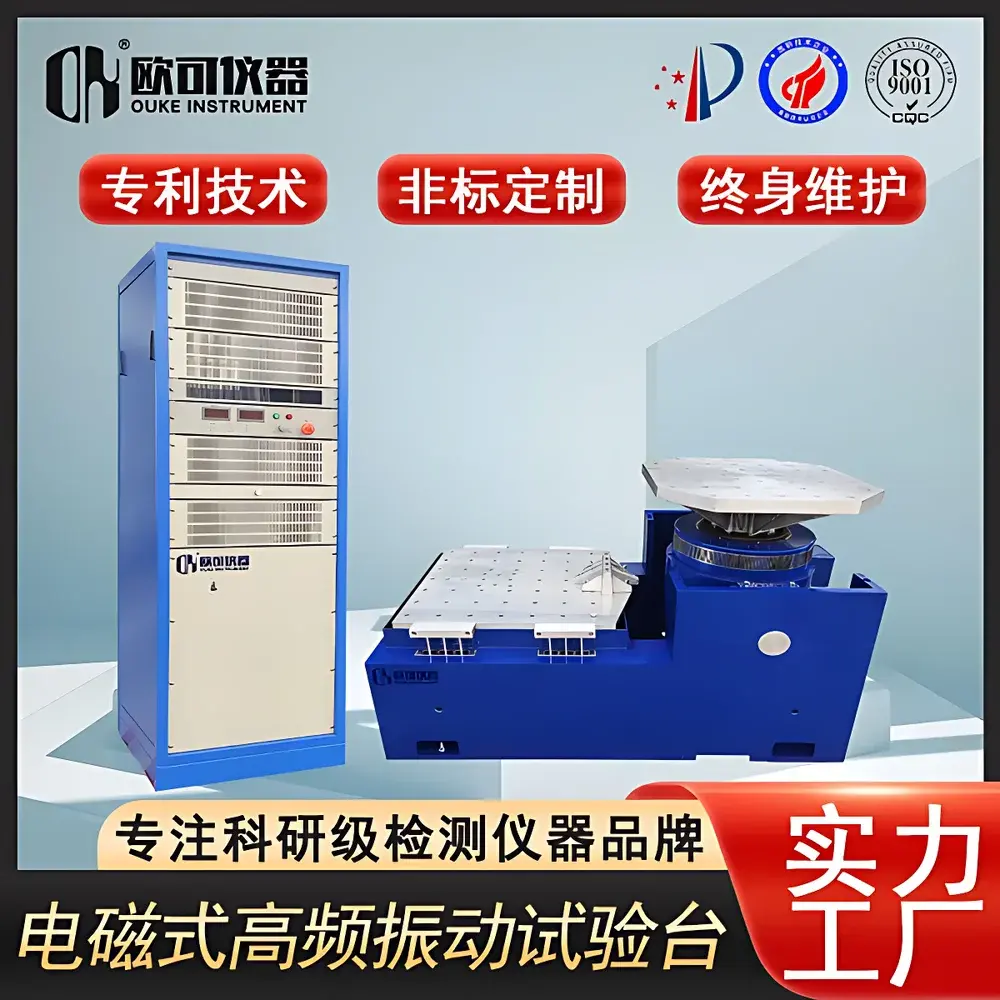
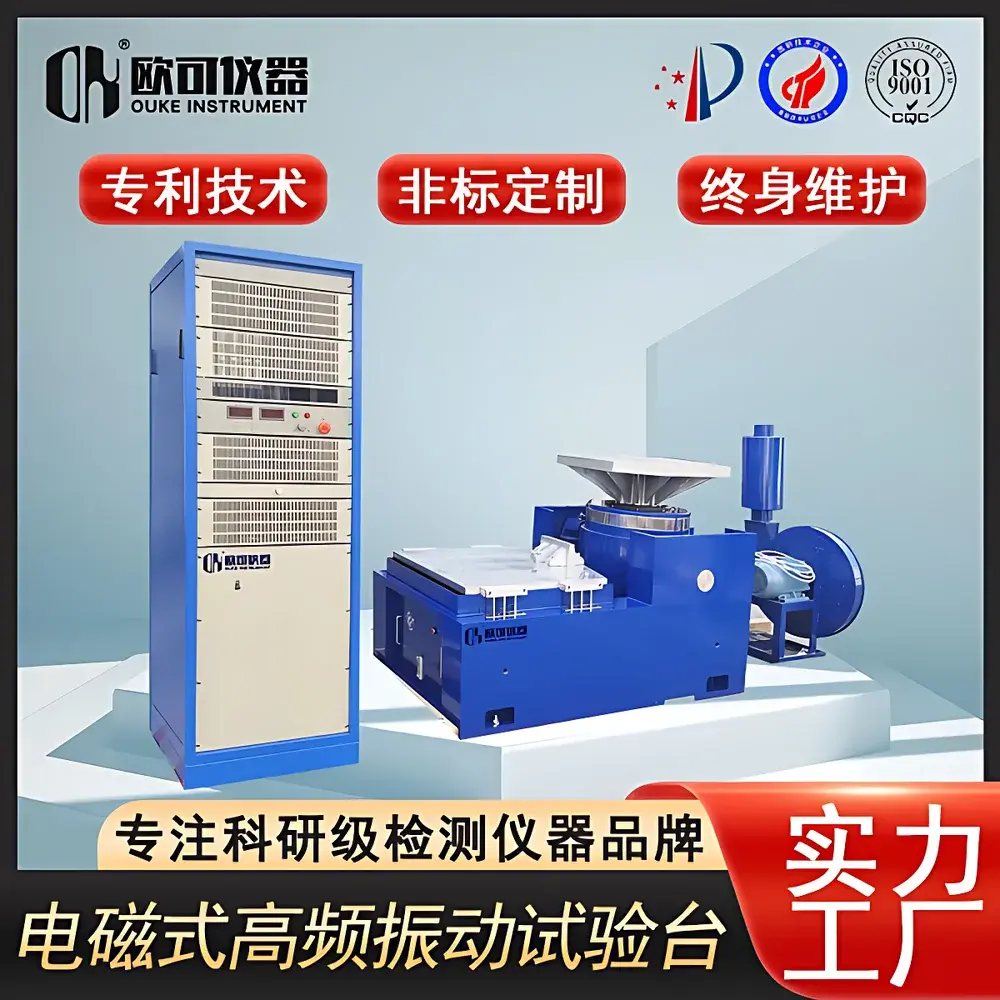
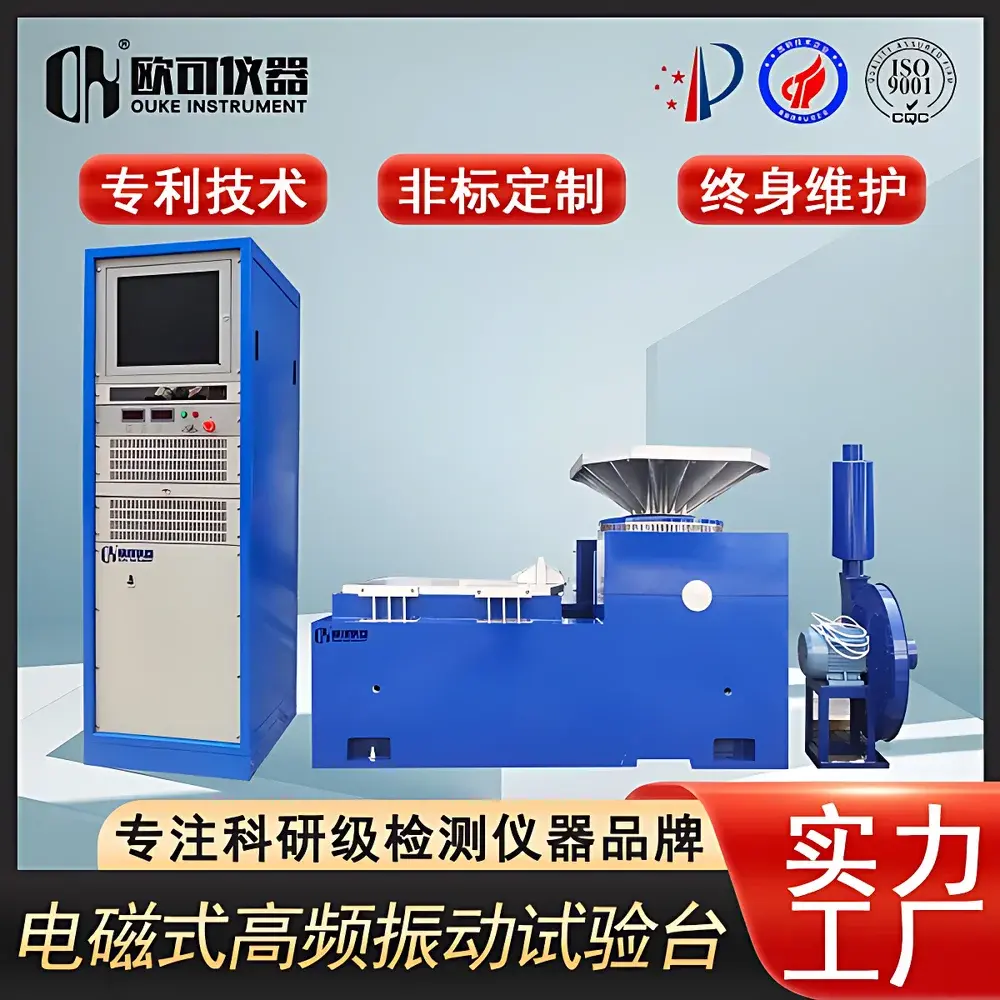
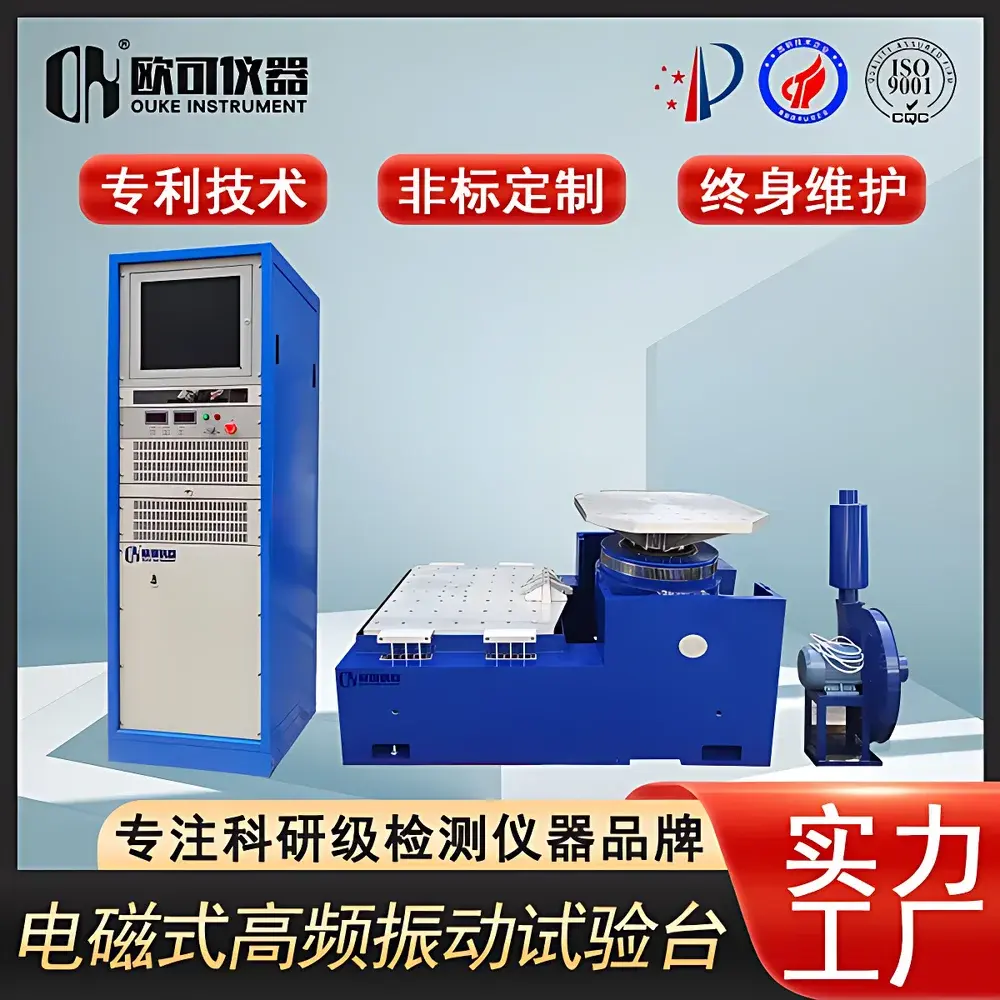
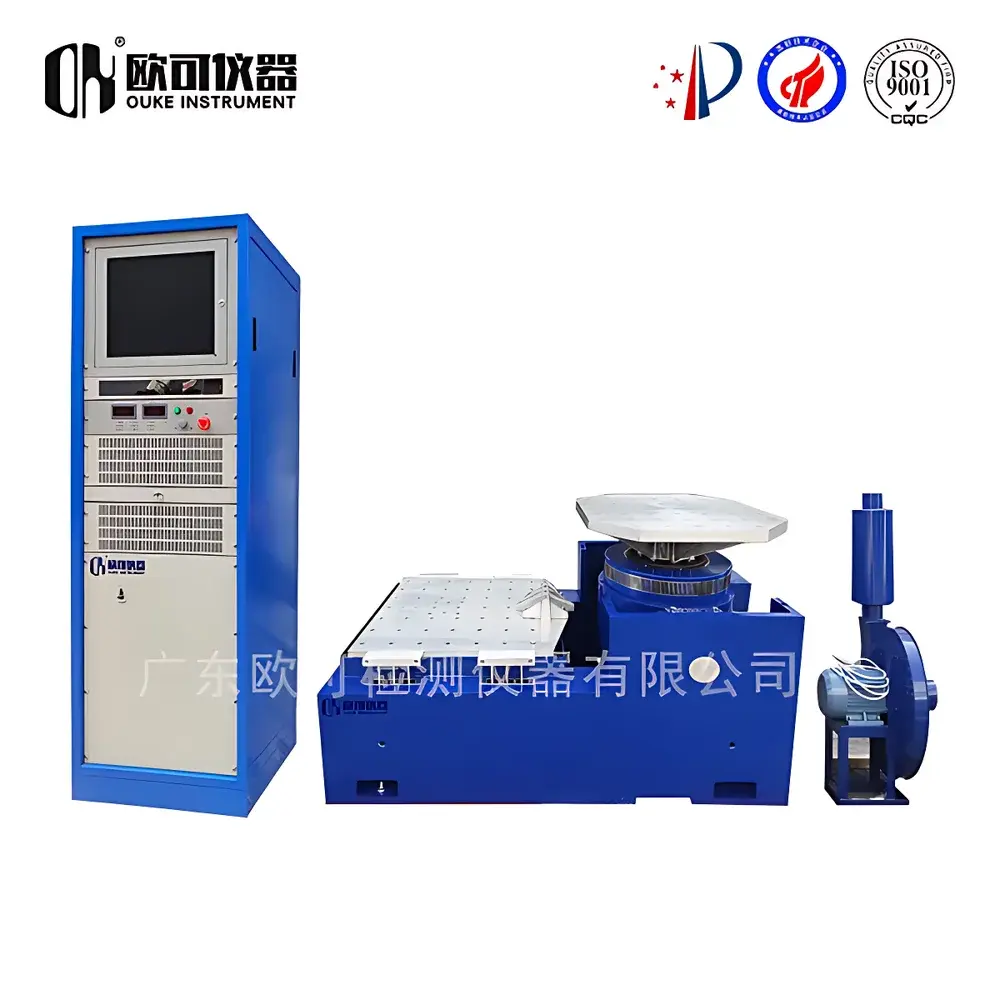
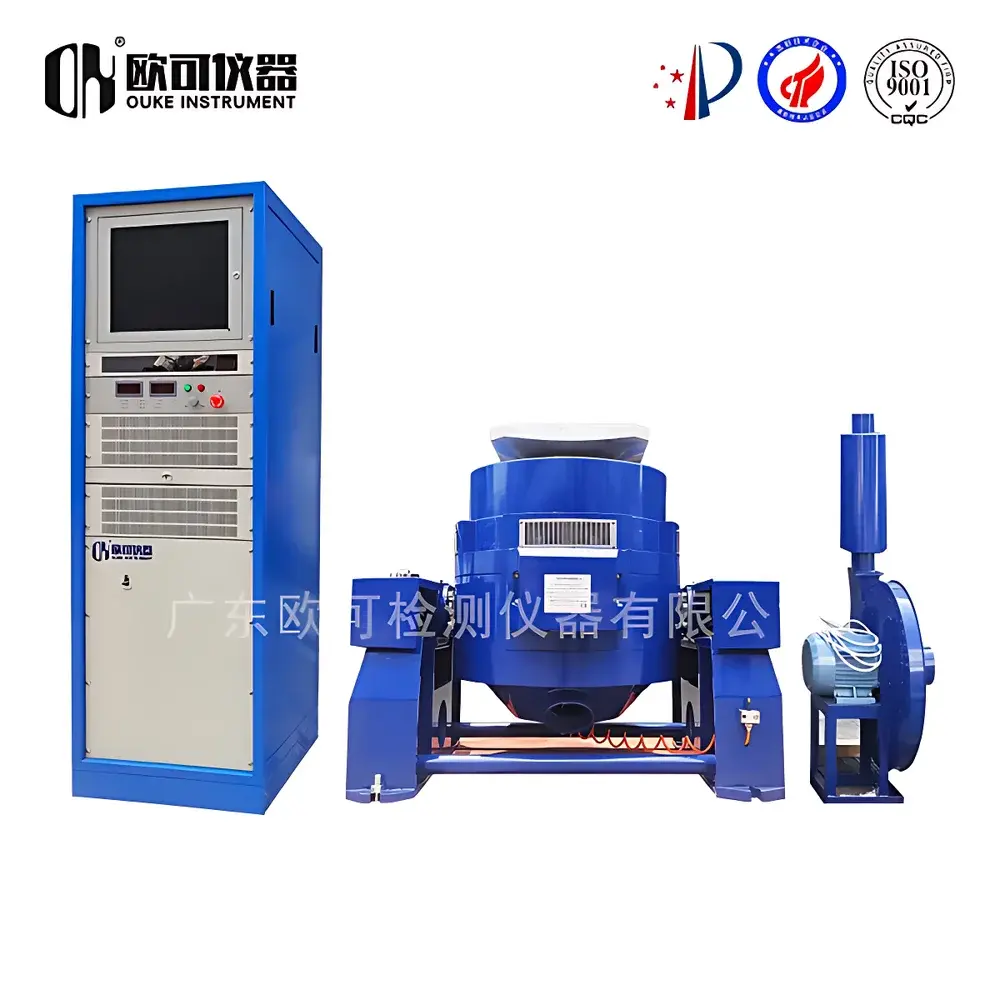
OK-ES-6.66 Electromagnetic Vibration Shaker System
| Brand | OK Instruments |
|---|---|
| Origin | Guangdong, China |
| Manufacturer Type | Direct Manufacturer |
| Instrument Type | Electromagnetic Shaker |
| Rated Force | 1.98 kN |
| Frequency Range | 5–5000 Hz |
| Max. Test Load | 70 kg |
| Table Dimensions | 400 × 400 × 30 mm |
| Max. Acceleration | 10 g |
| Table Mounting | Standard M6/M8 Threaded Holes |
| Cooling Method | Forced Air (Optional Water Cooling Available) |
| Control Interface | Digital Closed-Loop Controller with Real-Time Feedback |
Overview
The OK-ES-6.66 Electromagnetic Vibration Shaker System is a high-fidelity, digitally controlled electrodynamic shaker engineered for precision mechanical vibration testing across research, quality assurance, and product qualification environments. Operating on the principle of Lorentz force generation—where a time-varying current in a voice coil interacts with a static magnetic field to produce proportional linear motion—the system delivers repeatable, traceable, and spectrally accurate excitation. Its closed-loop architecture integrates real-time acceleration feedback from a reference sensor mounted directly on the shaker table, enabling dynamic error correction at microsecond resolution. Designed to comply with international test standards including ISO 10816 (vibration severity evaluation), IEC 60068-2-6 (sinusoidal vibration), IEC 60068-2-64 (random vibration), and MIL-STD-810H (method 514.8), the OK-ES-6.66 serves as a primary excitation source for structural dynamics characterization, fatigue life assessment, and environmental stress screening.
Key Features
- Electrodynamic actuation with permanent magnet circuit architecture—optimized for energy efficiency, thermal stability, and low harmonic distortion.
- Digital servo controller supporting sine, random, shock, and time-history (road profile) waveforms—with real-time FFT-based spectrum tracking and convergence monitoring.
- Rated peak force of 1.98 kN ensures robust performance under dynamic load conditions up to 70 kg (including fixture mass), with built-in safety margin per ASTM E1492 guidelines.
- Wide operational frequency bandwidth: 5 Hz to 5000 Hz—enabling both low-frequency resonance scanning and high-frequency modal analysis without mechanical resonance interference.
- Rigid 400 × 400 × 30 mm aluminum alloy table with standardized M6 and M8 threaded mounting patterns for universal fixture compatibility and minimal modal coupling.
- Integrated forced-air cooling system; optional water-cooled amplifier available for extended high-duty-cycle operation (e.g., prolonged random PSD testing).
- Compliance-ready architecture: audit trails, user access levels, and calibration log retention support GLP/GMP documentation requirements per FDA 21 CFR Part 11 when paired with validated software modules.
Sample Compatibility & Compliance
The OK-ES-6.66 accommodates a broad range of test specimens—from compact consumer electronics modules (<1 kg) to automotive ECUs, avionics enclosures, and industrial sensors—provided total mass (specimen + fixture + moving mass contribution) remains within the 70 kg mechanical load limit. Its flat, rigid table surface minimizes rocking modes and supports custom fixture integration via standardized hole patterns. The system meets electromagnetic compatibility (EMC) Class B emission limits per CISPR 11 and operates within ambient temperature ranges of 10–35°C and relative humidity ≤80% non-condensing. All control firmware and data acquisition modules are designed to interface seamlessly with third-party environmental chambers, enabling synchronized temperature-humidity-vibration (triple-combined) testing per IEC 60068-2-66 and RTCA DO-160 Section 8.
Software & Data Management
The shaker is operated via OK-VibControl™—a Windows-based, real-time deterministic control platform compliant with IEEE 1588 Precision Time Protocol for multi-channel synchronization. The software provides full spectral editing capabilities, including PSD shaping, kurtosis control for non-Gaussian random profiles, and SRS synthesis for transient shock replication. All test sessions generate timestamped, metadata-embedded binary files (.okv) compatible with MATLAB, Python (via provided SDK), and commercial post-processing tools such as MEScope and LMS Test.Lab. Calibration certificates include traceability to NIM (National Institute of Metrology, China) and are archived with digital signatures. Audit logs record operator ID, parameter changes, calibration events, and system faults—ensuring full compliance with ISO/IEC 17025 laboratory accreditation requirements.
Applications
- Resonance detection and modal parameter identification in printed circuit board assemblies and MEMS packaging.
- Reliability validation of automotive ADAS sensors under road-simulated random vibration spectra (e.g., ISO 16750-3, SAE J1211).
- Screening of aerospace-grade electronic modules per MIL-STD-810H Method 514.8 and ECSS-Q-ST-70-08C.
- Transportation simulation for home appliances (IEC 60068-2-63) and telecom infrastructure hardware (GR-63-CORE).
- Dynamic characterization of composite materials and adhesive joints in academic structural dynamics laboratories.
- Pre-compliance EMC vibration testing where mechanical disturbance must be isolated from electrical noise sources.
FAQ
What standards does the OK-ES-6.66 support out-of-the-box?
It natively supports IEC 60068-2-6 (sine), IEC 60068-2-64 (random), ISO 10816-1 (machinery vibration evaluation), and MIL-STD-810H Method 514.8—all accessible via preloaded test templates.
Can this shaker be integrated into a climatic chamber?
Yes—its low electromagnetic emissions and air-cooled design allow direct integration with standard walk-in or reach-in environmental chambers using feedthrough adapters and isolation mounts.
Is third-party calibration included with purchase?
A factory calibration certificate traceable to NIM is supplied; ISO/IEC 17025-accredited field calibration services are available upon request.
How is overload protection implemented?
Hardware-level current limiting, thermal cutoffs on the amplifier and coil, plus real-time displacement/acceleration saturation detection in the controller prevent mechanical or electrical damage during misconfiguration.
Does the system support remote operation and monitoring?
Yes—via Ethernet TCP/IP interface with RESTful API endpoints for status queries, parameter updates, and event-triggered data export, suitable for Industry 4.0 test cell integration.



