
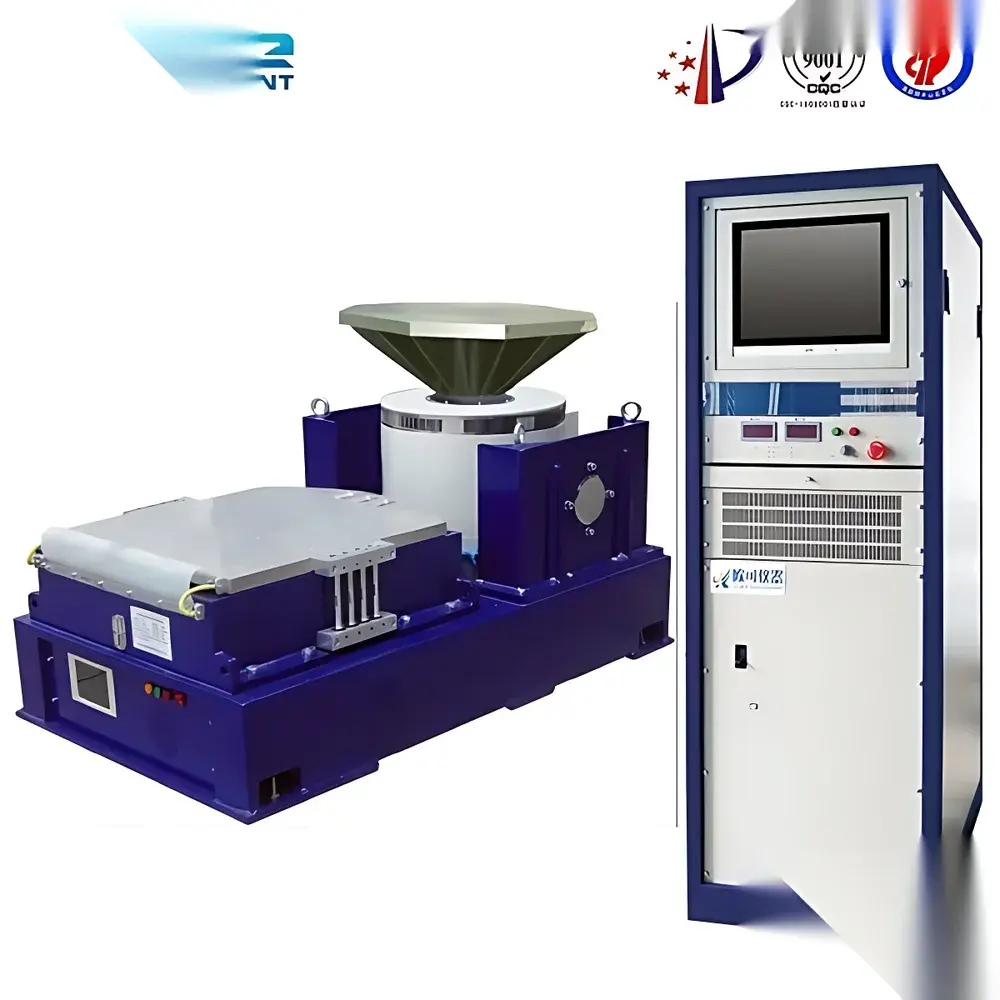
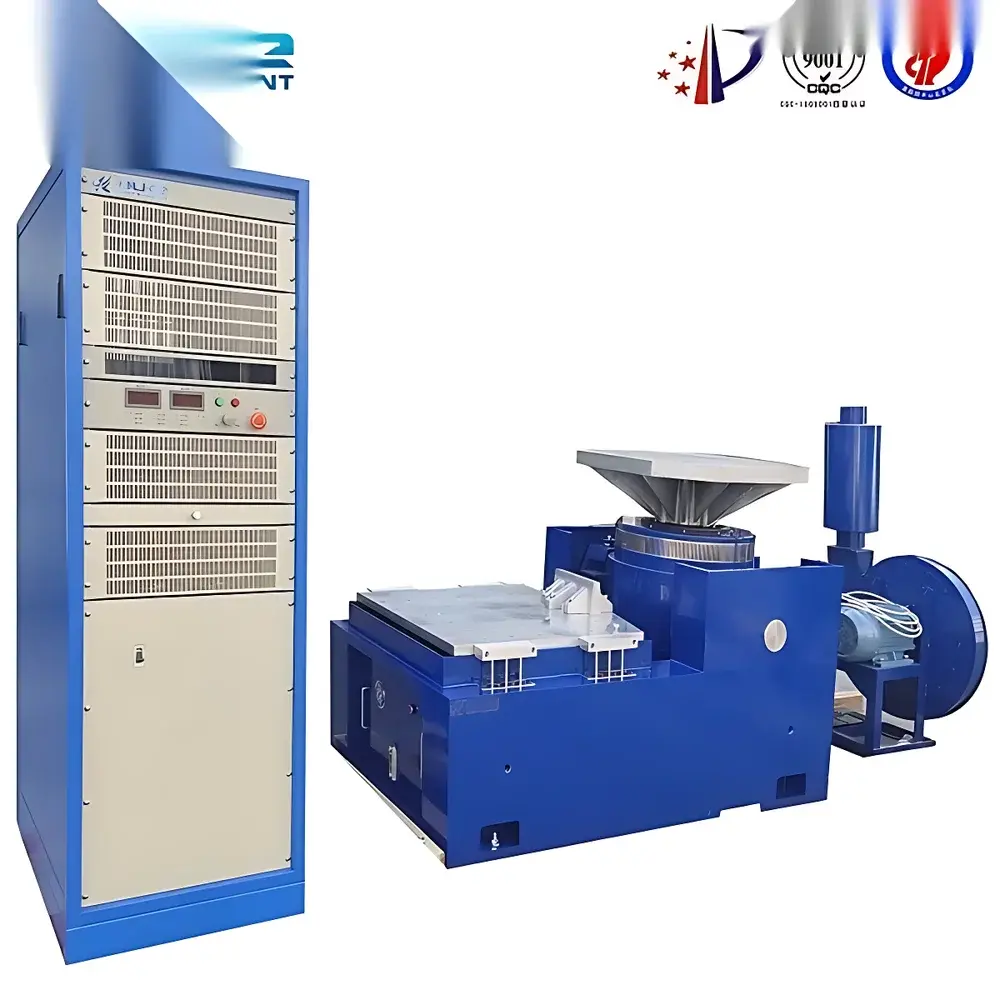
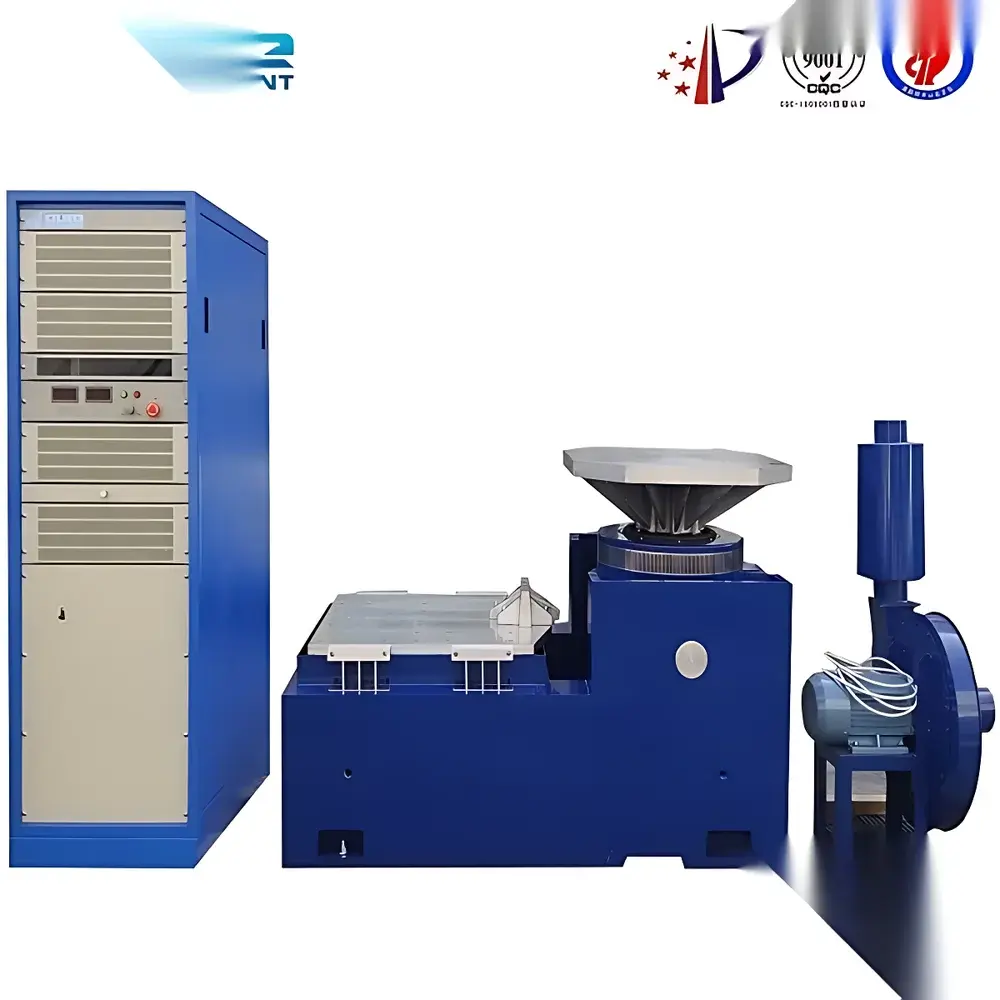
OK-ES-60 Vertical Electromagnetic Vibration Shaker System
| Brand | Other Brands |
|---|---|
| Origin | Imported |
| Manufacturer Type | Authorized Distributor |
| Frequency Range | 1–600 Hz |
| Max. Load Capacity | 100 kg |
| Peak Acceleration | 20 g |
| Adjustable Peak-to-Peak Amplitude | 0–5 mm |
| Vibration Axis | Vertical (configurable to horizontal, vertical+horizontal, 4-DOF or 6-DOF) |
| Control Modes | Sine, AM, Fixed-Frequency Sine, Programmable Sweep, Logarithmic Sweep, Octave Sweep, Time-Controlled Operation |
| Interface | RS-485 |
| Power Supply | 220 V ±20%, 10 A, 2.2 kW |
| Table Dimensions (L×W) | 50×50 cm |
| Unit Dimensions (L×H×W) | 50×20×50 cm |
| Frequency Resolution | 0.01 Hz (display), ±0.1 Hz accuracy |
| Compliance | Designed for ISO 2041, ASTM D999, IEC 60068-2-6, MIL-STD-810H vibration test standards |
Overview
The OK-ES-60 Vertical Electromagnetic Vibration Shaker System is an industrial-grade electrodynamic shaker engineered for precision mechanical shock and sinusoidal vibration testing in quality assurance, reliability engineering, and product development laboratories. Operating on electromagnetic force generation principles—where coil current interacts with a permanent magnetic field to produce controlled inertial motion—the system delivers repeatable, traceable excitation across a broad frequency spectrum (1–600 Hz). Its core architecture supports single-axis vertical excitation by default, with optional mechanical and control upgrades enabling bi-axial (vertical + horizontal), four-degree-of-freedom (4-DOF), or six-degree-of-freedom (6-DOF) configurations. The shaker meets the physical and metrological requirements of standardized environmental stress screening protocols, including harmonic resonance detection, fatigue life assessment, and modal survey pre-screening. All mechanical interfaces conform to ISO 5344 mounting specifications, ensuring compatibility with industry-standard fixtures and load adapters.
Key Features
- Electrodynamic actuator with 2.2 kW amplifier delivering up to 20 g peak acceleration at ≤100 kg payload
- Adjustable peak-to-peak displacement from 0 to 5 mm, dynamically constrained by acceleration-amplitude-frequency relationship per ISO 5347-1
- Multi-mode real-time control: sine, amplitude-modulated (AM), fixed-frequency, programmable sweep, logarithmic sweep, octave sweep, and time-gated operation
- RS-485 digital interface for integration into automated test benches and SCADA environments; supports Modbus RTU protocol
- Frequency resolution of 0.01 Hz with display accuracy ±0.1 Hz; full-range sweep linearity verified per IEC 60068-2-6 Annex B
- Stainless steel top plate (50 × 50 cm) with M8 threaded mounting array; base frame dimensions 50 × 20 × 50 cm for stable floor coupling
- Thermal protection, over-current cutoff, and mechanical end-stop limiters integrated into drive electronics
Sample Compatibility & Compliance
The OK-ES-60 accommodates rigidly mounted test specimens up to 100 kg, including electronic enclosures, automotive ECUs, aerospace avionics modules, packaging units, and PCB assemblies. Fixture design must maintain center-of-gravity alignment within ±15 mm of the table’s geometric center to minimize pitch/yaw moments. The system is configured and calibrated to support test execution per ISO 10816-1 (vibration severity evaluation), ASTM D999 (shipping container vibration simulation), and MIL-STD-810H Method 514.7 (vibration exposure profiles). Optional accelerometer input channels (sold separately) enable closed-loop control and real-time acceleration/velocity/displacement monitoring compliant with ISO 16063-21 traceability requirements. Documentation includes factory calibration certificate (NIST-traceable reference accelerometers used), mechanical compliance report, and electrical safety certification (IEC 61000-4 series immunity tested).
Software & Data Management
While the embedded controller provides standalone operation via front-panel keypad and LCD, full functionality requires optional PC-based software (sold separately). This Windows-compatible application supports test script creation using intuitive drag-and-drop logic blocks, real-time waveform visualization (FFT, time history, PSD), automated pass/fail thresholding, and export to CSV, MATLAB .mat, or Universal File Format (UFF 58). Audit trails record operator ID, timestamp, parameter settings, and hardware status changes—meeting FDA 21 CFR Part 11 requirements when deployed with user authentication and electronic signature modules. Data archives are encrypted and version-controlled; raw sensor streams are timestamped with microsecond resolution using IEEE 1588 PTP synchronization.
Applications
- Resonance search and dwell testing for structural integrity validation
- Transport simulation per ISTA 3A and ASTM D4169 shipping protocols
- Component-level HALT/HASS screening with controlled thermal-vibration coupling (when integrated with environmental chambers)
- Vibration fatigue analysis of solder joints, connectors, and MEMS devices
- Calibration verification of accelerometers and vibration sensors against primary standards
- Pre-compliance EMI/EMC mechanical disturbance testing prior to radiated emissions campaigns
FAQ
What is the maximum payload mass for guaranteed performance at 20 g?
At full rated acceleration (20 g), the system maintains linearity and distortion < –30 dB up to 50 kg. For 100 kg loads, peak acceleration is limited to 10 g across 5–100 Hz to preserve mechanical integrity and thermal stability.
Can the shaker operate continuously at 600 Hz?
Yes—within its thermal envelope—but sustained high-frequency operation requires active cooling and adherence to duty-cycle limits specified in Section 4.2 of the Technical Manual.
Is third-party calibration available after installation?
Yes. Accredited metrology labs offer on-site sensitivity verification, transfer function mapping, and ISO/IEC 17025-compliant calibration certificates with measurement uncertainty budgets.
Does the system support closed-loop control with external accelerometers?
Yes—via optional analog input module (±10 V, 24-bit ADC) supporting IEPE and charge-mode sensors; firmware v3.2+ enables real-time feedback compensation per ISO 5347-3.
What documentation is included with shipment?
Factory calibration report, mechanical installation guide, electrical safety compliance dossier, CE Declaration of Conformity, and English-language operating manual with troubleshooting matrix.



