
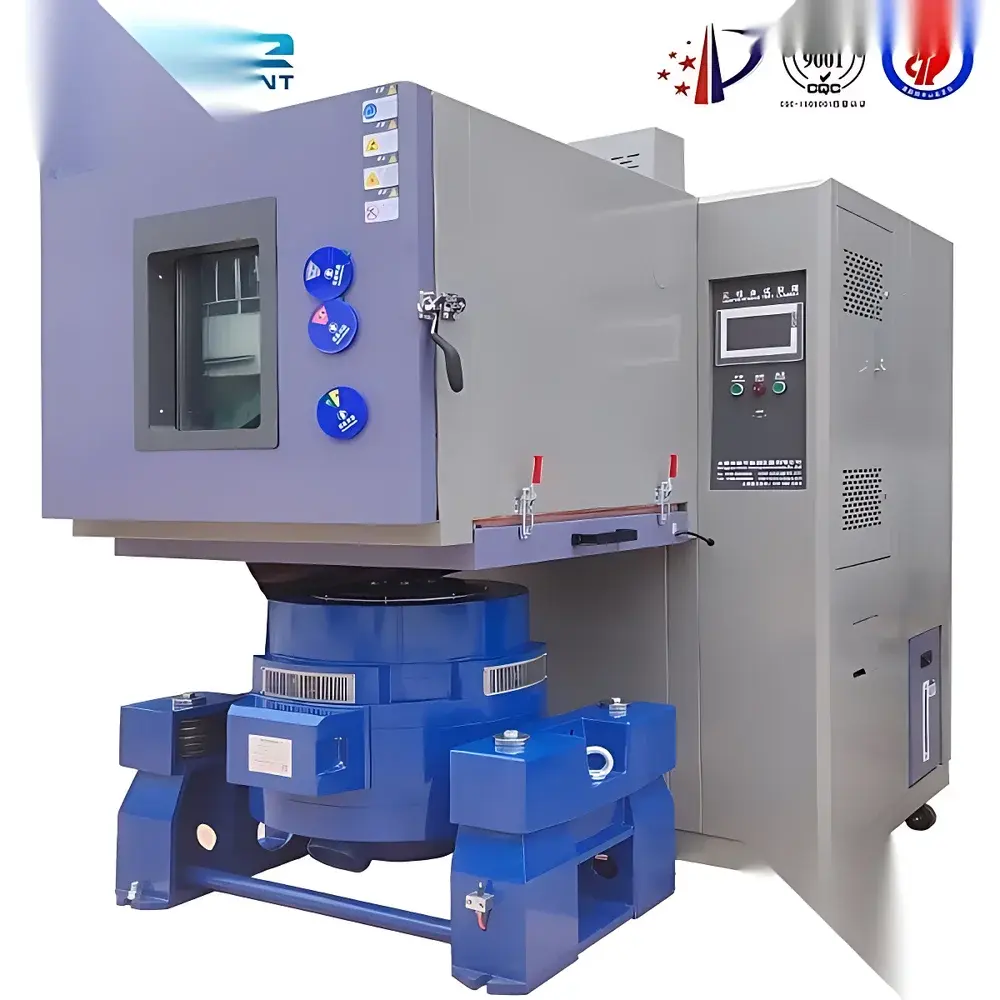
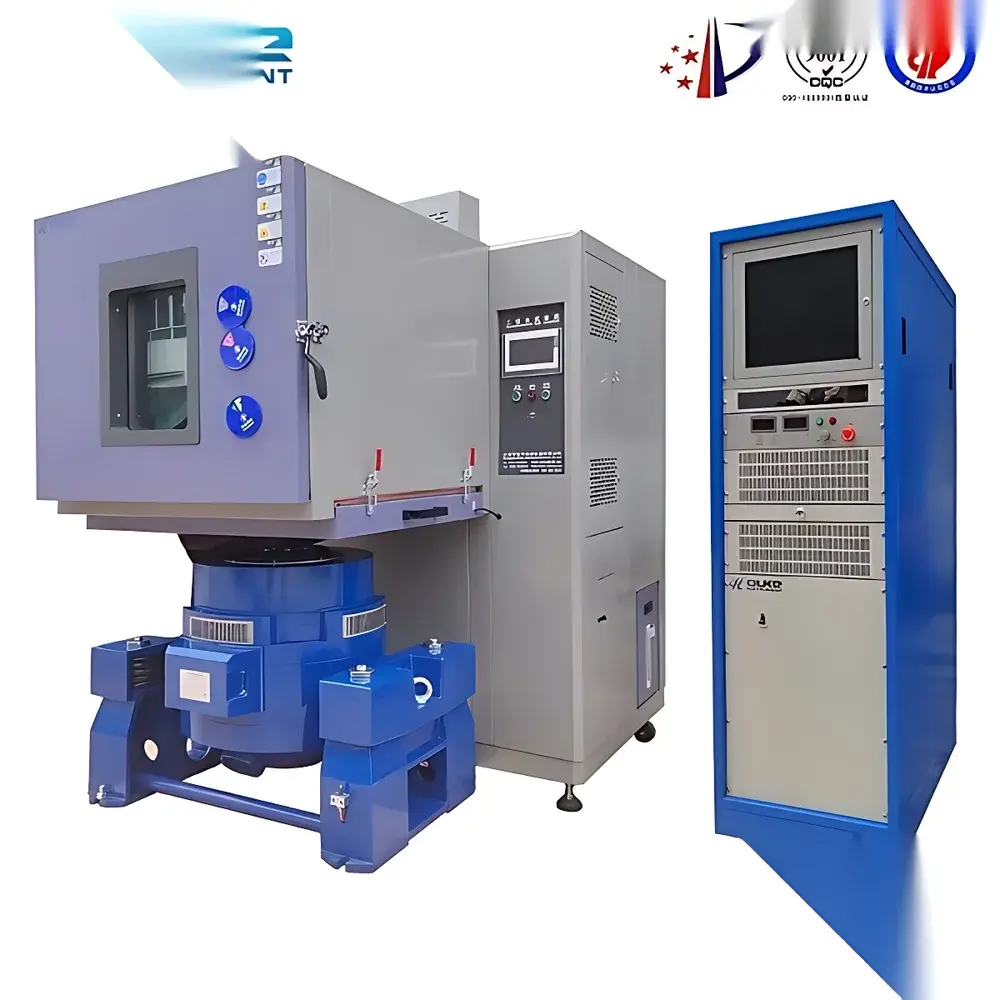
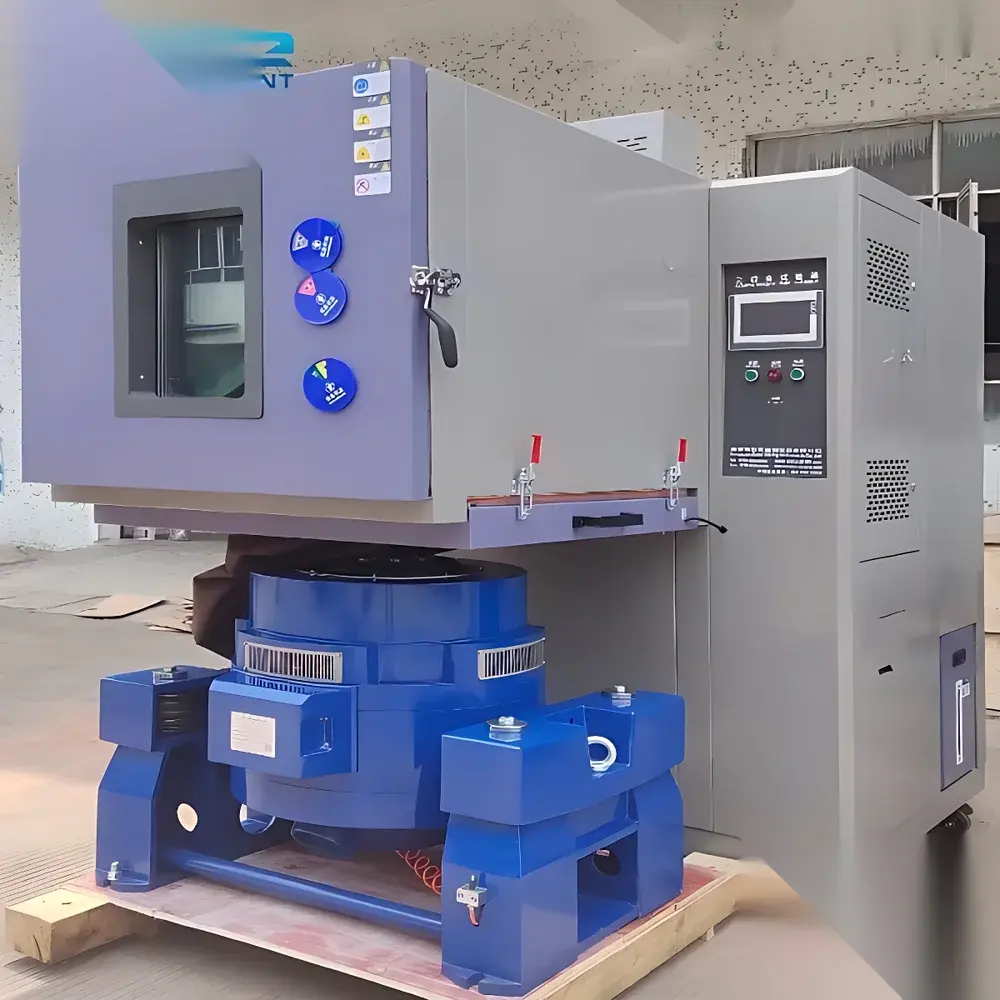
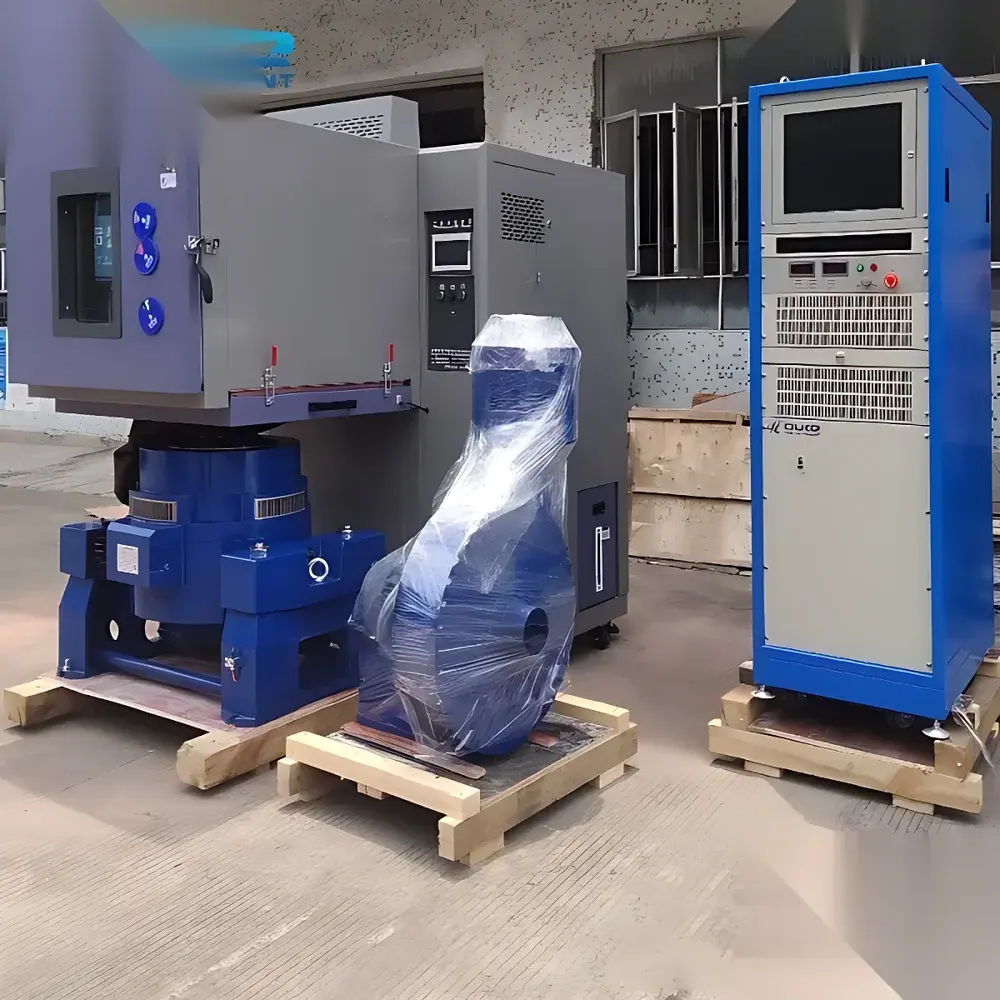
OK-ES Combined Temperature-Humidity-Vibration Environmental Test Chamber
| Brand | OK-ES |
|---|---|
| Model | OK-ES |
| Type | Combined Temperature, Humidity, and Vibration Test Chamber |
| Frequency Range | 5–2000 Hz |
| Frequency Resolution | 0.01 Hz |
| Frequency Accuracy | ±0.1 Hz |
| Peak Acceleration | 20 g (peak) |
| Displacement Amplitude | 0–5 mm p-p |
| Vibration Axes | Vertical + Horizontal (dual-axis simultaneous or independent operation) |
| Payload Capacity | 100 kg |
| Table Surface Dimensions | 1100 × 800 mm |
| Programmable Sweep | Up/Down, Logarithmic, Step, and Octave Modes (30-segment, 0.01 Hz resolution) |
| Waveform | Sine only |
| Time Control Resolution | 1 second |
| Power Supply | 380 V ±10%, 3-phase |
| Refrigeration System | Dual-stage cascade refrigeration with hermetic French Tecumseh compressors |
| Humidity Control Range | 20–98% RH |
| Temperature Range | −70°C to +180°C |
| Heating System | Nickel-chromium far-infrared heating elements |
| Dehumidification Method | Surface condensation via evaporator coil |
| Compliance | Designed for ASTM D4169, ISO 13355, ISTA 3A/3E, MIL-STD-810H environmental simulation protocols |
Overview
The OK-ES Combined Temperature-Humidity-Vibration Environmental Test Chamber is an engineered platform for accelerated reliability validation of electronic assemblies, automotive components, aerospace subsystems, and packaged goods under synchronized multi-stress conditions. It integrates three critical environmental stress domains—precisely controlled thermal cycling (−70°C to +180°C), regulated humidity (20–98% RH), and high-fidelity mechanical vibration (5–2000 Hz, up to 20 g peak acceleration)—within a single test envelope. The system operates on the principle of simultaneous stress application, enabling realistic replication of field-induced degradation mechanisms such as solder joint fatigue, material creep, seal failure, and interfacial delamination. Unlike sequential or single-stress testing, this triaxial approach significantly improves test fidelity and reduces time-to-failure correlation uncertainty in HALT/HASS and qualification programs.
Key Features
- Dual-axis vibration system with independent vertical and horizontal actuation—enabling true 2D dynamic loading without cross-axis coupling artifacts.
- High-resolution frequency control (0.01 Hz resolution, ±0.1 Hz accuracy) supporting precise resonance tracking and narrow-band dwell testing per MIL-STD-810H Method 514.8.
- Programmable waveform sequencing: sweep (linear/logarithmic), step, octave, and 30-segment user-defined profiles—all with sub-second timing granularity.
- Thermal-humidity subsystem featuring dual-stage cascade refrigeration (Tecumseh hermetic compressors), far-infrared rapid-heating elements, and surface-condensation dehumidification for stable RH control across full temperature range.
- Integrated anti-rebound braking mechanism and passive isolation mounts to suppress secondary impact and prevent energy transmission to facility infrastructure.
- Real-time synchronization logic ensures phase-coherent alignment between thermal ramp rates, humidity transitions, and vibration excitation profiles—critical for evaluating moisture-sensitive components during thermal shock.
Sample Compatibility & Compliance
The OK-ES chamber accommodates payloads up to 100 kg on its 1100 × 800 mm rigid aluminum table, supporting standard shipping containers (e.g., ISTA-certified corrugated boxes), PCB assemblies, ECUs, battery modules, and medical device enclosures. Its operational envelope satisfies key international standards including ASTM D4169 (performance testing of shipping containers), ISO 13355 (vibration testing of packaged products), ISTA 3A/3E (simulated transport environments), and MIL-STD-810H Method 514.8 (vibration) and Method 502.7 (temperature/humidity). The system architecture supports GLP-compliant audit trails when integrated with optional data logging firmware, meeting foundational requirements for FDA 21 CFR Part 11–aligned validation documentation.
Software & Data Management
Control and monitoring are executed via a dedicated Windows-based HMI with deterministic real-time kernel, supporting local touchscreen operation and remote Ethernet/RS-485 interface. The software suite provides synchronized multi-parameter logging at ≥100 Hz sampling rate (temperature, RH, acceleration, displacement), exportable in CSV and TDMS formats. Built-in profile validation tools verify parameter boundaries before test initiation; event-triggered data capture logs anomalies (e.g., thermal overshoot >±1.5°C, humidity deviation >±3% RH) with timestamped metadata. Optional firmware upgrade enables encrypted audit trail generation, electronic signatures, and role-based access control—aligning with GMP/GLP traceability expectations.
Applications
- Qualification of automotive ADAS sensors under combined thermal cycling and road-spectrum vibration.
- Accelerated life testing of lithium-ion battery packs subjected to humidity ingress and mechanical shock.
- Validation of hermeticity and solder joint integrity in avionics modules per DO-160 Section 21.
- Package integrity assessment for pharmaceutical primary packaging exposed to warehouse-condition humidity and transit vibration.
- Failure mode identification in MEMS devices using resonant dwell tests at thermally induced natural frequencies.
FAQ
What standards does the OK-ES chamber support for vibration testing?
It complies with MIL-STD-810H Method 514.8, ISO 10326-1, and ASTM D999 for sine vibration, with programmable sweep and dwell capabilities aligned to industry-accepted test spectra.
Can the chamber perform humidity cycling while vibrating?
Yes—thermal, humidity, and vibration subsystems operate synchronously under coordinated control, enabling coupled stress profiles such as “cold soak → humid ramp → resonant dwell” sequences.
Is remote monitoring and data export supported?
Standard Ethernet connectivity allows SCADA integration; raw sensor data and profile execution logs are exportable in CSV, TDMS, or XML formats with configurable timestamps and units.
What safety protections are built into the vibration system?
Hardware-limited over-acceleration cutoff, table displacement limit switches, anti-rebound hydraulic braking, and real-time amplitude clipping prevent mechanical damage during resonance excursions or load imbalance events.
Does the system meet electromagnetic compatibility (EMC) requirements for lab use?
The chamber meets EN 61326-1 (industrial EMC) and includes filtered power input and shielded signal cabling to minimize radiated emissions in shared laboratory environments.



