
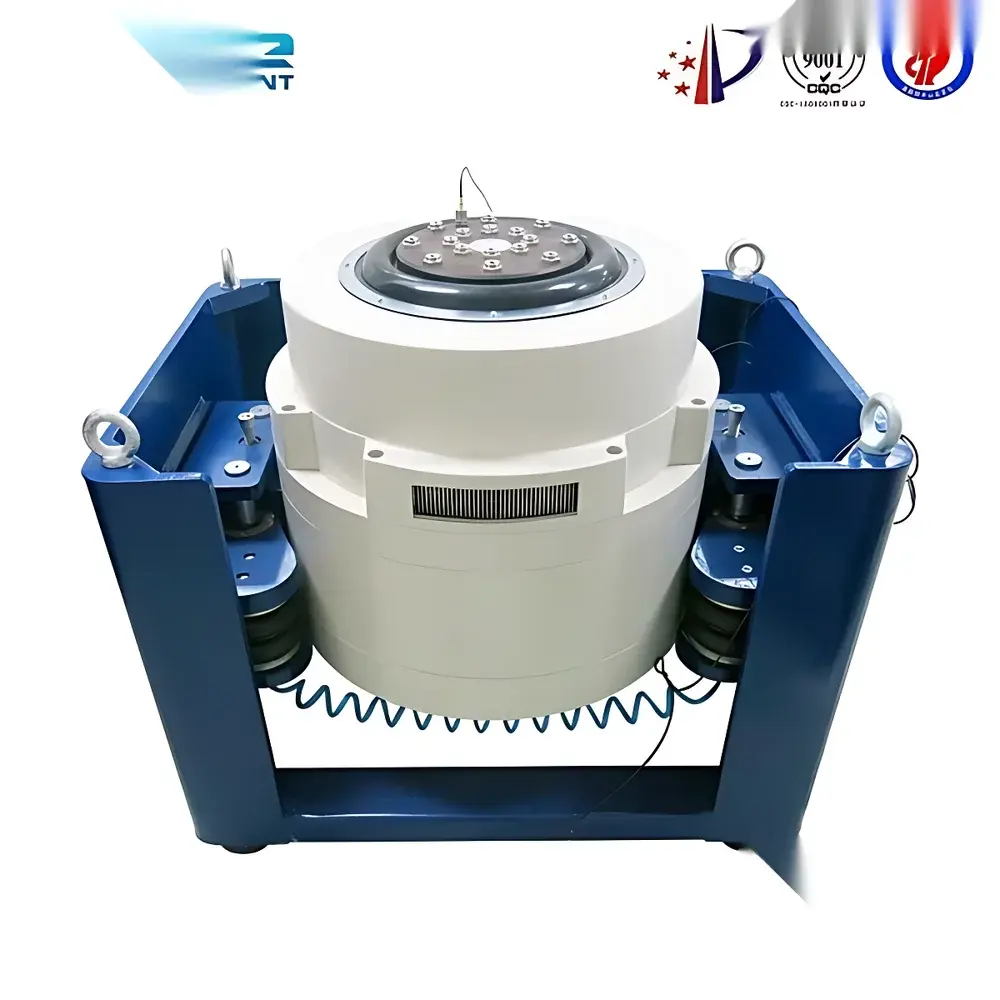
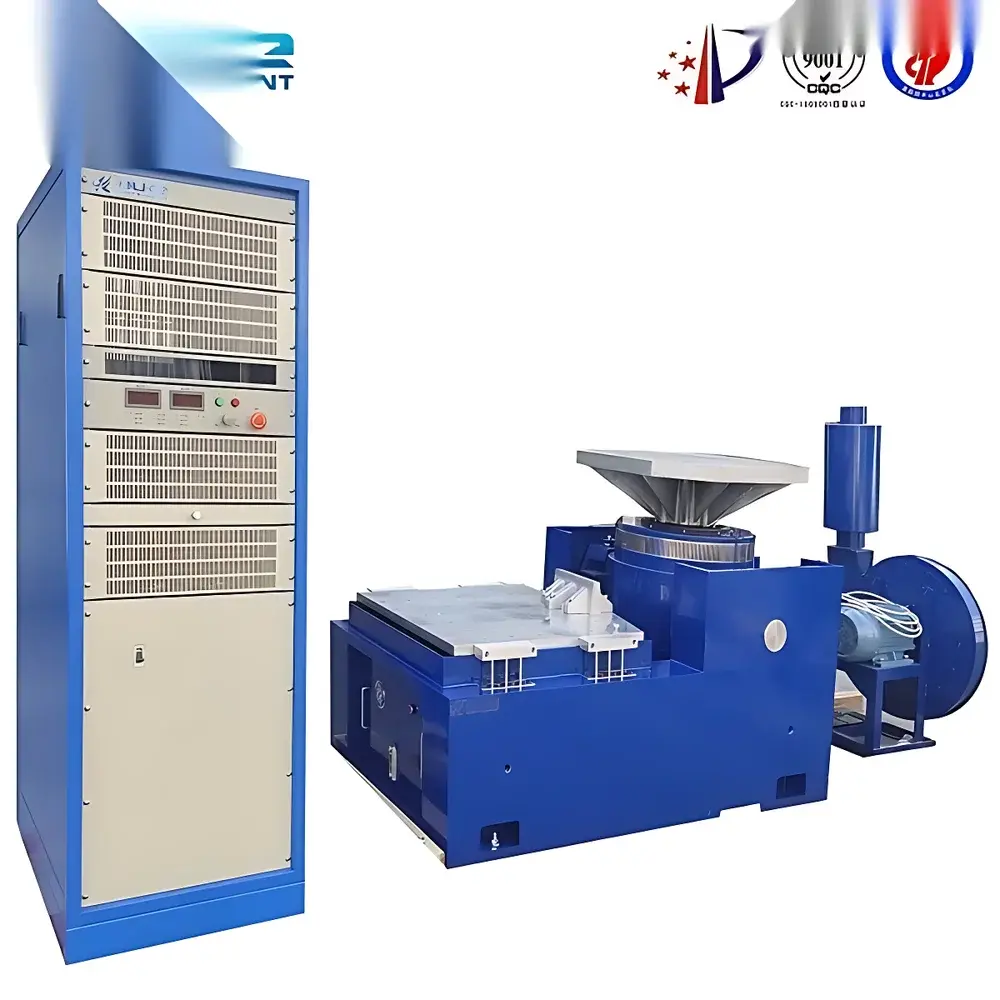
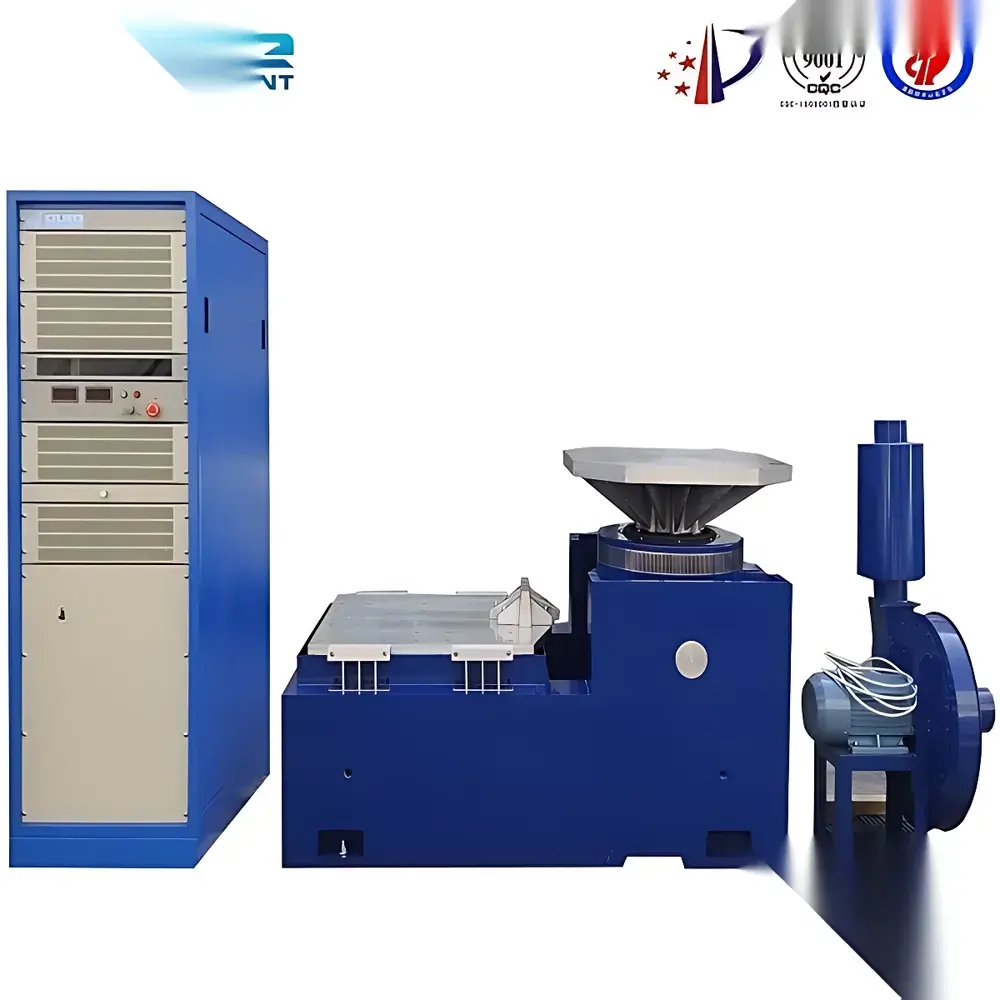
OK-ES Series Electromagnetic Vibration Shaker System
| Brand | Other Brands |
|---|---|
| Origin | Imported |
| Manufacturer Type | General Distributor |
| Power Supply | AC 220 V / 50 Hz ±2% |
| Operating Temperature | 0–45 °C |
| Max. Test Load | 40 kg |
| Frequency Range (Fixed & Sweep) | 5–200 Hz |
| Zero-Load Displacement Amplitude | 0–5 mm |
| Vibration Axis | Vertical |
| Timer Range | Up to 99 h |
| Test Table Dimensions (L×W×H) | 450 × 450 × 43 mm |
| Shaker Body Dimensions (L×W×H) | 500 × 500 × 385 mm |
| Control Unit Dimensions (L×W×H) | 380 × 255 × 170 mm |
| Rated Power | 2.2 kVA |
| Control Interface | Bilingual (English/Chinese) Menu, PC-Based Operation via Dedicated Test & Control Software |
| Data Acquisition | Real-time Curve Recording, Automatic Data Processing, Storage & Printing Capabilities |
| Display Functions | Dynamic Real-Time Waveform Plotting, Multi-Stage Parameter Monitoring, Logarithmic Scaling, and Synchronized Numerical Readouts |
Overview
The OK-ES Series Electromagnetic Vibration Shaker System is a precision-engineered electrodynamic vibration test platform designed for controlled mechanical stress evaluation of components, assemblies, and packaged goods under defined sinusoidal, swept-sine, or time-domain excitation profiles. Based on electromagnetic force generation (Lorentz principle), the system delivers repeatable, low-distortion vertical-axis motion across a 5–200 Hz operational bandwidth, enabling standardized simulation of transportation, handling, and service-life vibratory environments. Its rigid cast-aluminum shaker body, high-stiffness moving coil assembly, and closed-loop digital servo control architecture ensure high fidelity in amplitude and frequency response—critical for compliance-driven reliability screening in electronics, automotive, aerospace, and packaging R&D laboratories.
Key Features
- Electrodynamic actuation with zero mechanical backlash and minimal harmonic distortion below 1% THD at rated load
- Programmable sweep modes: linear, logarithmic, and step dwell; fully configurable start/stop frequencies, sweep rates, and dwell durations
- Dual-mode operation: fixed-frequency endurance testing and resonant search via frequency sweep
- Integrated real-time monitoring of acceleration, velocity, displacement, and drive current with auto-scaling waveform display
- Bilingual (English/Chinese) graphical user interface with intuitive navigation, parameter locking, and user-level access control
- PC-hosted control software supporting test script creation, multi-channel synchronization (with optional external sensors), and export to CSV, PDF, and XML formats
- Robust thermal management system ensuring stable performance over extended 99-hour continuous operation cycles
- Compliant mounting interface (M6 threaded holes on 450 × 450 mm table surface) accommodating fixtures, adapters, and environmental chambers
Sample Compatibility & Compliance
The OK-ES system accommodates specimens up to 40 kg mass with center-of-gravity height ≤150 mm above the table surface, maintaining dynamic balance and minimizing rocking moments. It supports standard test specimens per IEC 60068-2-6, ISO 10326-1, ASTM D999, and MIL-STD-810H Method 514.7 (vibration). The control software includes preloaded test templates aligned with common industry protocols—including random vibration spectra (e.g., road transport PSD profiles), shock pulse synthesis (half-sine, trapezoidal), and resonance dwell sequences. Audit trail functionality, user authentication logs, and electronic signature support align with GLP and GMP documentation requirements where applicable.
Software & Data Management
The dedicated test control software provides full lifecycle data governance: from test definition and real-time acquisition to post-processing and report generation. All raw waveform data are timestamped and stored with metadata (operator ID, test ID, calibration date, environmental conditions). The system implements automatic gain scaling, anti-aliasing filtering (10th-order digital FIR), and RMS/Peak/PPV statistical computation per channel. Export modules comply with FDA 21 CFR Part 11 readiness—supporting electronic signatures, audit trails, and secure data archiving. Raw binary files (.bin) and processed datasets (.csv) retain traceability to instrument firmware version and sensor calibration certificates.
Applications
- Pre-shipment reliability screening of consumer electronics to detect solder joint fatigue, connector loosening, or MEMS misalignment
- Structural integrity validation of automotive ECUs, battery modules, and infotainment housings under simulated road-induced vibration
- Packaging optimization studies assessing cushioning performance, stack stability, and seal integrity during simulated freight transit
- Resonance mapping of printed circuit board assemblies to guide mechanical redesign or mounting strategy refinement
- Accelerated life testing of industrial sensors, actuators, and optical encoders subjected to cyclic mechanical loading
- Verification of mounting bracket stiffness and fastener retention under variable-frequency excitation
FAQ
What standards does the OK-ES Series comply with for vibration testing?
The system supports execution of tests per IEC 60068-2-6, ISO 10326-1, ASTM D999, and MIL-STD-810H Method 514.7. Calibration and verification procedures follow ISO 16063-21 for vibration transducers and ISO 10816-1 for machine vibration severity assessment.
Can the system perform random vibration testing?
The base OK-ES configuration supports sinusoidal and swept-sine profiles. Random vibration capability requires optional spectral control module and dedicated power amplifier upgrade—available as a factory-configured option.
Is the control software compatible with Windows 10/11 and MATLAB integration?
Yes—the software runs natively on Windows 10/11 (64-bit) and provides TCP/IP and DLL-based APIs for third-party environment integration, including MATLAB, LabVIEW, and Python-based test automation frameworks.
How is system calibration maintained and verified?
Annual calibration is recommended using NIST-traceable accelerometers and laser vibrometers. The control unit stores calibration coefficients per channel and enforces lockout of unverified configurations during test execution.
What safety interlocks are implemented?
Hardware-enforced limits include over-temperature shutdown, over-current cutoff, displacement saturation detection, and emergency stop circuitry compliant with IEC 61800-5-2. A physical key switch disables all motion outputs when engaged.



