
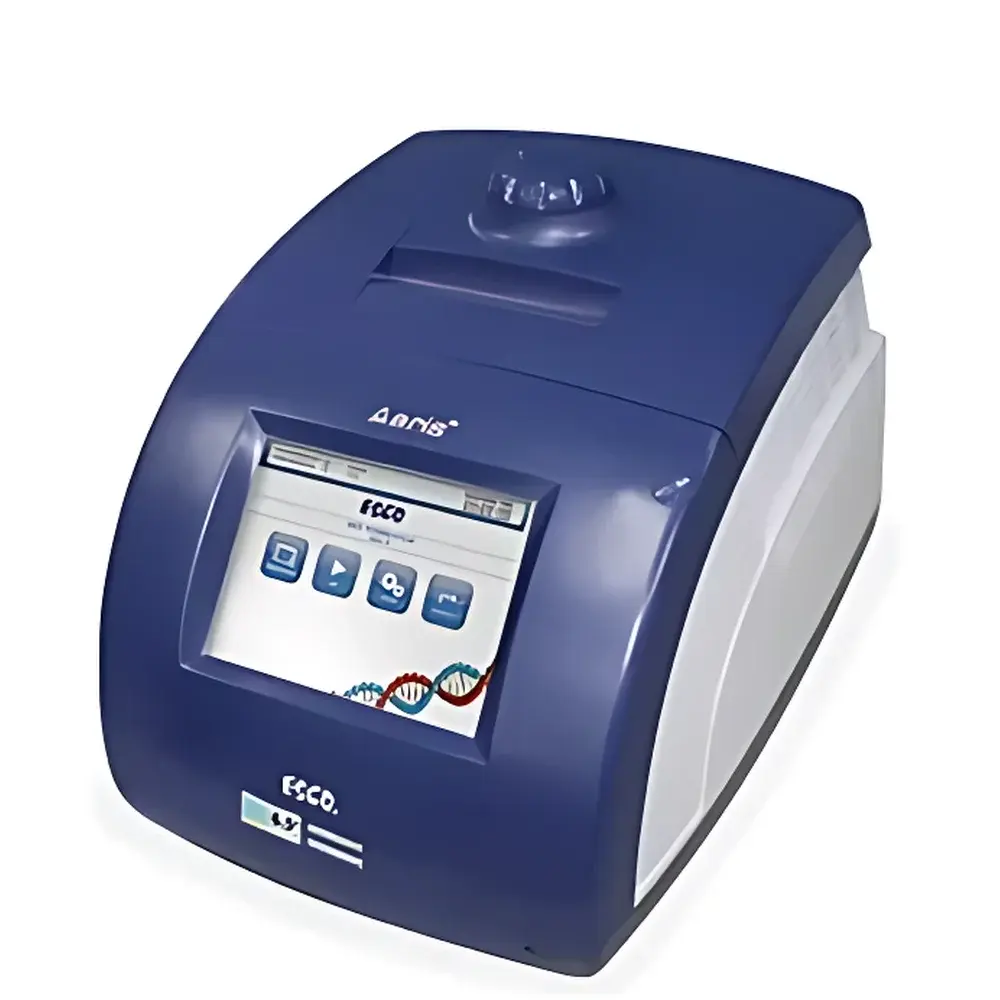
Esco Aeris-BG096 Gradient PCR Thermal Cycler
| Brand | Esco |
|---|---|
| Origin | Singapore |
| Manufacturer Type | Original Equipment Manufacturer (OEM) |
| Import Status | Imported |
| Model | AERIS-BG096 |
| Instrument Type | Gradient Thermal Cycler |
| Sample Capacity | 96-well (0.2 mL), 48-well (0.2 mL), 32-well (0.2 mL) |
| Heating Rate | 12 °C/s |
| Temperature Accuracy | ±0.1 °C (below 50 °C) |
| Well-to-Well Temperature Uniformity | ±0.2 °C (at 95 °C) |
Overview
The Esco Aeris-BG096 Gradient PCR Thermal Cycler is a third-generation, high-performance thermal cycler engineered for precision nucleic acid amplification across academic, clinical, and industrial molecular biology laboratories. Built upon the proven reliability of Esco’s Swift Maxi and MaxPro platforms, the Aeris series integrates advanced semiconductor-based Peltier technology with IsoHeat™ temperature control architecture to deliver rapid, reproducible thermal transitions and exceptional spatial uniformity across the reaction block. Its core measurement principle relies on real-time, closed-loop feedback from multiple high-stability platinum resistance thermometers (Pt1000) embedded directly beneath each well position—enabling dynamic compensation for thermal mass, ambient drift, and lid condensation effects. Designed for compliance with ISO/IEC 17025 quality management systems and aligned with FDA 21 CFR Part 11 data integrity requirements when used with AerisLink software, the instrument supports GLP/GMP-aligned workflows including audit trail logging, user authentication, and electronic signature-capable method execution.
Key Features
- High-efficiency semiconductor heating/cooling module with AeonStar™ thermal architecture, achieving up to 12 °C/s ramp rates and ≤ ±0.1 °C accuracy below 50 °C.
- IsoHeat™ temperature control system ensures ±0.2 °C well-to-well uniformity at 95 °C—critical for multiplex and low-template amplifications.
- SmartDrive™ automatic module recognition eliminates manual configuration; the system detects and calibrates to interchangeable blocks (96-well, 48+30 dual-format, 384-well, dual 48-well, or 4-slide in situ modules) in under 3 seconds.
- 6.5-inch full-color capacitive touchscreen with adjustable backlight and tri-language UI (English, Spanish, Simplified Chinese) optimized for glove-compatible operation and low-ambient lighting conditions.
- Onboard memory stores up to 250 user-defined protocols; unlimited expansion via USB 2.0 port or network-connected PC storage.
- Robust power resilience: automatic resume after interruption with full state recovery—including cycle count, elapsed time, and active gradient profile—preserving experimental integrity.
- Comprehensive self-diagnostic suite runs pre-run verification (≤3 min), reporting sensor health, thermal actuator status, and block calibration history.
Sample Compatibility & Compliance
The Aeris-BG096 supports broad consumable compatibility—including 0.2 mL single tubes, 0.2/0.5 mL strip tubes, 96-well and 384-well microplates, and standard glass slides for in situ PCR—without requiring adapter inserts. All modules are manufactured to ISO 9001-certified cleanroom standards and validated per ASTM E2500-13 (Guide for Specification, Design, and Verification of Pharmaceutical and Biopharmaceutical Manufacturing Systems). The instrument meets IEC 61010-1 safety requirements for laboratory equipment and complies with electromagnetic compatibility (EMC) standards EN 61326-1 and EN 55011. When operated with AerisLink software under controlled network conditions, it satisfies ALCOA+ principles (Attributable, Legible, Contemporaneous, Original, Accurate, Complete, Consistent, Enduring, Available) for regulated environments.
Software & Data Management
AerisLink is a Windows-based remote control and data management platform supporting simultaneous monitoring and control of up to 30 Aeris units from a single workstation. It provides full 21 CFR Part 11 compliance features: role-based access control, electronic signatures, immutable audit trails with timestamped operator actions, and encrypted protocol export/import (XML format). Data export supports CSV, PDF, and proprietary .aeris binary formats compatible with LIMS integration via HL7 or RESTful API extensions. The software includes built-in Tm calculator (nearest-neighbor method), gradient optimization wizard, and cycle-by-cycle temperature deviation logging for method validation and troubleshooting.
Applications
The Aeris-BG096 is validated for demanding applications including long-range PCR (amplicons >10 kb), nested PCR, touchdown PCR, hot-start activation, and in situ hybridization–coupled amplification. Its precise gradient capability (1–30 °C range, 30–105 °C setpoint) enables robust assay development for primer annealing optimization, SNP discrimination, and multiplex target detection. The 4 °C hold function supports post-amplification sample preservation prior to downstream analysis (e.g., Sanger sequencing, qPCR, or NGS library prep). Routine use cases span pathogen detection (SARS-CoV-2, HPV, TB), genotyping, GMO screening, forensic STR profiling, and CRISPR gRNA validation workflows.
FAQ
Does the Aeris-BG096 support ISO 13485 or GMP-compliant documentation packages?
Yes—Esco provides optional IQ/OQ/PQ validation protocols, traceable calibration certificates, and raw test data reports compliant with ISO 13485:2016 and EU Annex 15 requirements.
Can AerisLink generate electronic records meeting FDA 21 CFR Part 11 requirements?
Yes—when deployed with Windows Active Directory authentication, SQL Server database logging, and digital certificate signing enabled, AerisLink fulfills all technical and procedural controls outlined in Part 11 Subpart B.
What is the warranty coverage for the semiconductor module?
The AeonStar™ Peltier module carries a 3-year limited warranty covering material defects and thermal performance degradation exceeding ±0.3 °C uniformity specification.
Is remote firmware update supported via AerisLink?
Yes—secure over-the-air (OTA) updates are delivered through signed package files; each update triggers automatic backup of current configuration and generates a version-controlled audit log entry.
How does the instrument handle condensation during prolonged low-temperature holds?
The heated lid maintains programmable temperature (30–110 °C) with PID-controlled feedback, minimizing dew formation; optional anti-condensation mode dynamically adjusts lid temperature relative to block setpoint during extended 4 °C incubation.
Related Products



