
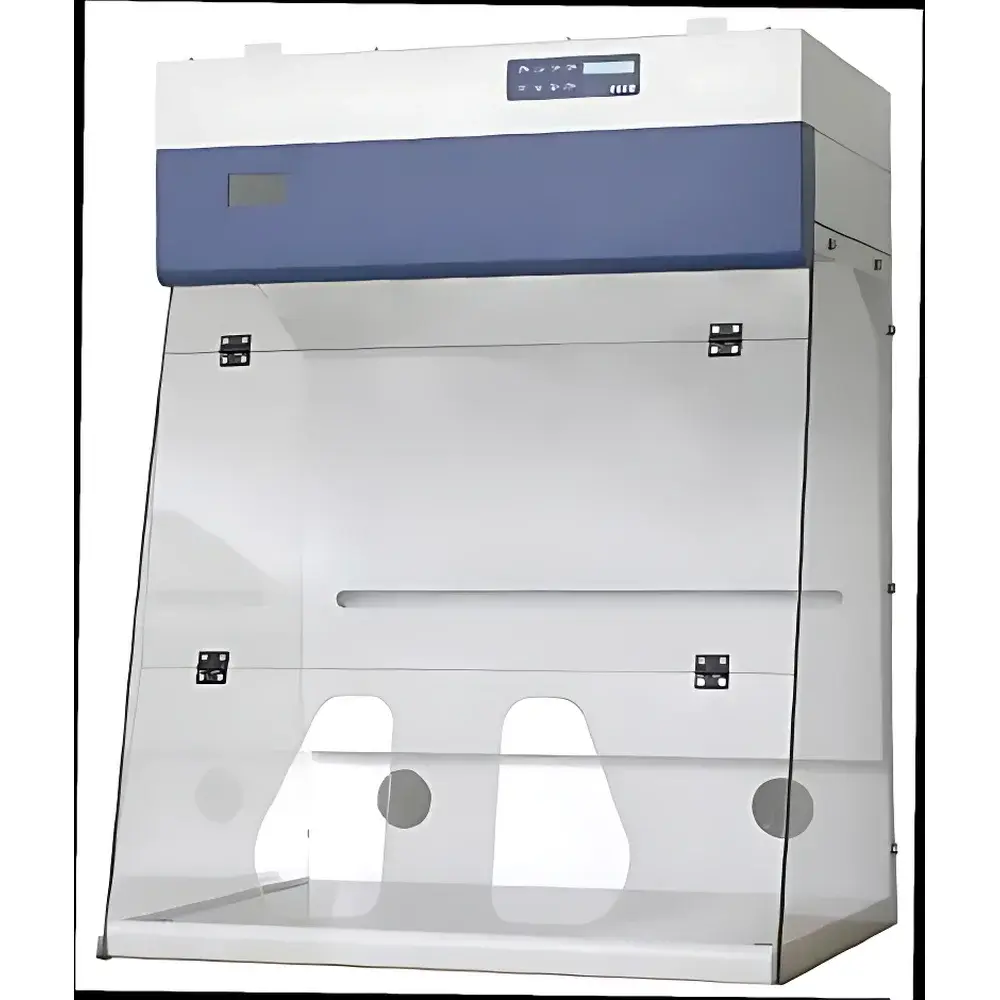
ESCO Ascent™ Opti SPD-3A1 Ductless Fume Hood
| Brand | ESCO |
|---|---|
| Origin | Singapore |
| Model | SPD-3A1 |
| External Dimensions (W×D×H) | 840 × 697 × 1110 mm |
| Airflow Capacity | 234 m³/h (138 CFM) |
| Inlet Face Velocity | 0.5 m/s (100 fpm) at work surface |
| Filter Configuration | Primary activated carbon filter bed (7-stage configurable adsorption media) + washable polyester pre-filter (20% coarse particle capture efficiency) |
| Noise Level | <55 dBA at operator position |
| Illumination | >800 lux at work surface |
| Construction | 1.2 mm electrogalvanized steel with white thermoset epoxy powder coating |
| Viewing Panel | 6 mm acrylic (frameless, front and side) |
| Work Surface Angle | 13° forward tilt |
| Control System | Sentinel™ microprocessor-based monitoring system |
Overview
The ESCO Ascent™ Opti SPD-3A1 Ductless Fume Hood is an engineered containment solution designed for laboratories requiring chemical vapor control without external ducting infrastructure. Unlike conventional ducted hoods that exhaust air to the exterior environment, this unit operates on a recirculating principle: ambient laboratory air is drawn across the work surface at a controlled face velocity of 0.5 m/s, passed sequentially through a high-efficiency pre-filter and a multi-stage activated carbon filtration system, and then returned to the room as purified air. This closed-loop operation eliminates structural ventilation modifications while maintaining operator safety under defined chemical exposure limits. The hood complies with internationally recognized performance criteria for ductless containment devices—including EN 14175-7 (2021), ANSI/ASHRAE 110-2016 (for face velocity uniformity and containment verification), and ISO 15714:2018 (for airflow visualization and tracer gas testing methodology). Its design prioritizes both human factors engineering and regulatory traceability, making it suitable for GLP-compliant research labs, QC environments in pharmaceutical manufacturing, and teaching laboratories where space constraints or building code restrictions limit ducted installation.
Key Features
- 13° forward-tilted work surface enhances ergonomic posture and reduces operator fatigue during extended procedures.
- Frameless 6 mm acrylic sash and side panels provide unobstructed lateral and frontal visibility—critical for real-time observation of reactions and instrumentation setup.
- Sentinel™ microprocessor control system continuously monitors airflow integrity, filter saturation status, and sash position; triggers audible and visual alerts upon deviation from preset operational thresholds.
- Robust 1.2 mm electrogalvanized steel chassis with thermoset epoxy powder coating ensures long-term resistance to acid, alkali, and solvent exposure typical in synthetic chemistry workflows.
- Integrated T8 fluorescent lighting (≥800 lux at work surface), mounted outside the primary airflow path, prevents turbulence-induced measurement artifacts and maintains consistent illumination without compromising containment.
- Modular 7-stage activated carbon filter bed allows configuration optimization based on specific chemical classes—e.g., aldehydes, halogenated solvents, or low-molecular-weight amines—supporting documented risk-based filter selection per ISO 16000-32 guidance.
Sample Compatibility & Compliance
The SPD-3A1 is validated for use with low-to-moderate volatility organic compounds (LVOCs and MVOCs), including acetone, ethanol, methanol, chloroform, and toluene—provided their time-weighted average (TWA) exposure limits exceed 10 ppm and their vapor pressures remain below 20 mmHg at 20°C. It is not intended for perchloric acid, hydrofluoric acid, radioactive isotopes, or nanoparticle-generating processes. Filter service life is determined via real-time pressure differential sensing and must be verified against manufacturer-recommended replacement intervals or breakthrough testing per ASTM D5228. The unit supports audit-ready documentation for FDA 21 CFR Part 11 compliance when integrated with ESCO’s optional data logging module, which records timestamped airflow, filter status, and user-initiated events with electronic signature capability.
Software & Data Management
While the base SPD-3A1 operates via embedded Sentinel™ firmware without external software dependency, optional connectivity modules enable integration into centralized laboratory infrastructure management systems (LIMS/LabVantage). The onboard controller stores up to 30 days of operational logs—including daily average face velocity, cumulative runtime, and filter usage metrics—with export capability via USB-C interface in CSV format. All alarm events are timestamped and retain context (e.g., “Sash opened beyond 500 mm at 14:22:07 UTC”), satisfying GLP requirement §58.130(a)(3) for instrument performance verification records. No cloud-based telemetry or remote firmware updates are implemented, preserving network security boundaries required in regulated environments.
Applications
- Weighing and dispensing of volatile reagents in analytical chemistry and formulation development.
- Preparation of standard solutions and calibration standards under ISO/IEC 17025-accredited conditions.
- Small-scale solvent-based extractions and evaporation steps in natural product isolation.
- Handling of odoriferous or mildly toxic compounds in university teaching labs where duct installation is prohibited.
- Stable isotope labeling workflows involving deuterated or C-13 enriched solvents, provided vapor concentrations remain within validated filter capacity.
FAQ
What types of chemicals are appropriate for use in the SPD-3A1?
Only chemicals with documented compatibility in ESCO’s Chemical Compatibility Database (CCDB v4.2) may be handled—primarily LVOCs and MVOCs with vapor pressures ≤20 mmHg and TLV-TWAs ≥10 ppm. Full list available upon request with signed NDA.
How often must the carbon filter be replaced?
Filter replacement frequency depends on total VOC mass loading, not calendar time. ESCO recommends monthly pressure drop verification and mandatory replacement upon reaching 85% of initial static pressure differential or after 12 months of continuous operation—whichever occurs first.
Can this unit be used for perchloric acid digestion?
No. Perchloric acid applications require dedicated ducted hoods with wash-down capability and explosion-proof construction per NFPA 45 requirements. The SPD-3A1 lacks condensate management and spark-resistant components.
Is third-party certification available for this model?
Yes. ESCO provides independent verification reports from TÜV SÜD (Certificate No. TUV-ES-ASCE-2023-SPD3A1) confirming conformance with EN 14175-7:2021 Annex B containment testing protocols using SF₆ tracer gas.
Does the unit meet USP <1058> requirements for analytical instrument qualification?
The SPD-3A1 satisfies USP <1058> Category II environmental controls when deployed as part of a qualified analytical workstation. IQ/OQ documentation templates are included in the ESCO Validation Support Package (VSP-SPD3A1-EN).
Related Products



