
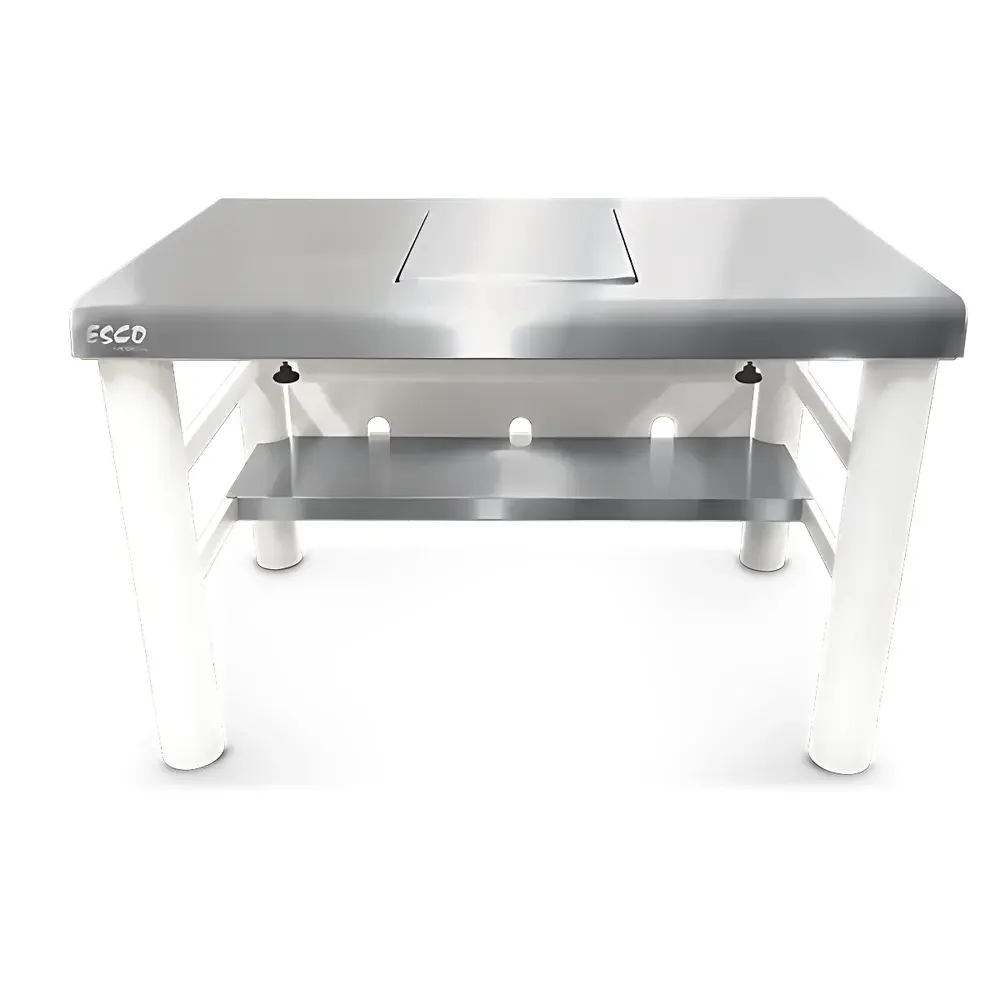
ESCO MIRI AVT Antivibration Damping Table
| Brand | ESCO |
|---|---|
| Origin | Imported |
| Manufacturer Type | Manufacturer |
| Model | MIRI AVT |
| Pricing | Upon Request |
| Vibration Isolation Range | 5.5–50 Hz |
| Construction | Stainless Steel Worktop & Structural Frame |
| Isolation Mechanism | Passive Mechanical Damping |
Overview
The ESCO MIRI AVT Antivibration Damping Table is an engineered platform specifically designed to support high-precision optical and micromanipulation workflows in life science laboratories. It operates on a passive mechanical damping principle—utilizing tuned mass-spring-damper systems integrated into its structural base—to attenuate ambient floor-borne vibrations within the critical 5.5–50 Hz frequency band. This range encompasses common environmental disturbances including building HVAC resonance, footfall-induced structural oscillations, and low-frequency machinery emissions—sources known to degrade image stability in high-magnification microscopy and compromise positional accuracy during submicron-scale manipulations. The MIRI AVT is not a generic vibration isolation solution; it is purpose-built for integration with inverted microscopes, micromanipulator rigs, and piezoelectric positioning stages used in assisted reproductive technologies (ART), particularly intracytoplasmic sperm injection (ICSI) procedures under IVF protocols.
Key Features
- Passive mechanical isolation architecture—no compressed air, electricity, or active feedback control required—ensuring continuous, maintenance-free operation and eliminating risk of system failure during sensitive procedures.
- Stainless steel worktop surface (304 grade) providing non-porous, corrosion-resistant, and electrostatically neutral properties essential for sterile ART environments and compatibility with ethanol-based disinfection protocols.
- Structural frame fabricated from heavy-gauge stainless steel tubing with reinforced cross-bracing, delivering high rigidity-to-mass ratio and long-term dimensional stability under sustained static loads up to 120 kg (distributed).
- Integrated leveling feet with lockable adjustment mechanism enabling precise horizontal alignment on uneven laboratory floors while maintaining consistent isolation performance across all four corners.
- Low-profile design (typical height: 720 mm) optimized for ergonomic integration with standard microscope benches and laminar flow hoods without compromising operator posture or workflow continuity.
Sample Compatibility & Compliance
The MIRI AVT accommodates standard microscope configurations—including Nikon Eclipse Ti2, Leica DMi8, and Olympus IX83 platforms—as well as dual-manipulator setups (e.g., Eppendorf FemtoJet + TransferMan NK2). Its inert surface supports placement of Petri dishes, culture dishes, and microinjection chamber assemblies without slippage or thermal drift concerns. While the table itself is not a medical device, its mechanical specifications align with ISO 2631-1 (evaluation of human exposure to whole-body vibration) and ASTM E1774 (standard guide for vibration considerations in optical instrumentation). When deployed in clinical embryology labs, the MIRI AVT contributes to adherence with CAP (College of American Pathologists) and ESHRE (European Society of Human Reproduction and Embryology) guidelines on environmental control for gamete and embryo handling.
Software & Data Management
As a purely mechanical isolation platform, the MIRI AVT does not incorporate embedded electronics, firmware, or software interfaces. Its performance is deterministic and repeatable without calibration dependencies or digital configuration. However, its stable mechanical output enables reliable synchronization with third-party imaging and micromanipulation software suites—including MetaMorph, Micromanager, and Eppendorf VivaView—by minimizing motion artifacts that otherwise trigger false-positive focus-lock failures or induce tracking errors in automated stage navigation. No data logging, audit trails, or 21 CFR Part 11 compliance features are applicable, consistent with its classification as Class I laboratory support equipment per FDA guidance.
Applications
- Intracytoplasmic sperm injection (ICSI) and pronuclear scoring in clinical IVF laboratories.
- Time-lapse embryo imaging using high-resolution differential interference contrast (DIC) or phase-contrast microscopy.
- Single-cell biopsy and blastomere aspiration in preimplantation genetic testing (PGT) workflows.
- Microinjection of CRISPR-Cas9 reagents into zygotes or oocytes in transgenic model development.
- Long-duration live-cell imaging experiments requiring sub-100 nm lateral stability over multi-hour acquisitions.
FAQ
Does the MIRI AVT require compressed air or electrical power?
No. It relies exclusively on passive mechanical damping and requires no external utilities.
Can it be used with upright microscopes?
It is optimized for inverted microscope configurations; upright systems may require custom mounting adapters due to center-of-gravity constraints.
What is the maximum recommended payload?
120 kg distributed load; point loads exceeding 30 kg should be supported across ≥200 mm² contact area to prevent localized deformation.
Is the stainless steel surface compatible with UV-C sterilization?
Yes—304 stainless steel maintains structural integrity and surface passivation after repeated UV-C exposure at standard germicidal intensities (254 nm, ≤10 mJ/cm²).
How often does maintenance need to be performed?
Annual visual inspection of leveling feet and frame weld integrity is recommended; no routine servicing or component replacement is specified by ESCO.



