
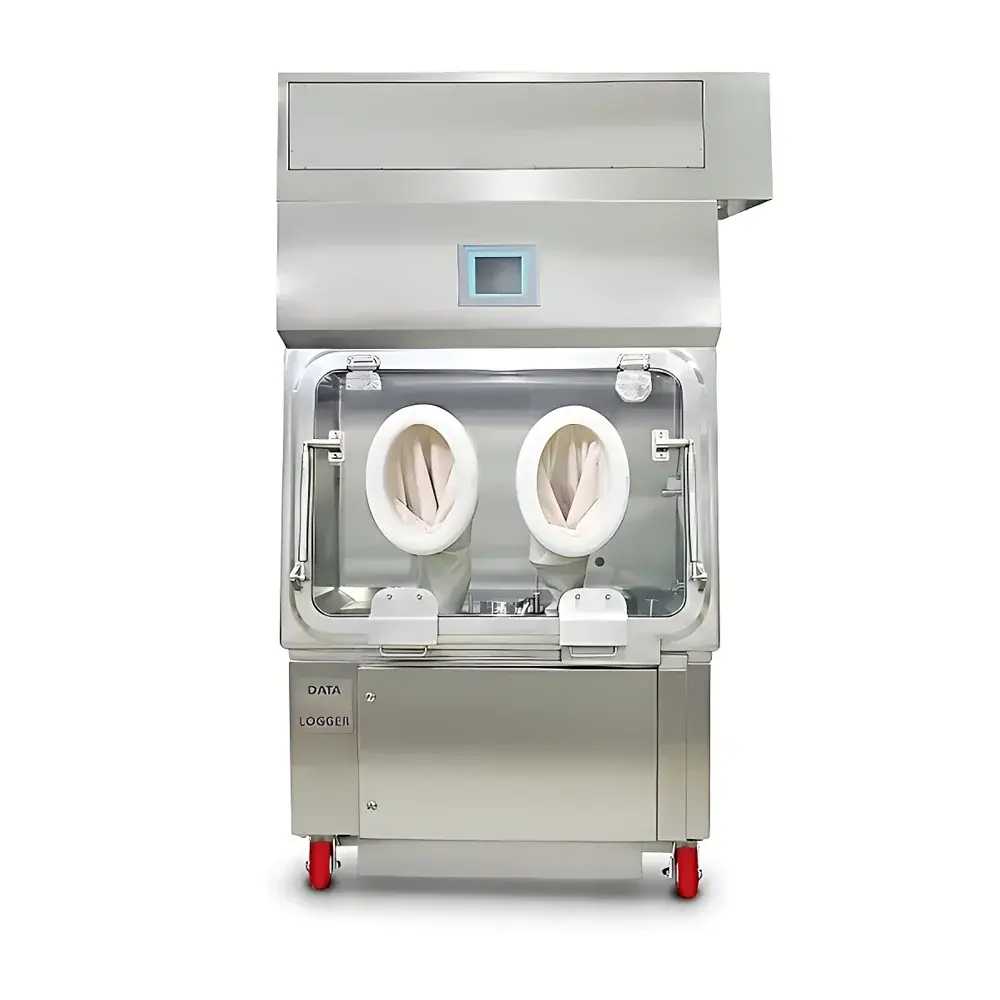
Esco STI Series Sterility Test Isolators
| Brand | Esco |
|---|---|
| Origin | Singapore |
| Manufacturer Type | Original Equipment Manufacturer (OEM) |
| Origin Category | Imported |
| Model | STI-2G / STI-3G / STI-4G |
| Air Filtration | ULPA U15 (99.9998% @ 0.12 µm) for supply air, HEPA H14 (99.997% @ 0.3 µm) for exhaust air |
| Cleanroom Class | ISO 14644-1 Class 5 (A-grade) |
| Chamber Material | Electropolished 316L stainless steel |
| Surface Roughness | ≤0.4 Ra (external), ≤0.6 Ra (internal) |
| Operating Pressure Mode | Positive or negative pressure configurable |
| Airflow Modes | Unidirectional or recirculated |
| Lighting | ≥600 lux, external-mounted LED |
| Noise Level | ≤68 dBA |
| Power Supply | 220–240 V AC, 50/60 Hz or 110–120 V AC, 60 Hz |
| Compressed Air Requirement | 6 barg, 5 L/sec |
| Exhaust Ducting | 10" diameter connection |
Overview
The Esco STI Series Sterility Test Isolators are engineered as fully contained, physically segregated barrier systems designed to eliminate environmental microbiological interference during pharmaceutical and biotechnology sterility testing. Based on the principle of physical isolation combined with controlled unidirectional or recirculated airflow, these isolators maintain an ISO 14644-1 Class 5 (A-grade) environment within the working chamber—meeting stringent regulatory expectations for aseptic processing validation under USP , EU Annex 1, and FDA Guidance for Industry on Sterile Drug Products. The system’s core architecture integrates laminar airflow dynamics, validated decontamination cycles using vaporized hydrogen peroxide (VHP), and pressure-controlled containment to ensure operator protection and product integrity. Unlike traditional cleanrooms or laminar flow hoods, the STI isolator eliminates reliance on personnel gowning and procedural discipline as primary contamination control measures—replacing them with deterministic engineering controls that deliver reproducible, auditable, and GMP-compliant sterility test outcomes.
Key Features
- Monolithic 316L stainless steel chamber fabricated with full orbital welding and large-radius internal transitions to prevent particle entrapment and facilitate cleaning validation.
- ULPA U15 (99.9998% efficiency at 0.12 µm) supply air filtration and H14 HEPA (99.997% at 0.3 µm) exhaust filtration, both featuring embedded silicone gasket sealing for leak-tight integrity and safe filter change protocols—even under toxic compound handling conditions.
- Configurable pressure regime: positive pressure for non-hazardous sterile materials; negative pressure with dual-stage exhaust filtration for cytotoxic or potent compound applications.
- Automated pressure decay testing integrated into the control system for routine integrity verification per ISO 14644-7 requirements.
- Electropolished surfaces (≤0.6 Ra internally, ≤0.4 Ra externally) compliant with ASME BPE surface finish standards for pharmaceutical equipment.
- Glove ports with quick-release, leak-tested glove change mechanism enabling replacement under controlled conditions without compromising chamber sterility.
- Externally mounted, low-heat LED lighting system delivering ≥600 lux uniform illumination across the entire work area—designed for long-term reliability and minimal thermal load on samples.
- Hydraulic height-adjustable support frame (280 mm range) ensuring ergonomic operator positioning across diverse anthropometric profiles.
Sample Compatibility & Compliance
The STI series accommodates a broad spectrum of sterility test formats—including membrane filtration, direct inoculation, and automated microbial detection platforms—without modification to chamber geometry or airflow profile. All models comply with ISO 14644-7 for cleanroom separative devices, USP for microbial control of aseptic processing environments, and EU GMP Annex 1 (2022) requirements for isolator qualification. For regulated environments operating under 21 CFR Part 11, the optional data logger provides time-stamped, audit-trail-capable records of pressure differentials, temperature, humidity, VHP concentration, and filter differential pressure—fully traceable and exportable in CSV or PDF format. The system supports qualification protocols including Installation Qualification (IQ), Operational Qualification (OQ), and Performance Qualification (PQ) aligned with ASTM E2500 and ISPE Baseline Guide principles.
Software & Data Management
The STI isolator is controlled via a validated PLC-based HMI interface with password-protected user roles (Operator, Technician, Administrator). Process logs—including sterilization cycle parameters (exposure time, concentration, dwell), pressure monitoring history, and alarm events—are stored locally with optional network integration for centralized SCADA or MES connectivity. When equipped with the optional data logger module, all critical process variables are recorded at configurable intervals (1–60 sec), with automatic generation of electronic signatures compliant with ALCOA+ data integrity principles. Optional integration with Bioquell or Steris VHP generators enables synchronized cycle execution and real-time bioburden reduction reporting—supporting evidence-based risk assessment per ICH Q9.
Applications
These isolators serve as primary containment platforms for pharmacopoeial sterility testing of injectables, ophthalmics, and cell therapy products. They are routinely deployed in QC laboratories performing compendial testing per USP , Ph. Eur. 2.6.1, and JP 4.07. Additional use cases include: aseptic assembly of test kits prior to microbial challenge studies; environmental monitoring media preparation under Grade A conditions; and containment of high-potency APIs during sterility assay setup. The modular design allows seamless integration with peripheral equipment such as peristaltic pumps, vacuum manifolds, and rapid microbiological methods (RMM) analyzers—enabling end-to-end workflow automation while preserving segregation integrity.
FAQ
What regulatory standards does the STI isolator meet?
The STI series complies with ISO 14644-1 (Class 5), ISO 14644-7 (separative devices), USP , EU Annex 1 (2022), and ASTM E2500 for qualification of pharmaceutical equipment.
Can the isolator be used for both toxic and non-toxic compounds?
Yes—configurable pressure modes (positive for non-hazardous, negative for hazardous) and dual-stage H14 exhaust filtration enable safe operation across compound potency classes.
Is VHP decontamination validated out-of-the-box?
Each unit ships with a pre-qualified VHP cycle protocol; site-specific validation (including biological indicator placement and recovery) must be performed per ISO 14644-3 and PDA Technical Report No. 59.
How is glove integrity verified after replacement?
The glove change system includes integrated pressure hold testing and visual inspection ports; post-change integrity is confirmed via helium leak testing per ISO 14644-3 Annex B.
What maintenance documentation is provided?
Comprehensive technical manuals, preventive maintenance schedules, spare parts catalogs, and calibration certificates for all critical sensors (pressure transducers, RH/T probes, VHP sensors) are included with delivery.




