
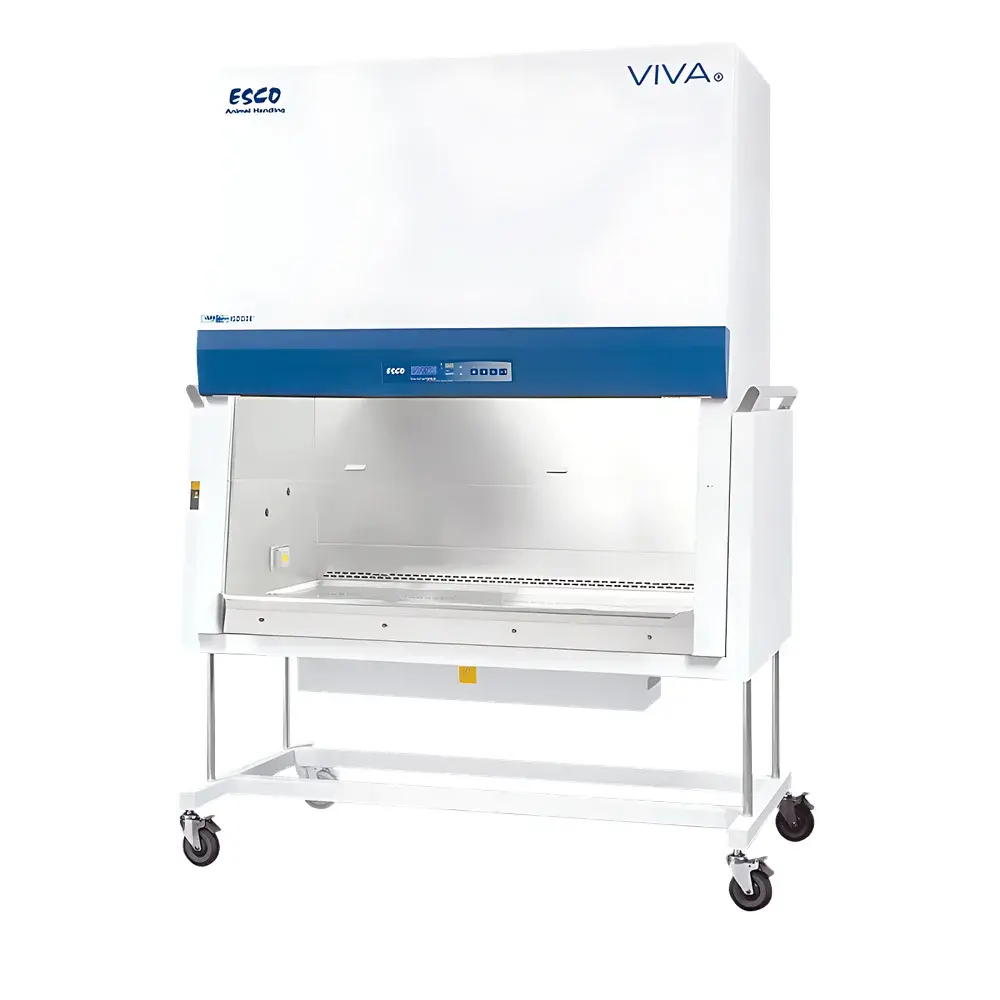
Esco VIVA Universal Animal Handling Biological Safety Cabinet
| Brand | Esco |
|---|---|
| Origin | Singapore |
| Model | VIVA |
| Cabinet Class | Type II A2-equivalent |
| External Dimensions (L×W×H) | 1423 × 815 × 1510 mm (VA2-4A1-E) / 2030 × 815 × 1510 mm (VA2-6A1-E) |
| Work Area Dimensions (L×W×H) | 1270 × 623 × 680 mm (VA2-4A1-E) / 1870 × 620 × 680 mm (VA2-6A1-E) |
| Inflow Velocity | 0.45 m/s (90 fpm) |
| Downflow Velocity | 0.35 m/s (70 fpm) |
| Power Supply | 220–240 VAC, 50/60 Hz |
| Pre-filter | Polyester, 85% arrestance |
| Final Filter | Dual ULPA, ≥99% MPPS @ 0.12 µm |
| Airflow Monitoring | Real-time digital sensing with Sentinel microprocessor control |
| Compliance | ISO 14644-1 Class 3 (equivalent to Fed Std 209E Class 1), NSF/ANSI 49 compliant design principles |
Overview
The Esco VIVA Universal Animal Handling Biological Safety Cabinet is an engineered solution for containment and protection during routine animal handling, dosing, injection, and minor surgical procedures in preclinical research laboratories. Designed to meet the operational demands of vivariums, core facilities, and GLP-compliant pharmacology units, the VIVA cabinet employs a Type II A2-equivalent airflow architecture—featuring inward inflow for operator protection, downward laminar downflow for product integrity, and partially recirculated, partially exhausted air treated through dual ULPA filtration. This configuration ensures simultaneous personnel, product, and environmental protection without requiring dedicated ducted exhaust infrastructure. The cabinet’s ISO Class 3 (Fed Std 209E Class 1) work area delivers ≤1 particle per cubic foot at 0.12 µm—over 100× cleaner than standard Class 100 HEPA-filtered cabinets—making it suitable for low-bioburden animal manipulations where sterility assurance and aerosol containment are critical.
Key Features
- Dual ULPA filtration system: One ULPA filter treats downflow air directed onto the work surface; a second ULPA filter purifies exhaust air prior to recirculation or safe release, achieving ≥99% minimum particle penetration size (MPPS) efficiency at 0.12 µm—surpassing conventional HEPA performance at sub-micron challenges.
- Integrated Esco Sentinel microprocessor control panel: Provides real-time digital monitoring of inflow and downflow velocities, sash position, filter loading status, and system alarms via intuitive LCD interface.
- Acoustic-optical safety alerts: Audible beeper and visual LED indicators activate upon sash deviation from optimal height (e.g., >200 mm opening) or airflow deviation exceeding ±10% of setpoint—ensuring immediate operator response per NSF/ANSI 49 operational thresholds.
- Fail-safe airflow interlock: Automatically de-energizes blower motors and triggers alarm if inflow or downflow velocity falls below validated minimums, preventing unsafe operation under compromised conditions.
- ISOCIDE antimicrobial powder-coated steel surfaces: Applied to all exposed interior and exterior structural components to inhibit microbial colonization and support routine disinfection protocols compliant with veterinary facility hygiene standards.
- High-efficiency polyester pre-filter: Positioned beneath the work surface, captures coarse particulates and lint at 85% arrestance, extending ULPA filter service life and reducing maintenance frequency.
Sample Compatibility & Compliance
The VIVA cabinet accommodates a wide range of animal handling tasks—including rodent restraint, oral gavage, intraperitoneal injection, tail vein sampling, and light tissue excision—without compromising containment integrity. Its large work depth and optimized ergonomics support extended procedural durations while maintaining operator comfort. The cabinet adheres to fundamental engineering principles outlined in NSF/ANSI 49 (2022) for Class II biosafety cabinets, with validation documentation supporting its classification as a Type II A2-equivalent device. While not certified as a medical device under FDA 21 CFR Part 820, its airflow performance, material biocompatibility, and construction traceability align with GLP Annex 11 and ISO/IEC 17025 environmental monitoring requirements. All electrical components comply with IEC 61010-1 safety standards for laboratory equipment.
Software & Data Management
The Esco Sentinel microprocessor does not incorporate cloud connectivity or data export functionality; instead, it provides local, tamper-resistant audit trails stored in non-volatile memory. Each event—including sash movement, airflow excursions, filter runtime, and alarm activation—is timestamped and retained for ≥12 months. These logs support internal QA reviews and regulatory inspections under GLP or AAALAC-accredited programs. No software validation package is supplied; however, the firmware version, calibration date, and last functional test record are accessible via password-protected service mode, enabling traceable instrument qualification per SOP-driven laboratory practices.
Applications
- Routine rodent and lagomorph handling in academic and contract research organizations (CROs)
- Pre-dose and post-dose observation stations in toxicology studies
- Vaccination and compound administration workflows requiring aerosol suppression
- Cell line passaging adjacent to animal housing zones where cross-contamination risk must be minimized
- Training environments for veterinary students performing aseptic technique under controlled containment
FAQ
Is the VIVA cabinet certified to NSF/ANSI 49?
No—it is engineered to Type II A2-equivalent performance specifications and validated against internal Esco protocols aligned with NSF/ANSI 49 airflow and containment criteria, but it is not independently listed by NSF International.
Can the cabinet be installed without external ducting?
Yes. The VIVA operates in recirculating mode with optional canopy connection; no hard-ducted exhaust is required for standard use.
What is the recommended maintenance interval for ULPA filters?
ULPA filters should be integrity-tested semiannually using DOP or PAO challenge methods, and replaced every 5–7 years depending on usage intensity and pre-filter condition.
Does the cabinet support integration with building management systems (BMS)?
No native BMS interface is provided; however, dry-contact relay outputs are available for remote status signaling (e.g., alarm active, power on) upon request.
Is ISOCIDE coating compatible with common veterinary disinfectants?
Yes—the antimicrobial coating remains stable under repeated exposure to 70% ethanol, quaternary ammonium compounds, and sodium hypochlorite solutions at concentrations approved for cage washer sanitation.




