
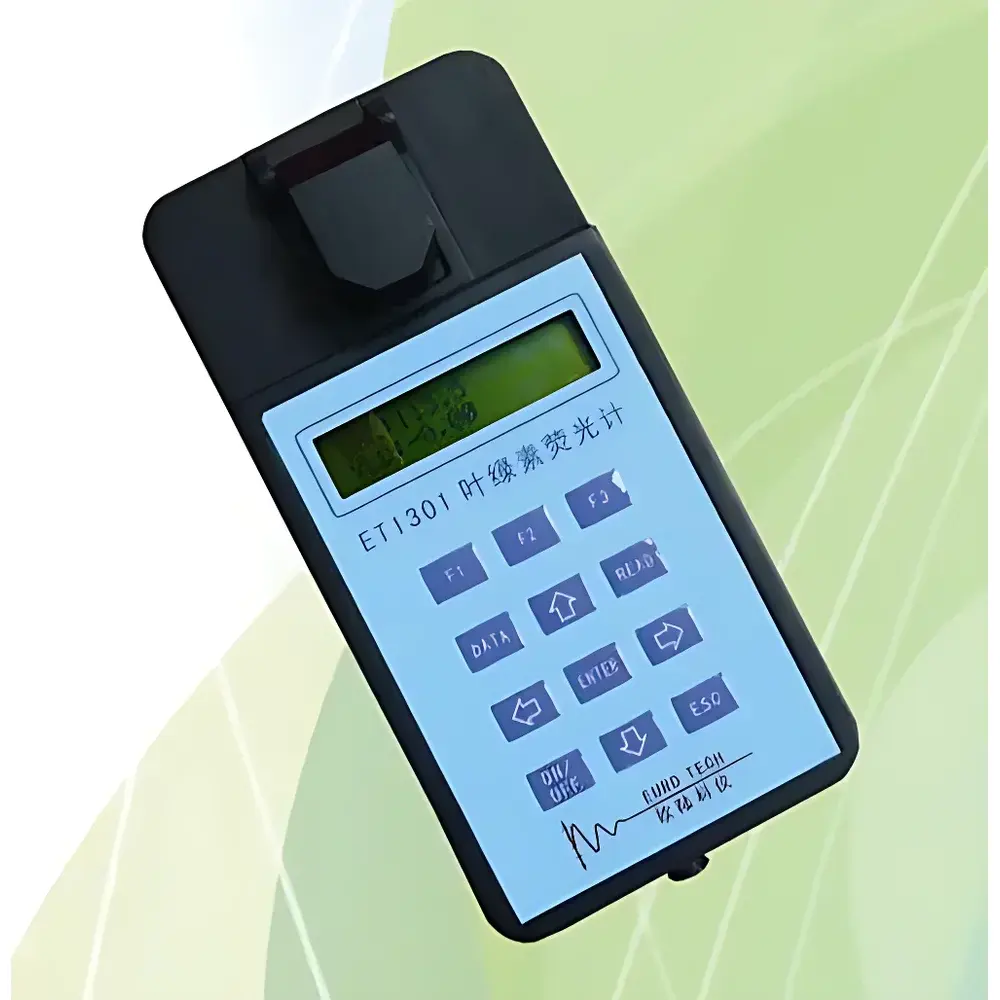
ET1301 Portable Chlorophyll Fluorometer for Ballast Water Monitoring
| Brand | EURO TECH |
|---|---|
| Model | ET1301 |
| Measurement Range | 0–100 µg/L (Chlorophyll a) |
| Detection Principle | Pulse-Amplitude Modulated (PAM) Fluorescence |
| Linearity | R² = 0.998 |
| Weight | 0.65 kg |
| Dimensions | 190 × 105 × 60 mm |
| Operating Temperature | 5–40 °C |
| Power Supply | 4 × AA batteries (5 V DC nominal) |
| Data Storage Capacity | 500 measurement sets |
| Environmental Rating | IPX4 (splash-resistant) |
| Sample Cell | 1 × 1 mm quartz cuvette (non-matched, low-sensitivity-to-cell-variability design) |
| Input Parameters | pH, temperature, turbidity (manual entry) |
| Output Interface | ASCII via USB |
Overview
The ET1301 Portable Chlorophyll Fluorometer is an engineered field instrument designed specifically for rapid, non-invasive quantification of photosynthetic activity in phytoplankton within ballast water matrices. It employs pulse-amplitude modulated (PAM) fluorometry—a well-established optical technique that measures variable chlorophyll a fluorescence yield under controlled actinic and saturating light pulses. This principle enables sensitive detection of photosystem II (PSII) functional integrity without cell lysis or chemical extraction, preserving sample viability for downstream analysis. The device meets the operational demands of maritime regulatory frameworks—particularly those aligned with the International Maritime Organization’s (IMO) Guidelines for Ballast Water Management (G8) and the U.S. Coast Guard’s Type Approval requirements—by delivering repeatable, interference-resistant measurements under dynamic marine conditions.
Key Features
- True field-deployable architecture: No warm-up time required; operates immediately upon battery insertion.
- Splash-resistant (IPX4-rated) enclosure ensures reliable performance during deck operations, rain exposure, or high-humidity environments aboard vessels.
- Optical design optimized for ambient-light immunity: Dual-wavelength excitation and lock-in detection suppress background solar radiation interference—critical for daytime sampling on open decks.
- Integrated real-time clock (RTC) automatically timestamps each dataset, supporting audit-ready traceability per ISO/IEC 17025 and GLP-compliant workflows.
- Compact 1 × 1 mm quartz micro-cuvette system eliminates need for matched-cell calibration, reducing operator dependency and cross-contamination risk during high-throughput ballast sampling.
- On-device manual parameter entry for ancillary water quality variables (e.g., pH, temperature, turbidity), enabling contextual normalization during post-acquisition analysis.
Sample Compatibility & Compliance
The ET1301 is validated for use with untreated, filtered (≥10 µm pre-filtration optional), and preserved ballast water samples containing viable microalgae—including diatoms, dinoflagellates, and cyanobacteria. Its linear response across 0–100 µg/L chlorophyll a aligns with the concentration ranges typical of coastal and estuarine ballast intakes. While not a standalone compliance instrument per IMO D-2 standard, it serves as a Tier 1 screening tool to support risk-based monitoring strategies and pre-treatment efficacy verification. All firmware and data handling protocols are structured to support future integration into FDA 21 CFR Part 11–compliant laboratory information management systems (LIMS) when deployed ashore.
Software & Data Management
Data export occurs in plain ASCII format via USB interface, ensuring broad compatibility with third-party statistical packages (e.g., R, Python pandas, MATLAB) and regulatory reporting templates. Each file includes header metadata: timestamp (YYYY-MM-DD HH:MM:SS), measured Fv/Fm or Y(II) values, user-entered ancillary parameters, and instrument serial ID. Internal memory retains up to 500 complete datasets with cyclic overwrite protection. No proprietary software installation is required—data ingestion can be automated using standard serial communication libraries or drag-and-drop file transfer.
Applications
- Routine ballast water treatment validation onboard commercial vessels prior to discharge.
- Port State Control (PSC) inspections requiring rapid viability assessment of incoming ballast tanks.
- Research-grade field studies on phytoplankton photophysiology under salinity and temperature gradients relevant to ballast transport pathways.
- Calibration reference for larger benchtop PAM systems during method transfer between lab and shipboard settings.
- Training platforms for maritime biosecurity personnel in standardized fluorescence-based viability testing protocols.
FAQ
Does the ET1301 require daily calibration with standard solutions?
No—factory calibration is stable over its specified operating temperature range (5–40 °C); however, users should perform a zero-check using deionized water before each sampling session.
Can the instrument distinguish between live and dead algal cells?
It measures functional PSII electron transport efficiency (e.g., Y(II)), which correlates strongly with metabolic viability; however, complementary assays (e.g., membrane integrity dyes) are recommended for definitive viability classification.
Is USB data transfer compatible with macOS and Linux systems?
Yes—the ASCII output requires no drivers; files appear as standard text documents mountable on any OS with USB mass-storage support.
What is the expected battery life under continuous operation?
Approximately 8–10 hours at 25 °C using alkaline AA cells; lithium AA cells extend runtime by ~30% in cold ambient conditions.
How does the 1 × 1 mm cuvette design improve measurement robustness?
Minimal pathlength reduces inner-filter effects from highly turbid ballast samples while maintaining sufficient signal-to-noise ratio; non-matched cuvettes eliminate inter-cell variability errors common in traditional 10-mm systems.





