
ETran Surface Evapotranspiration Monitoring System
| Origin | Czech Republic |
|---|---|
| Manufacturer Type | Authorized Distributor |
| Origin Category | Imported |
| Model | ETran |
| Pricing | Upon Request |
Overview
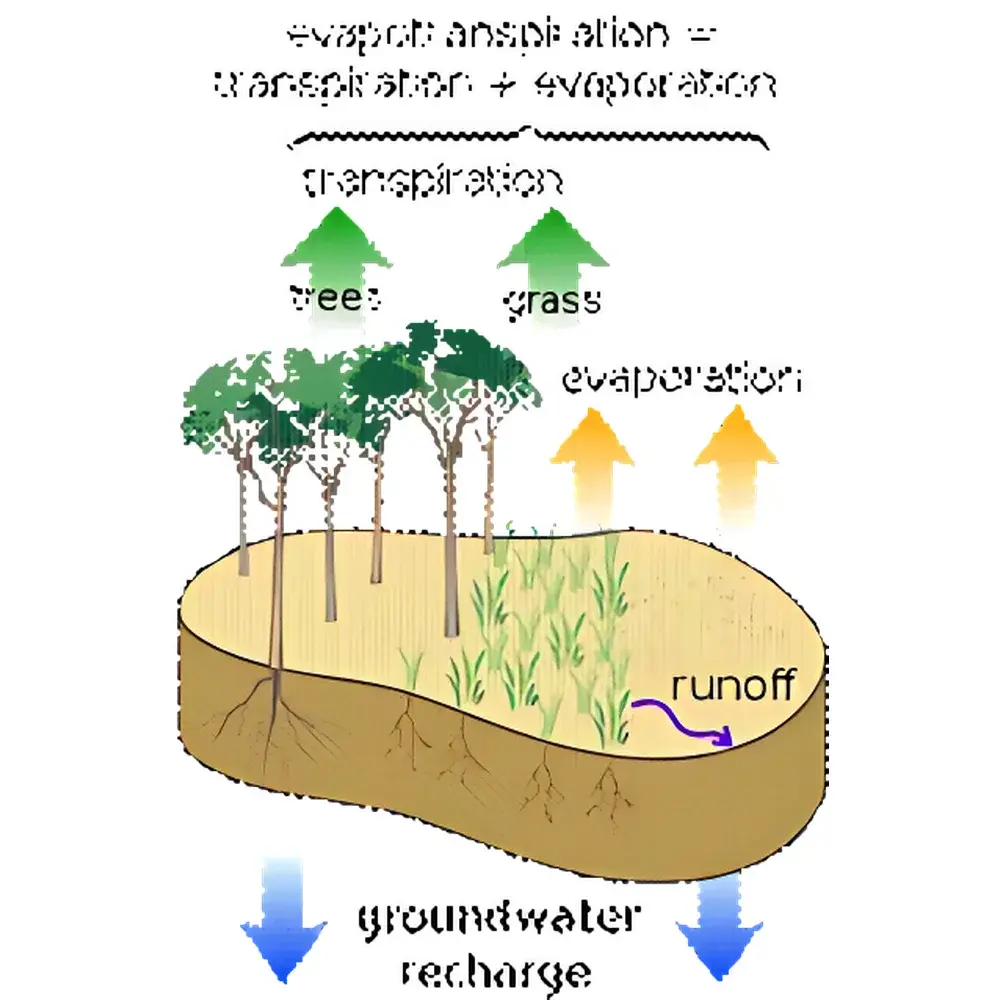
The ETran Surface Evapotranspiration Monitoring System is a field-deployable, multi-method environmental observation platform engineered for high-fidelity quantification of evapotranspiration (ET) across heterogeneous terrestrial ecosystems. ET—the combined flux of soil evaporation and plant transpiration—represents a critical component of the hydrological cycle, land–atmosphere energy exchange, and water budget modeling. The ETran system integrates three physically distinct but synergistic measurement principles: (1) lysimetric mass balance via portable micro-lysimeters, (2) micrometeorological estimation using the Bowen ratio energy balance (BREB) method, and (3) plant physiological assessment via stem sap flow monitoring. This tripartite architecture enables concurrent, co-located measurement of soil moisture dynamics, canopy-level energy partitioning, and species-specific transpirational demand—providing a mechanistically grounded, cross-validated dataset essential for process-based modeling, climate impact assessment, and sustainable water resource management.
Key Features
- Modular, transportable micro-lysimeters (patented design) with minimal site disturbance: installed intact into undisturbed vegetation, equipped with TDR soil moisture probes and high-resolution load cells (±0.1 g resolution) for direct ET determination via mass change;
- Configurable lysimeter geometry: standard unit features 10002 cm² base area and 50 cm depth (≈70 kg with in-situ soil column); custom dimensions available for grassland, cropland, slope, or wetland applications;
- Dual sap flow methodologies: SHB (Stem Heat Balance) for small-diameter stems (6–20 mm), employing circumferential heating and micro-T-type thermocouples (0.6 mm probe diameter); THB (Tissue Heat Balance) for tree trunks (≥8 cm DBH), utilizing stainless-steel electrode plates for direct xylem current heating and embedded needle thermistors;
- Comprehensive Bowen ratio meteorological station: measures net radiation (0.3–30 µm spectral range, ±2% annual stability), soil heat flux (±2000 W·m⁻²), dual-height air temperature/humidity (±0.2 °C, ±2% RH), soil temperature (−20 to +60 °C, ±0.5 °C), wind speed/direction, and precipitation;
- Scalable deployment architecture: supports single-point monitoring or comparative studies (e.g., forest interior vs. edge, irrigated vs. rainfed plots) via multiple lysimeters and/or redundant meteorological stations;
- Optional ancillary modules: H-F surface runoff collector, PL300 soil air permeability analyzer, Hood infiltrometer, and high-precision throughfall gauge (14640 cm² aperture, 0.01 mm resolution) for forest understory applications.
Sample Compatibility & Compliance
The ETran system is validated for use across diverse biomes—including temperate grasslands, agroecosystems, deciduous/coniferous forests, and semi-arid shrublands. Its non-invasive installation protocol preserves natural root–soil hydraulic continuity, satisfying ISO 16439:2014 requirements for lysimeter-based ET validation. All sensors comply with IEC 60751 (Pt100 RTD accuracy), ASTM D5084 (saturated hydraulic conductivity), and WMO Guide to Meteorological Instruments and Methods of Observation (CIMO Guide) standards for field environmental instrumentation. Data acquisition firmware supports audit-trail logging and time-stamped metadata embedding, facilitating GLP-compliant data handling in regulatory or long-term ecological research contexts.
Software & Data Management
The integrated ETran Control & Analysis Suite provides secure local or remote data retrieval via Ethernet/RS-485/LoRaWAN interfaces. Software capabilities include real-time telemetry visualization, sensor calibration management, configurable sampling intervals (1 min to 24 h), automated gap-filling using Penman–Monteith reference ET interpolation, and export to CSV, NetCDF, or SQL formats. Statistical modules support linear regression, time-series decomposition, and correlation analysis between ET components and auxiliary drivers (e.g., VPD, soil water potential, PAR). Raw data files retain full sensor-level metadata (serial numbers, calibration dates, location coordinates), ensuring traceability per FDA 21 CFR Part 11 and ISO/IEC 17025 requirements for accredited environmental testing laboratories.
Applications
- Quantifying ecohydrological partitioning (evaporation vs. transpiration) in response to drought stress, land-use change, or afforestation;
- Validating satellite-derived ET products (e.g., MOD16, SSEBop) at eddy-covariance tower footprints;
- Parameterizing crop coefficient (Kc) curves for irrigation scheduling under variable climate scenarios;
- Assessing carbon–water coupling in forest stands using concurrent sap flow and eddy covariance CO₂ flux data;
- Calibrating vadose zone models (e.g., HYDRUS-1D) with observed soil moisture depletion and drainage patterns;
- Long-term monitoring of ecosystem resilience in protected areas and UNESCO biosphere reserves.
FAQ
What is the minimum recommended plot size for installing the ETran micro-lysimeter without edge effects?
For representative measurements in homogeneous vegetation, a minimum buffer zone of 3× the lysimeter diameter is advised—typically ≥3 m radius around the unit.
Can the THB and SHB sensors be deployed simultaneously on the same tree?
Yes; THB electrodes are installed at breast height while SHB sensors target scaffold branches, enabling vertical sap flow profiling.
Is the system compatible with third-party dataloggers such as Campbell Scientific CR6 or Decagon EM50?
All analog and digital outputs adhere to industry-standard protocols (0–5 V, 4–20 mA, SDI-12, Modbus RTU), ensuring seamless integration.
How frequently does the TDR sensor require recalibration in mineral soils?
Under stable salinity and texture conditions, factory calibration remains valid for ≥24 months; field verification against gravimetric samples is recommended annually.
Does the ETran software support automated quality control flags for outlier detection?
Yes—threshold-based spike detection, physical plausibility checks (e.g., negative sap flow during nighttime), and consistency screening between lysimeter mass loss and BREB-derived ET are implemented by default.







