
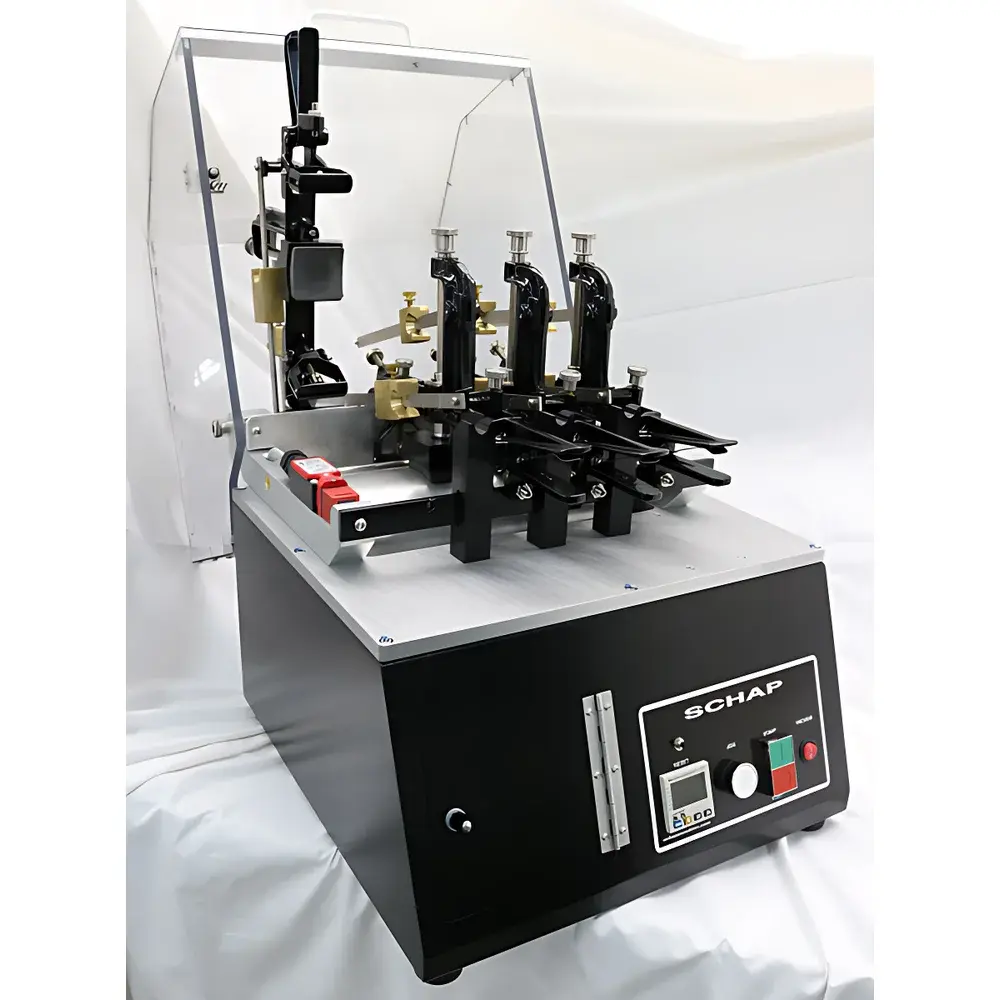
ASTM D4157 Wyzenbeek Abrasion Tester by HENGYU HY-603
| Brand | HENGYU |
|---|---|
| Model | HY-603 |
| Standard Compliance | ASTM D4157, ASTM D3597, FED-STD-191/5304, SAE J1948, SAE J1530, GM 2756M, Toyota TSL 5101G.3.9.4 |
| Construction | Anodized aluminum & stainless steel frame with powder-coated enclosure |
| Bearing System | THK precision linear bearings |
| Controller | Programmable digital counter with auto-stop function |
| Speed Control | Adjustable jog and test speed (mechanically regulated) |
| Safety | Interlocked ventilation guard with pinch-point protection |
| Motor | High-efficiency brushless DC motor |
| Power Input | Configurable voltage (specify at order) |
| Dimensions (L×W×H) | 66 × 66 × 102 cm |
| Weight | 58 kg |
| Warranty | 12-month manufacturer warranty |
| Origin | Tianjin, China |
| Distribution Type | Authorized distributor |
Overview
The HENGYU HY-603 ASTM D4157 Wyzenbeek Abrasion Tester is a mechanically driven tribological testing instrument engineered for standardized evaluation of surface durability in flexible sheet materials. It operates on the principle of reciprocating linear abrasion—where a standardized abradant fabric (typically #10 cotton duck or wire mesh) moves back-and-forth under controlled tension and load across a stationary specimen mounted on a rigid frame. This method simulates real-world wear mechanisms such as rubbing, scuffing, and edge fatigue encountered in upholstery, automotive interiors, footwear, and technical textiles. Unlike rotary or oscillating abrasion systems, the Wyzenbeek configuration delivers highly reproducible results for comparative ranking of material resistance to surface degradation, pilling, yarn breakage, and seam integrity loss. The instrument is purpose-built to meet the strict mechanical repeatability and dimensional tolerances required by ASTM D4157 and its harmonized international counterparts—including SAE J1948 for automotive seating and Toyota TSL 5101G.3.9.4 for interior trim validation.
Key Features
- Robust structural architecture: Frame fabricated from anodized aluminum extrusions and corrosion-resistant stainless steel components, finished with industrial-grade powder coating for long-term stability and chemical resistance.
- Precision motion system: Equipped with THK linear motion bearings ensuring consistent stroke alignment, minimal frictional deviation, and extended service life under continuous cyclic loading.
- Programmable digital controller: Enables precise cycle count setting (up to 999,999 cycles), automatic termination upon completion, and manual jog mode for specimen positioning and calibration verification.
- Adjustable mechanical speed regulation: Independent control of traverse speed and dwell time per stroke—critical for matching application-specific wear profiles without electronic variability.
- Integrated safety enclosure: Ventilated polycarbonate guard with interlock circuitry prevents operator access during operation and eliminates pinch-point hazards at the reciprocating arm interface.
- High-torque brushless DC motor: Delivers uniform torque output across the full operational range, eliminating brush wear, electrical noise, and speed drift associated with brushed alternatives.
Sample Compatibility & Compliance
The HY-603 accommodates flat specimens up to 100 mm × 100 mm, including woven and nonwoven textiles, coated fabrics, synthetic leathers, vinyls, laminates, and stitched seam assemblies. Specimen clamping utilizes dual pneumatic or mechanical fixtures (optional) to maintain constant tension throughout testing—ensuring compliance with ASTM D4157’s requirement for 38 N ± 1.0 N normal force. The abradant mounting system supports standardized #10 cotton duck (ASTM D4157), wire mesh (SAE J1948), or customer-supplied media per internal specifications. All mechanical dimensions—including stroke length (102 mm ± 1 mm), reciprocation frequency (60–120 cycles/min), and load application geometry—conform to the dimensional and procedural requirements of ASTM D4157, ASTM D3597, and FED-STD-191/5304. The system is routinely validated using NIST-traceable reference materials and documented in accordance with GLP principles for regulated quality assurance environments.
Software & Data Management
While the HY-603 operates via embedded microcontroller logic without proprietary software dependency, it supports external data capture through TTL-level pulse output (1 pulse = 1 cycle) compatible with PLCs, DAQ systems, or custom LabVIEW/Python acquisition scripts. Cycle logs, stop triggers, and manual intervention timestamps are retained in non-volatile memory for audit trail reconstruction. For laboratories operating under FDA 21 CFR Part 11 or ISO/IEC 17025 frameworks, optional I/O modules enable integration with LIMS platforms for automated result export, user authentication logging, and electronic signature workflows. Calibration records—including bearing preload verification, stroke length metrology, and load cell traceability—must be maintained per ISO 17025 Clause 6.5 and updated at least annually or after 5,000 operational cycles.
Applications
- Automotive interior validation: Seat fabric, door panel trim, headliner materials, and airbag covers tested per GM 2756M and SAE J1530.
- Aerospace cabin components: Flame-retardant textiles and composite overlays evaluated against FAA AC 25.853 Appendix F protocols.
- Furniture and contract upholstery: Performance benchmarking of commercial-grade fabrics per ANSI/BIFMA X5.7 and ASTM D3776.
- Footwear and accessories: Linings, straps, and reinforcement patches subjected to cyclic flex-abrasion per ISO 12947-2.
- Medical device packaging: Seal integrity and pouch film durability assessment under simulated handling stress.
FAQ
What abradants are supported by the HY-603?
Standard configurations include ASTM #10 cotton duck and SAE-specified wire mesh; custom abradants may be mounted using the universal holder with appropriate thickness and tensile modulus verification.
Is temperature or humidity control integrated?
No—environmental conditioning must be performed externally per ASTM D1776; the HY-603 is designed for ambient laboratory operation only.
Can test parameters be modified beyond ASTM D4157 defaults?
Yes—stroke count, speed, and load are manually adjustable within mechanical limits; deviations require documented method validation per ISO/IEC 17025 Clause 7.2.2.
How often does the system require calibration?
Annual calibration is recommended; stroke length, load application, and counter accuracy should be verified before each qualification batch or after 5,000 cycles.
Does the unit comply with CE or UKCA marking requirements?
Compliance documentation is available upon request; the instrument meets EN 61000-6-2 (immunity) and EN 61000-6-4 (emissions) when installed with specified grounding and power conditioning.



