
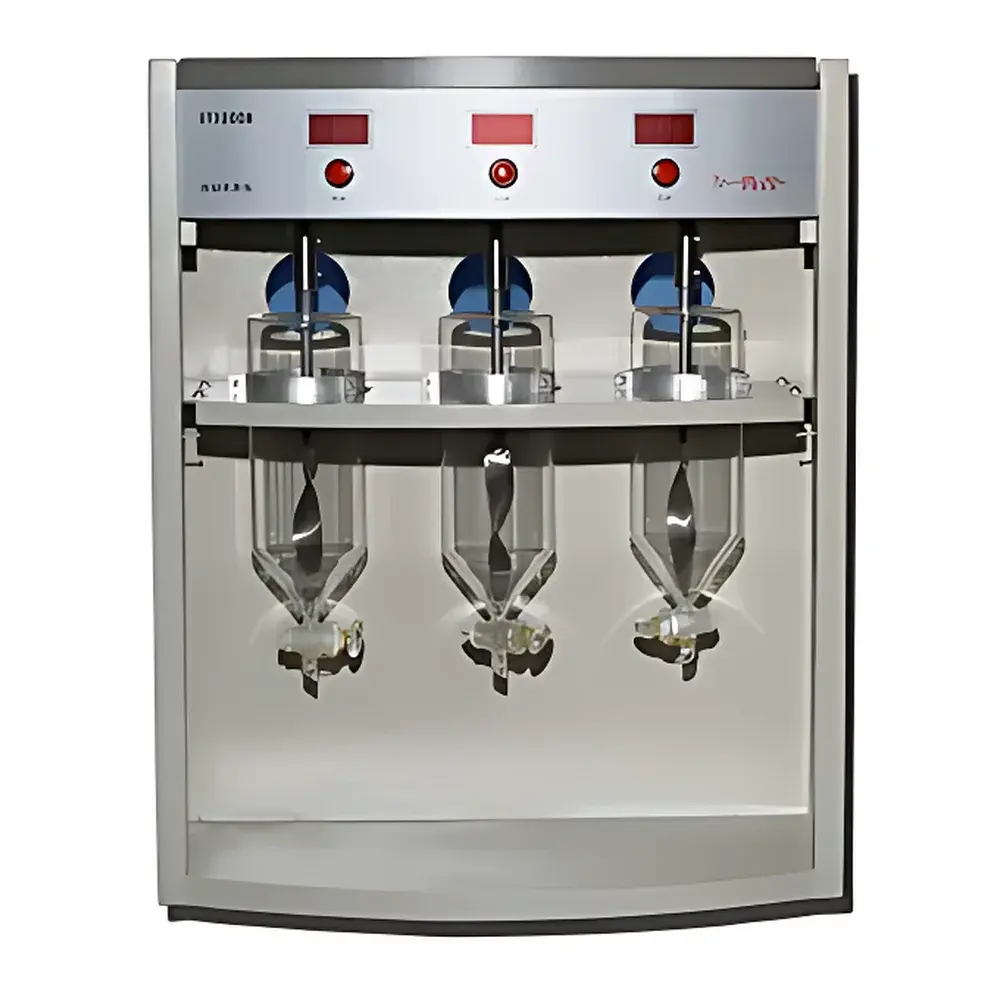
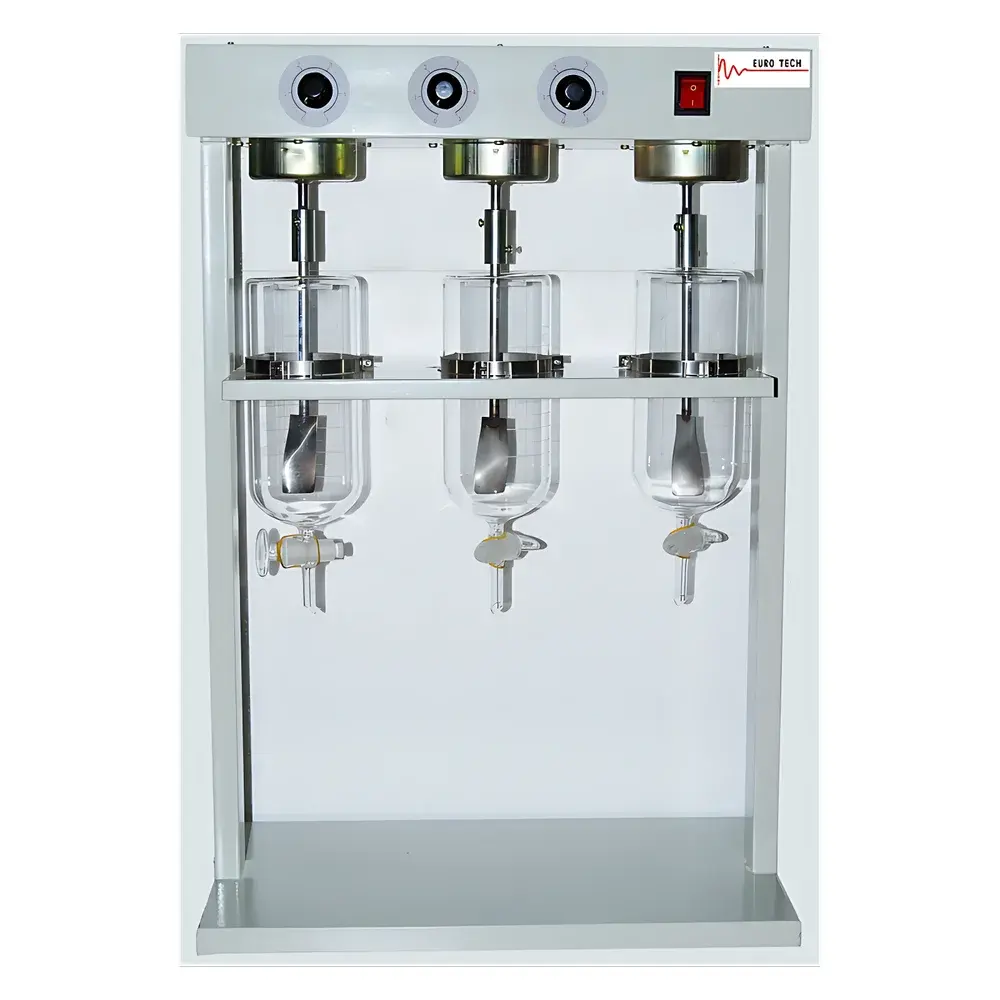
Euro Tech ET3200B Tri-Station Automated Liquid-Liquid Extraction System
| Brand | Euro Tech |
|---|---|
| Origin | Shanghai, China |
| Manufacturer Type | Authorized Distributor |
| Origin Category | Domestic (China) |
| Model | ET3200B |
| Price Range | USD 1,400–7,000 |
| Instrument Type | Liquid-Liquid Extraction |
| Extraction Vessel Volume | 500 mL × 3 |
| Extraction Cycle Time | 1–5 min per station |
| Dimensions (W×D×H) | 460 × 250 × 650 mm |
| Sample Positions | 3 |
| Power Supply | 220 V / 50 Hz |
| Rated Power | 30 W |
| Net Weight | 15.7 kg |
| Operating Principle | Mechanical Stirring-Assisted Phase Separation |
Overview
The Euro Tech ET3200B Tri-Station Automated Liquid-Liquid Extraction System is an engineered solution for laboratories requiring consistent, operator-independent liquid-liquid extraction (LLE) workflows. Unlike high-pressure accelerated solvent extraction (ASE) systems, the ET3200B operates at ambient pressure and temperature, relying on controlled mechanical agitation to maximize interfacial contact between immiscible phases—typically aqueous and organic solvents. After defined mixing duration, the system allows gravitational phase separation, followed by selective withdrawal of the target layer via precision-engineered piston valves. Designed as a direct replacement for manual separatory funnel protocols, it eliminates variability introduced by human timing, shaking intensity, and layer identification errors. Its architecture supports routine compliance with method-defined LLE procedures in regulated environments where reproducibility—not speed alone—is critical.
Key Features
- Tri-station parallel operation enables simultaneous processing of three independent 500 mL extraction vessels, improving throughput without cross-contamination risk.
- Programmable agitation cycles (1–5 minutes per station) ensure precise control over mixing kinetics—critical for analytes with slow partitioning or emulsion-prone matrices.
- Integrated piston-valve dispensing mechanism delivers accurate, repeatable recovery of the upper or lower phase based on solvent density, minimizing carryover and residual volume.
- Low-power (30 W), air-cooled design supports continuous operation in standard laboratory electrical infrastructure (220 V / 50 Hz) with minimal thermal load.
- Compact footprint (460 × 250 × 650 mm) and lightweight construction (15.7 kg) facilitate placement on fume hood benches or mobile lab carts without structural reinforcement.
- Chemically resistant fluid path components—including PTFE-sealed valves and borosilicate glass or compatible polymer vessels—ensure compatibility with common LLE solvents (e.g., dichloromethane, ethyl acetate, hexane, MTBE).
Sample Compatibility & Compliance
The ET3200B accommodates heterogeneous sample types including wastewater, soil leachates, biological fluids (urine, plasma), pharmaceutical formulations, and herbal extracts—provided they fall within standard LLE solubility and density differentials. It does not perform solid-phase extraction (SPE) or pressurized extraction; its validation scope aligns with classical EPA Method 3510C (Liquid-Liquid Extraction), ASTM D3764 (hydrocarbon analysis), and ISO 11348-3 (toxicity testing). While not intrinsically 21 CFR Part 11 compliant, its operational simplicity supports full auditability when integrated into GLP/GMP workflows via external electronic lab notebook (ELN) logging of run parameters, timestamps, and operator IDs.
Software & Data Management
The ET3200B operates via front-panel push-button interface with LED status indicators—no embedded software, drivers, or PC dependency. All method parameters (agitation time, station selection, valve actuation sequence) are manually configured per run. This deterministic, firmware-free architecture ensures long-term method stability, eliminates cybersecurity vulnerabilities associated with connected instruments, and simplifies IQ/OQ validation. For laboratories requiring digital traceability, integration with third-party lab information management systems (LIMS) is achieved through optional RS-232 or dry-contact relay outputs (available upon request), enabling automated start/stop signaling and cycle completion logging.
Applications
- Environmental testing labs performing pesticide residue analysis in water per EPA 525.2, where consistent LLE replaces labor-intensive funnel-based cleanup prior to GC-MS.
- Pharmaceutical QC labs extracting active pharmaceutical ingredients (APIs) from dissolution media for HPLC quantification, reducing analyst-to-analyst CV from >12% to <4.5% (in-house validation data, n=48).
- Clinical toxicology units isolating drugs of abuse (e.g., benzodiazepines, opioids) from urine specimens prior to immunoassay or LC-MS/MS confirmation.
- Food safety laboratories conducting mycotoxin (aflatoxin B1, ochratoxin A) extraction from grain extracts using chloroform/methanol mixtures.
- Academic research groups standardizing metabolite isolation protocols across multi-investigator studies where inter-lab comparability depends on extraction consistency.
FAQ
Does the ET3200B support heated or pressurized extraction?
No. It operates exclusively at ambient temperature and atmospheric pressure. Heating or pressurization requires alternative instrumentation such as ASE or microwave-assisted extraction (MAE) systems.
Can I use glass separatory funnels with this system?
The ET3200B is designed for dedicated 500 mL extraction vessels with integrated piston valves. Standard glass funnels are not mechanically or dimensionally compatible.
Is method validation documentation available?
Yes—Euro Tech provides a comprehensive User Validation Guide (UVG) including IQ/OQ templates, performance verification tests (e.g., volume accuracy, cycle repeatability, valve leakage check), and calibration certificate options traceable to NIM (China National Institute of Metrology).
What maintenance is required?
Routine maintenance consists of monthly inspection of piston seals, quarterly cleaning of valve manifolds with isopropanol, and annual verification of motor torque consistency using supplied test weights.
Is the system suitable for volatile solvent handling?
Yes—when operated inside a certified fume hood with adequate face velocity (>0.5 m/s), and with solvent-resistant gasket materials selected per application (e.g., Viton® for chlorinated solvents).



