
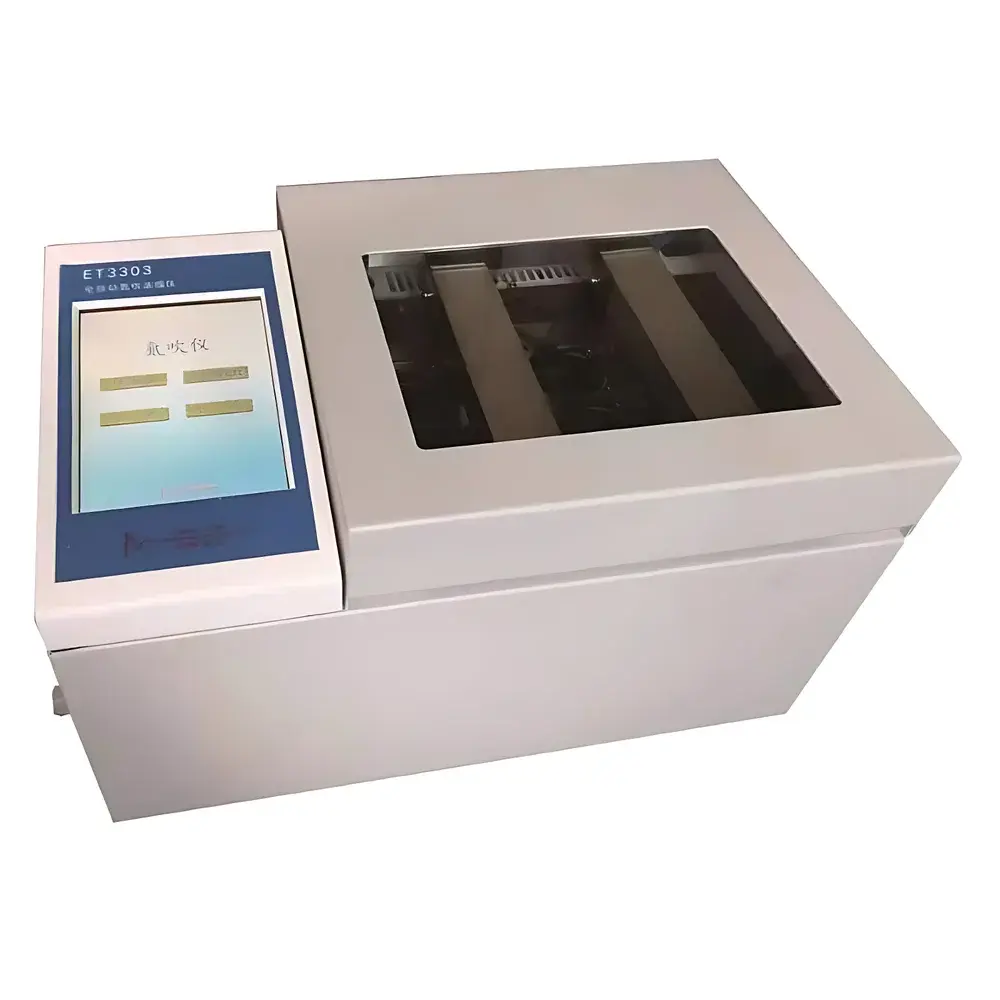
EURO TECH ET3303 Automated Nitrogen Evaporator
| Brand | EURO TECH |
|---|---|
| Origin | Shanghai, China |
| Model | ET3303 |
| Sample Capacity | 12 positions (compatible with 50 mL and 200 mL glass tubes) |
| Temperature Range | Ambient to 60 °C |
| Gas Pressure Range | 0–25 psi (adjustable) |
| Endpoint Detection Options | 0.5 mL or 1.0 mL (optical sensor-based) |
| Display | 8-inch capacitive touchscreen |
| Power Supply | 220 VAC, 50 Hz |
| Dimensions (W×H×D) | 54 cm × 31 cm × 35 cm |
| Net Weight | 25 kg |
| Exhaust Duct | 5.1 cm ID × 3.0 m length included |
| Timer Range | 1–999 minutes |
| Gas Inlet Requirement | Minimum 40 psi supply pressure, regulated to ≤100 psi maximum |
Overview
The EURO TECH ET3303 Automated Nitrogen Evaporator is an engineered solution for high-throughput, reproducible solvent removal in analytical laboratories. It operates on the principle of inert gas-assisted evaporation—specifically nitrogen stream impingement combined with precise water-bath temperature control—to gently concentrate liquid samples without thermal degradation or cross-contamination. Unlike manual or semi-automated systems, the ET3303 integrates real-time optical endpoint detection, eliminating reliance on operator judgment or fixed timers. Its compact footprint (54 × 31 × 35 cm) and built-in exhaust ducting enable deployment outside fume hoods—reducing infrastructure dependency while maintaining compliance with laboratory ventilation safety standards. Designed for routine use in QC, environmental testing, food safety, and clinical research labs, the system supports GLP-aligned workflows through auditable endpoint logging and fault-traceable diagnostics.
Key Features
- Optical endpoint sensing technology continuously monitors liquid meniscus height in each sample tube; automatically terminates gas flow at user-selected residual volumes (0.5 mL or 1.0 mL), ensuring consistent final concentration across all 12 positions.
- Integrated exhaust manifold with 5.1 cm internal diameter duct (3.0 m supplied) routes nitrogen and volatile vapors safely away from the work area—no external hood connection required.
- Non-welded, corrosion-resistant gas nozzles prevent rust formation and clogging, enabling long-term reliability with minimal maintenance.
- Four programmable operating modes: Time-based, Volume-based (endpoint-triggered), Hybrid (time + endpoint), and Manual Override—supporting method flexibility across diverse sample matrices.
- Self-diagnostic firmware performs continuous health checks of optical sensors, heating elements, pressure regulators, and thermal feedback loops; faults are logged with descriptive codes and displayed on the 8-inch capacitive touchscreen.
- Gas vortex delivery system enhances mass transfer efficiency by directing laminar nitrogen flow tangentially across the liquid surface—accelerating evaporation while minimizing splashing or foaming.
Sample Compatibility & Compliance
The ET3303 accommodates standard borosilicate glass test tubes (50 mL and 200 mL formats) with optional dual-capacity configurations (e.g., six 200 mL + six 50 mL positions). Its water bath maintains temperature stability within ±0.5 °C across the 20–60 °C operational range, meeting ASTM E2917-22 requirements for thermal uniformity in evaporation instrumentation. The system complies with IEC 61010-1:2010 for electrical safety in laboratory equipment and incorporates fail-safe thermal cutoffs. While not inherently 21 CFR Part 11 compliant, audit-ready operation logs—including start/stop timestamps, endpoint confirmation events, and diagnostic alerts—can be exported via USB for integration into validated LIMS or ELN environments under GxP frameworks.
Software & Data Management
Operation is managed entirely through the embedded 8-inch resistive-capacitive touchscreen interface. No external PC or proprietary software installation is required. All method parameters—including target endpoint volume, bath temperature setpoint, gas pressure, timer duration, and mode selection—are stored as named protocols with version-stamped creation dates. System-generated event logs record every endpoint detection, thermal deviation exceeding ±1.0 °C, pressure anomaly, or sensor recalibration cycle. Logs export in CSV format for traceability and retrospective review. Firmware updates are performed via USB drive with SHA-256 checksum verification to ensure integrity.
Applications
- Residue analysis in environmental monitoring (e.g., EPA Method 505, 525.3): Concentration of pesticide extracts from aqueous samples prior to GC-MS analysis.
- Pharmaceutical impurity profiling: Preparative cleanup of SPE eluates containing low-concentration genotoxic impurities per ICH M7 guidelines.
- Food contaminant screening: Reduction of acrylamide or mycotoxin extracts from complex lipid-rich matrices using controlled nitrogen sweep and mild thermal input.
- Clinical toxicology: Parallel concentration of urine or plasma samples for LC-MS/MS quantification of opioids, benzodiazepines, or synthetic cannabinoids.
- Forensic chemistry: High-reproducibility preparation of seized drug dilutions for calibration curve generation under ISO/IEC 17025-accredited conditions.
FAQ
Does the ET3303 require connection to a central nitrogen supply?
No—it accepts regulated nitrogen from standard high-pressure cylinders (≥40 psi inlet) equipped with an inline pressure regulator. Maximum allowable inlet pressure is 100 psi.
Can the optical endpoint sensor be recalibrated by the user?
Yes—calibration is accessible via service menu and requires only a reference tube filled to the exact 0.5 mL or 1.0 mL mark. Full procedure is documented in the technical manual.
Is the water bath fluid circulation actively maintained?
The bath uses passive convection; temperature uniformity is ensured by optimized heater placement and thermal mass design—not forced circulation—to minimize vibration-induced sample disturbance.
What maintenance intervals are recommended?
Optical sensor windows should be wiped weekly with lint-free isopropanol swabs; gas nozzles inspected monthly for particulate accumulation; water bath drained and refilled quarterly with deionized water.
Can the ET3303 be integrated into a robotic sample prep line?
Not natively—the system lacks Ethernet or RS-232 interfaces. However, its physical dimensions and standardized tube geometry allow mechanical integration with third-party robotic arms using custom end-effectors.



