
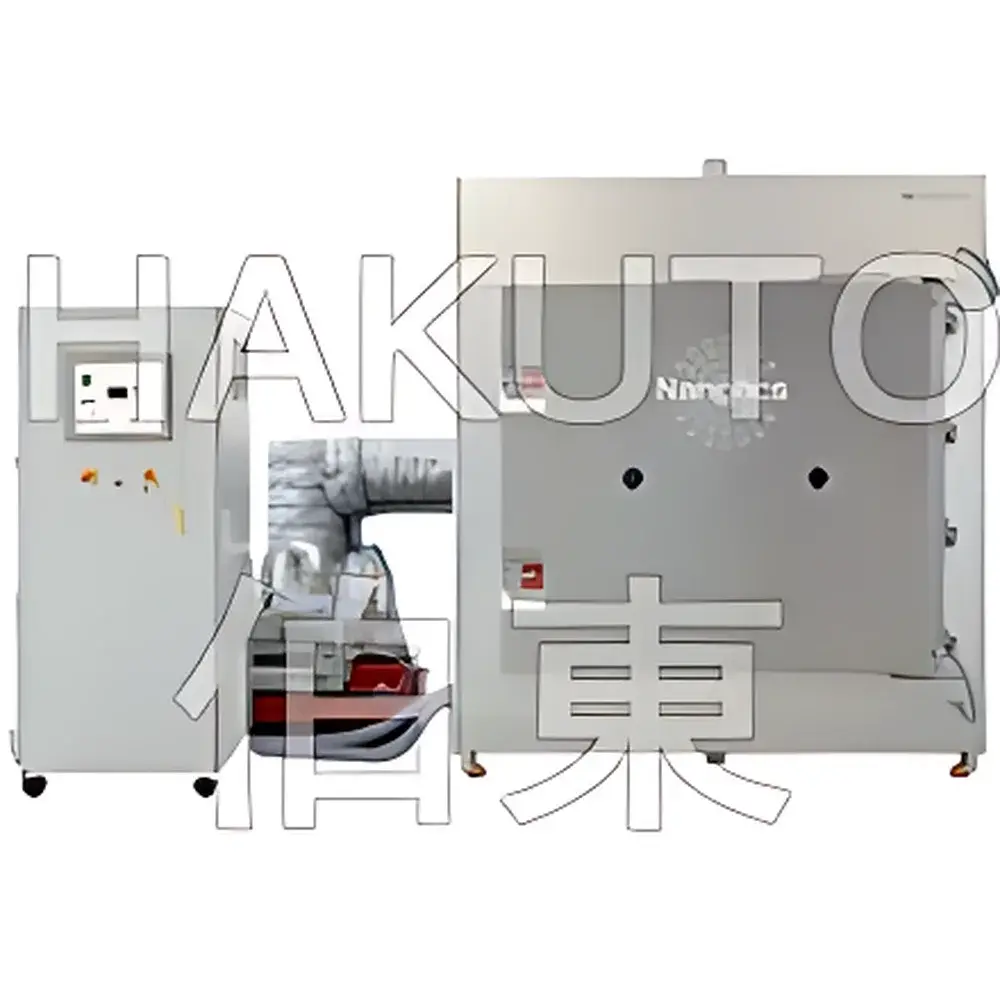
Europlasma CD 1836 Halogen-Free (Fluorine-Free) Nanocoating Plasma System
| Brand | Europlasma |
|---|---|
| Origin | Belgium |
| Model | CD 1836 |
| Power | 5 kW |
| Chamber Dimensions | 1600 × 1350 × 850 mm |
| Chamber Volume | 1836 L |
| Chamber Material | Anodized Aluminum |
| Process Gases | O₂, Ar, N₂, or custom gas mixtures |
| Control System | PLC-based Fully Automated Platform |
| Vacuum Measurement | Pirani gauge |
| Vacuum Pump | Dry Scroll Pump Assembly |
| RF Generator | Custom-configurable (13.56 MHz typical) |
| Electrical Supply | 380 V AC, 3-phase, 50 Hz, 63 A |
| Gas Inlet | 1/4″ (6.45 mm) stainless steel port with MFC |
| Exhaust Port | 28 mm OD |
| Safety Features | Emergency stop, vacuum interlock, thermal overheat protection, CE certified |
Overview
The Europlasma CD 1836 is a large-volume, industrial-grade low-pressure plasma nanocoating system engineered for halogen-free functional surface modification under controlled vacuum conditions. Unlike conventional wet-chemical or fluoropolymer-based waterproofing methods, the CD 1836 utilizes reactive plasma-enhanced chemical vapor deposition (PE-CVD) and atomic layer deposition (ALD)-compatible surface polymerization to deposit sub-10 nm conformal coatings—without fluorinated precursors. Operating at pressures below 10 Pa, the system initiates plasma dissociation of non-halogenated organic monomers (e.g., siloxane or acrylic derivatives), enabling covalent grafting onto substrate surfaces via radical recombination. This process preserves bulk material properties while imparting durable hydrophobicity (contact angle >110°), oleophobicity, corrosion resistance, or controlled wettability—critical for applications demanding biocompatibility, regulatory compliance, and long-term environmental stability.
Key Features
- 1836-liter aluminum chamber with electro-polished anodized interior—optimized for uniform plasma distribution and minimal particle generation
- Four standardized loading slots (each 1000 × 285 mm), accommodating up to eight 285 × 756 mm trays per batch for high-throughput processing of textiles, membranes, or medical devices
- Integrated Pirani vacuum monitoring and dry scroll pump assembly—eliminating oil contamination and enabling rapid pump-down (<120 s to 10 Pa)
- Programmable PLC control architecture supporting full recipe management: vacuum ramp rate, gas flow sequencing (O₂/Ar/N₂ + precursor vapor), RF power modulation, dwell time, and temperature stabilization
- Real-time parameter logging—including chamber pressure, RF forward/reflected power, gas flow rates, and process duration—with audit-trail capability compliant with GLP and ISO 9001 documentation requirements
- CE-marked safety system featuring dual-channel emergency stop, vacuum interlock on door actuation, and thermal cutoff at 85°C cabinet surface temperature
Sample Compatibility & Compliance
The CD 1836 accommodates substrates ranging from flexible nonwovens (e.g., meltblown polypropylene masks) and microporous battery separators to rigid PCB assemblies and 3D-molded silicone catheters. Its low-energy plasma regime ensures no thermal degradation (<40°C surface rise during standard cycle), making it suitable for heat-sensitive polymers including PET, TPU, PE, and medical-grade silicones. Coating uniformity across complex geometries is validated per ASTM F2248 (standard guide for plasma surface treatment of medical devices) and ISO 10993-21 (biological evaluation of medical device coatings). The halogen-free chemistry aligns with IEC 61249-2-21 (halogen-free printed circuit board materials), RoHS 2011/65/EU Annex II, and EU REACH SVHC screening criteria—enabling direct use in consumer electronics (IPX5–IPX8 rated enclosures), lithium-ion battery manufacturing, and Class I/IIa medical device production environments.
Software & Data Management
The embedded HMI interface supports multi-user role-based access (operator, engineer, QA supervisor) with password-protected parameter editing and electronic signature functionality. All process logs—including timestamped vacuum curves, gas injection profiles, and RF impedance tracking—are exportable as CSV or PDF for internal quality review or regulatory submission. Optional integration with LabArchives ELN or TrackWise QMS enables automated data linkage to SOP-controlled workflows. System firmware complies with FDA 21 CFR Part 11 requirements for electronic records and signatures when deployed with network authentication and audit trail activation.
Applications
- Water-repellent finishing of technical textiles: outdoor apparel, surgical gowns, and filtration media without compromising breathability or tensile strength
- Functional coating of lithium-ion battery separators—enhancing electrolyte wettability and thermal shutdown integrity
- Hydrophobic barrier layers on PCBs and MEMS sensors—replacing parylene C in moisture-sensitive electronics
- Surface activation and nanocoating of medical tubing and endoscopic components—meeting USP and cytotoxicity standards
- Controlled hydrophilic patterning of diagnostic microfluidic chips using spatially selective plasma masking
FAQ
What halogen-free chemistries are compatible with the CD 1836?
The system supports commercially available fluorine-free monomers such as hexamethyldisiloxane (HMDSO), allylamine, and glycidyl methacrylate—delivered via liquid precursor vaporizer or gas-phase injection.
Can the CD 1836 achieve conformal coating on porous 3D structures?
Yes—low-pressure plasma diffusion enables uniform treatment through pores down to 0.2 µm, verified by XPS depth profiling and water intrusion testing per ISO 4022.
Is remote diagnostics and preventive maintenance supported?
Standard Ethernet/IP connectivity allows secure remote monitoring of pump health, RF generator status, and vacuum integrity—enabling predictive service scheduling per ISO 13374.
What validation documentation is provided with installation?
Factory acceptance test (FAT) report, IQ/OQ protocols aligned with ISO 13485, and a traceable calibration certificate for all critical sensors (vacuum, flow, temperature) are included.
How does the system handle exhaust gas abatement?
A dedicated catalytic oxidizer or activated carbon scrubber can be integrated downstream per local VOC emission regulations (e.g., EPA Method 18, EN 13649).



