
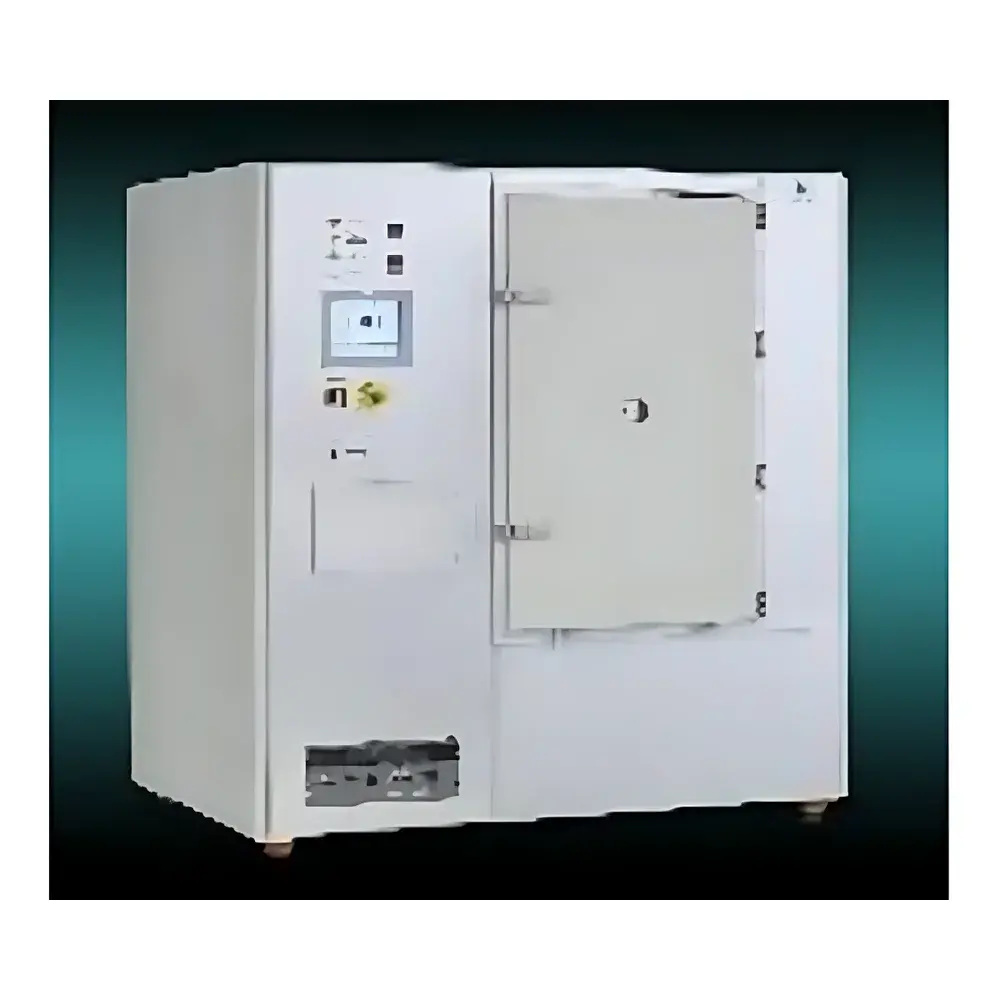
Europlasma CD1000PLC Low-Pressure Plasma Surface Treater
| Brand | Europlasma |
|---|---|
| Origin | Belgium |
| Model | CD1000PLC |
| RF Frequency | 50 Hz (Note: This is likely a misstatement — standard low-pressure plasma systems use RF frequencies of 13.56 MHz or 40 kHz |
| Power Supply | 380 V AC, 3-phase, 50 Hz, 40 A |
| Chamber Dimensions | 700 × 700 × 1000 mm |
| Chamber Volume | 490 L |
| Chamber Material | Anodized Aluminum |
| Vacuum System | Rotary vane roughing pump + mechanical booster pump (480 m³/h) |
| Vacuum Measurement | Pirani gauge |
| RF Generator | 0–2500 W, adjustable |
| Control System | PLC-based automated control with parameter logging |
| Gas Inlet | Single port with MFC (1/4″ BSP, max inlet pressure 1 bar) |
| Exhaust Port | Ø38 mm |
| Safety Features | Emergency stop, vacuum interlock, overtemperature protection |
| Compliance | CE-marked |
| Sample Tray Capacity | 8 trays (591 × 697 × 40 mm each) |
| Process Temperature | <40 °C |
| Operating Mode | Batch-type, low-pressure glow discharge plasma |
Overview
The Europlasma CD1000PLC is a bench-scale, low-pressure plasma surface treatment system engineered for precise, non-thermal modification of material surfaces in research laboratories and pilot production environments. It operates on the principle of capacitively coupled radiofrequency (RF) glow discharge plasma generated under controlled vacuum conditions (typically 0.1–10 Pa). Using inert or reactive process gases (e.g., O₂, Ar, N₂, or air), the system produces energetic electrons, ions, radicals, and UV photons that interact with substrate surfaces to remove organic contaminants, activate polymer surfaces, improve adhesion, or introduce functional chemical groups—without altering bulk material properties. Designed for reproducible, operator-independent processing, the CD1000PLC maintains chamber temperatures below 40 °C throughout operation, eliminating thermal degradation risks for heat-sensitive substrates such as PET, polyimide, PDMS, and biomedical polymers.
Key Features
- Robust anodized aluminum reaction chamber (700 × 700 × 1000 mm, 490 L volume) with integrated viewing window for real-time plasma observation
- High-capacity dual-stage vacuum system: primary rotary vane pump paired with a 480 m³/h mechanical booster pump, enabling rapid evacuation to base pressures <1 Pa
- Adjustable RF power generator (0–2500 W) operating at industry-standard 13.56 MHz (note: 50 Hz referenced in documentation corresponds to mains input frequency, not RF output)
- PLC-based automation with programmable logic controller enabling full sequence control—including pump-down, gas dosing, plasma ignition, dwell time, venting, and safety interlocks
- Integrated Pirani vacuum sensor for continuous pressure monitoring and closed-loop feedback during process cycles
- Single-gas inlet with mass flow controller (MFC), calibrated for flow rates up to 100 sccm, supporting precise stoichiometric control of reactive species
- Eight standardized sample trays (591 × 697 × 40 mm) optimized for uniform plasma exposure and high-throughput batch processing
- Comprehensive safety architecture: emergency stop circuit, vacuum loss lockout, thermal cutoff (<50 °C), and CE-compliant electrical design per EN 61000-6-2/6-4 and EN 61010-1
Sample Compatibility & Compliance
The CD1000PLC accommodates a broad range of solid substrates including polymers (e.g., PP, PE, PC, PTFE), metals (Al, Ti, stainless steel), ceramics, glass, and composite laminates. Its low-temperature operation ensures compatibility with temperature-sensitive materials used in microfluidics, flexible electronics, and medical device manufacturing. All process parameters—including chamber pressure, RF power, gas flow, and treatment duration—are fully traceable and auditable, supporting compliance with GLP (Good Laboratory Practice) frameworks and pre-validation requirements for ISO 13485 or ASTM D7906 (Standard Guide for Plasma Treatment of Polymeric Substrates). The system meets CE marking requirements for electromagnetic compatibility (EMC) and low-voltage directive (LVD), and its control architecture supports future integration into 21 CFR Part 11–compliant environments via optional audit trail and electronic signature modules.
Software & Data Management
While the base CD1000PLC utilizes a dedicated PLC HMI interface (no PC-dependent software), all operational parameters—including vacuum ramp rate, final pressure, RF forward/reflected power, MFC setpoints, treatment time, and real-time temperature—are logged internally with timestamping. Data export is supported via USB or RS-485 serial interface for integration into laboratory information management systems (LIMS) or statistical process control (SPC) platforms. Parameter sets can be saved as named recipes with user-level access control (operator vs. engineer passwords), ensuring procedural consistency across shifts and minimizing human error. Optional Ethernet/IP or Modbus TCP gateways enable remote monitoring and centralized fleet management in multi-unit installations.
Applications
- Surface cleaning of optical components and semiconductor wafers prior to coating or bonding
- Plasma activation of polyolefin films for improved ink adhesion in packaging R&D
- Hydrophilization of PDMS microchannels for enhanced capillary filling in lab-on-a-chip development
- Removal of silicone mold release agents from elastomeric parts before adhesive application
- Functionalization of carbon fiber surfaces with amine or carboxyl groups for composite interfacial optimization
- Pre-treatment of biodegradable scaffolds (e.g., PLA, PCL) to enhance protein adsorption in tissue engineering studies
- Decontamination of reusable labware surfaces without solvents or thermal stress
FAQ
What RF frequency does the CD1000PLC actually operate at?
The system uses a 13.56 MHz RF generator—the industrial, scientific, and medical (ISM) band designated for plasma applications. The “50 Hz” specification refers only to the mains power supply frequency.
Can the system operate with multiple process gases simultaneously?
No—the standard configuration includes one MFC-controlled gas inlet. Dual-gas operation requires optional manifold integration and additional MFCs.
Is remote diagnostics or service support available?
Yes—Europlasma provides secure remote access capability via encrypted VPN for firmware updates and troubleshooting, subject to customer network policy approval.
Does the chamber require periodic cleaning or maintenance?
Chamber wall deposits are minimal under oxygen or argon plasma; routine inspection every 200 operating hours is recommended, with aluminum surfaces cleaned using IPA and lint-free wipes.
How is process repeatability verified?
Repeatability is ensured through closed-loop pressure control, calibrated MFCs, and RF power stabilization. Users may validate performance using standardized contact angle test substrates (e.g., polystyrene reference wafers) per ASTM D7490.



