
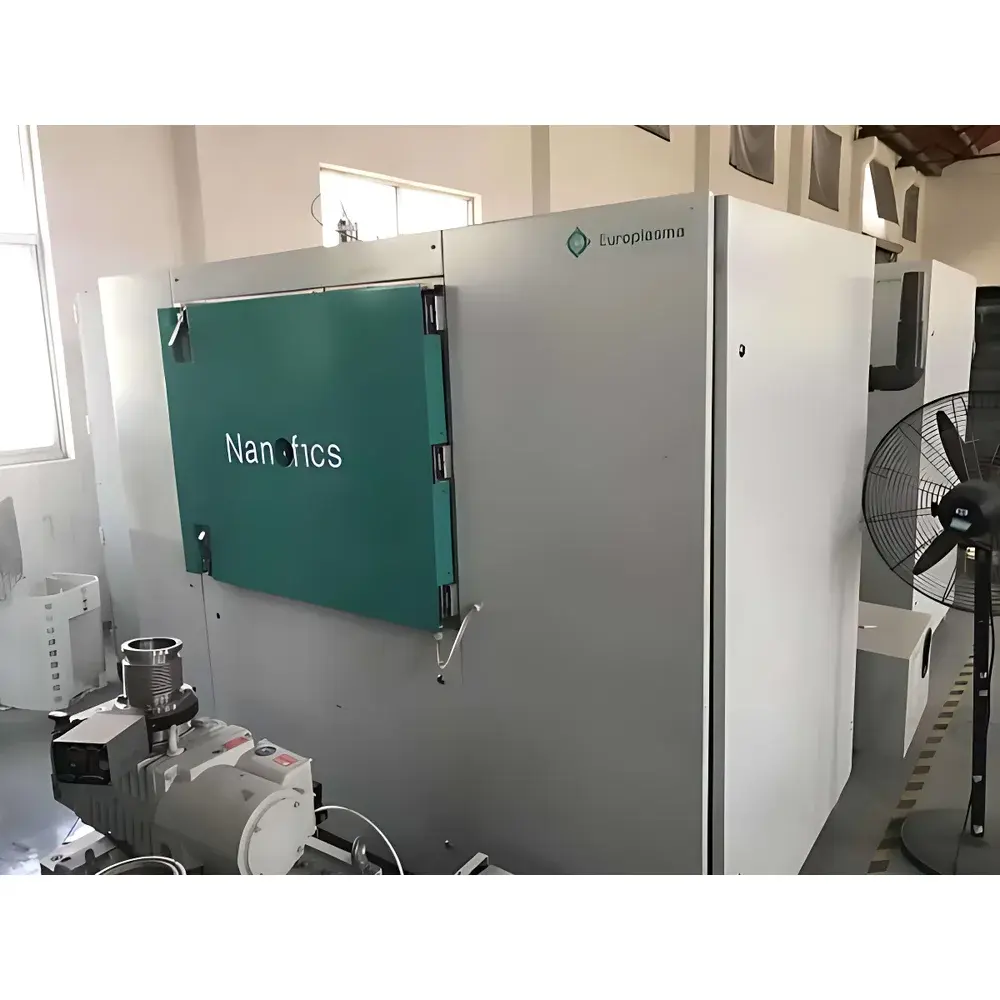
Europlasma CD1000PLC Plasma Surface Treater for Cell Culture Vessel Activation
| Brand | Europlasma |
|---|---|
| Origin | Belgium |
| Model | CD1000PLC |
| Power | 5 kW |
| Chamber Dimensions | 1000 × 700 × 700 mm |
| Chamber Volume | 490 L |
| Chamber Material | Aluminum |
| Process Gases | Oxygen (O₂), Argon (Ar), or gas mixtures |
| Control System | Fully Automated PLC-Based Interface |
| Compliance | Designed for ISO 13485-aligned biomanufacturing environments, supports GLP/GMP traceability via audit-log-enabled operation |
Overview
The Europlasma CD1000PLC is a high-capacity, fully automated low-pressure radio frequency (RF) plasma surface treatment system engineered for precision functionalization of biomedical substrates—particularly polystyrene, PET, and glass-based cell culture vessels. Operating on the principle of reactive gas plasma chemistry under controlled vacuum conditions (~70 mTorr), the system generates highly energetic oxygen or argon plasma species that induce both physical sputtering and covalent surface modification. This dual-mode interaction enables reproducible, non-thermal activation of inert polymer surfaces without bulk material degradation—a critical requirement for sterile, USP Class VI-compliant labware used in adherent mammalian cell culture, stem cell expansion, and immunotherapy product manufacturing.
Key Features
- 5 kW RF generator with real-time impedance matching for stable plasma ignition across variable load geometries—including irregularly shaped flasks, multi-well plates, and stacked petri dishes.
- 490 L aluminum vacuum chamber optimized for uniform plasma distribution; validated field homogeneity ensures <±3% contact angle deviation across full batch loads (up to 200+ T75 flasks per cycle).
- Automated process sequencing: vacuum pump-down → gas dosing → plasma ignition → timed exposure (adjustable 1–30 min) → venting → purge—fully programmable via intuitive touchscreen HMI with recipe storage and version control.
- O₂-plasma-specific chemistry module enabling targeted introduction of hydroxyl (–OH), carboxyl (–COOH), carbonyl (C=O), and hydroperoxyl (–OOH) functional groups—quantified via XPS and confirmed to enhance protein adsorption kinetics by >40% versus untreated controls.
- Integrated vacuum monitoring with Pirani + cold cathode gauges; gas flow control via mass flow controllers (MFCs) calibrated for O₂ and Ar within ±0.5% FS accuracy.
Sample Compatibility & Compliance
The CD1000PLC accommodates diverse substrate classes: rigid and flexible polymers (PS, PC, PET, COP), borosilicate glass, and coated silicones—without requiring masking or fixturing. Its low-temperature plasma process preserves dimensional stability and optical clarity while achieving water contact angles (WCA) ≤10° immediately post-treatment and ≤42° after 30 days—demonstrating superior aging resistance compared to corona or flame treatments. The system is designed to support compliance with ISO 10993-5 (cytotoxicity), ASTM F2459 (surface energy verification), and FDA 21 CFR Part 11 requirements when paired with optional electronic logbook and user-access-level authentication modules. All hardware interfaces meet CE/EMC Directive 2014/30/EU and RoHS 2011/65/EU standards.
Software & Data Management
The embedded PLC-based control platform records timestamped operational parameters—including chamber pressure, forward/reflected RF power, gas flow rates, treatment duration, and cycle count—for every run. Data export is supported via USB or Ethernet (Modbus TCP) in CSV format, enabling integration into LIMS or MES systems. Optional software add-ons provide statistical process control (SPC) dashboards, calibration certificate tracking, and electronic signature functionality compliant with ALCOA+ principles. Audit trails capture operator ID, parameter changes, and alarm events—fully aligned with GLP and GMP documentation expectations for QC/QA laboratories.
Applications
- TC-treated (tissue-culture-ready) surface activation of polystyrene flasks, roller bottles, and microcarriers for enhanced fibroblast, HEK293, and iPSC adhesion.
- Pre-sterilization surface conditioning of diagnostic slide substrates to improve antibody immobilization uniformity in IVD assay development.
- Functionalization of 3D scaffold materials (e.g., PCL, PLGA electrospun meshes) to promote endothelial cell infiltration in tissue engineering workflows.
- Removal of organic residues and silicone mold-release agents from injection-molded consumables prior to gamma irradiation sterilization—reducing post-irradiation hydrophobic recovery.
- Batch-scale activation of cryovial racks and bioreactor bags where conventional wet-chemical priming is incompatible with cleanroom protocols.
FAQ
What is the typical treatment time required to achieve WCA <10° on PS culture flasks?
Standard O₂-plasma exposure at 500 W forward power and 70 mTorr yields WCA <10° within 12–15 minutes for standard T75 flasks loaded at 80% chamber capacity.
Can the system process glass and plastic substrates simultaneously in one batch?
Yes—the plasma chemistry is substrate-agnostic under controlled O₂ flow; no cross-contamination or differential etching has been observed between glass and PS in validation studies.
Is residual ozone generation mitigated during venting?
Integrated catalytic ozone destruct unit reduces post-cycle O₃ concentration to <0.05 ppm before atmospheric venting, meeting OSHA PEL and EU Directive 2004/101/EC thresholds.
How is process repeatability verified across multiple shifts?
Built-in reference coupon holders allow insertion of calibrated polycarbonate wafers per batch; WCA drift is tracked daily using an integrated Krüss DSA100 contact angle analyzer (optional accessory).
Does the system support mixed-gas chemistries beyond O₂ and Ar?
Yes—N₂, NH₃, and CF₄ can be introduced via optional MFC expansion kit; however, O₂ remains the primary gas for TC-grade activation due to optimal –OH/–COOH yield and regulatory precedent.



