
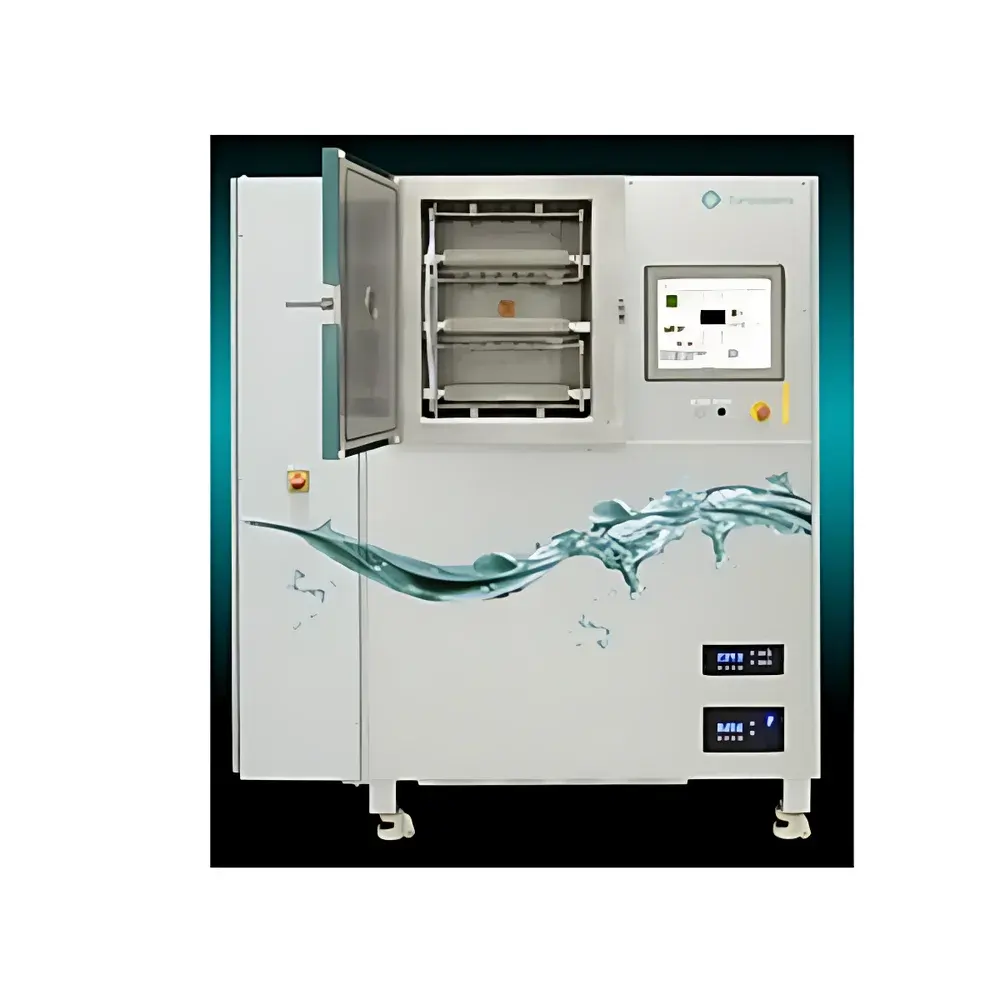
Europlasma CD500 Nanofics Low-Pressure Plasma Surface Treatment System
| Brand | Europlasma |
|---|---|
| Origin | Belgium |
| Model | CD500 |
| RF Frequency | 50 Hz |
| Power Supply | 380 V AC, 3-phase, 40 A |
| Chamber Dimensions | 500 × 400 × 650 mm |
| Chamber Volume | 129 L |
| Chamber Material | Anodized Aluminum |
| Vacuum Measurement | Pirani Gauge |
| Vacuum Pump | Dry Scroll Pump |
| Gas Inlet | 1/4″ (6.45 mm) with MFC |
| Exhaust Port | 28 mm |
| Control System | PLC-based Automated Interface |
| Safety Certifications | CE Compliant |
| Operating Temperature | <40 °C |
Overview
The Europlasma CD500 Nanofics is a benchtop low-pressure plasma surface treatment system engineered for precision functionalization, cleaning, and nanoscale coating deposition under controlled vacuum conditions. It operates on the principle of capacitively coupled radio-frequency (RF) plasma generation at 50 Hz—optimized for stable, non-thermal plasma discharge in low-pressure environments (typically 0.1–10 Pa). Unlike atmospheric plasma systems, the CD500’s vacuum-based architecture ensures uniform energy distribution across complex 3D geometries and eliminates ambient contamination, enabling reproducible surface modification without thermal damage to heat-sensitive substrates. The system integrates Nanofics—a proprietary plasma-enhanced process for depositing ultra-thin, conformal hydrophobic, corrosion-resistant, and oxidation-inhibiting nanolayers—without solvents or post-curing. Designed for laboratory-scale R&D and pilot-line validation, it supports material-agnostic surface engineering for polymers, metals, ceramics, textiles, and biomedical devices.
Key Features
- Low-temperature operation (<40 °C) preserves substrate integrity—critical for PET, PC, silicone elastomers, and flexible electronics.
- 129 L anodized aluminum reaction chamber with three 360 × 360 mm adjustable trays and integrated viewing window for real-time process monitoring.
- Dry scroll vacuum pump system with Pirani gauge feedback ensures rapid evacuation (<3 min to 5 Pa) and stable process pressure control.
- PLC-driven automation with password-protected access, full parameter logging (vacuum level, gas flow rate, RF power delivery, treatment time, chamber temperature), and configurable recipe storage.
- Single-gas inlet with mass flow controller (MFC) for precise dosing of argon, oxygen, nitrogen, or fluorocarbon precursors (e.g., C4F8, CHF3); exhaust port compatible with standard abatement systems.
- Comprehensive safety architecture: emergency stop, vacuum interlock, overtemperature cutoff, and CE-certified electrical design compliant with EN 61000-6-2/6-4 and EN 61000-3-2.
Sample Compatibility & Compliance
The CD500 accommodates diverse sample formats—including wafers, PCBs, injection-molded housings, textile swatches, filtration membranes, and medical device components—within its large-volume chamber. Its low-energy plasma regime meets ISO 15730:2020 (plasma surface activation standards) and supports GLP-aligned documentation when paired with optional audit-trail software modules. While not inherently FDA 21 CFR Part 11–compliant out-of-the-box, the PLC control system provides timestamped, user-logged parameter records suitable for internal quality audits and pre-submission technical dossiers. All hardware complies with EU Machinery Directive 2006/42/EC and Electromagnetic Compatibility Directive 2014/30/EU.
Software & Data Management
The embedded HMI interface enables intuitive setup of multi-step plasma protocols: pre-evacuation, gas purging, plasma ignition, dwell, venting, and cooldown. Each step is programmable with independent setpoints for pressure (Pa), gas flow (sccm), RF duration (s), and inter-step delays. Process data—including vacuum ramp profiles, real-time MFC output, and chamber temperature traces—are logged to internal memory and exportable via USB to CSV for traceability. Optional Ethernet connectivity allows integration into LabVantage or Thermo Fisher SampleManager LIMS environments using Modbus TCP protocol. All user actions—including login events, parameter changes, and alarm acknowledgments—are recorded with ISO/IEC 27001–aligned timestamping.
Applications
- Electronics: Hydrophobic passivation of Bluetooth earbuds, AR glasses frames, and drone housings against sweat, humidity, and salt fog (per IEC 60529 IPX4/IPX7 simulation).
- Technical Textiles: Durable water repellency (DWR) on nylon and polyester fabrics without PFAS chemistry—validated per AATCC TM22 and ISO 4920.
- Medical Devices: Surface activation of polyurethane catheters prior to heparin immobilization; enhancement of cell adhesion on PEEK spinal implants.
- Membrane Science: Tuning surface energy of PVDF and PTFE filters to optimize oil–water separation selectivity (ASTM D7334 contact angle verification).
- Automotive Sensors: Removal of mold release agents from ABS/PC sensor housings to ensure reliable adhesive bonding in ADAS assemblies.
FAQ
What vacuum level does the CD500 achieve, and how is it measured?
The system reaches base pressures down to 0.1 Pa using its integrated dry scroll pump, monitored continuously by a calibrated Pirani gauge with ±5% full-scale accuracy.
Can the CD500 operate with multiple process gases simultaneously?
No—it features a single MFC-controlled gas inlet. Multi-gas operation requires external manifold integration and custom PLC firmware configuration.
Is the Nanofics coating process compatible with ISO 13485-certified cleanroom environments?
Yes—the system emits no volatile organic compounds (VOCs) and generates zero particulate shedding; it may be installed in Class 7 (ISO 14644-1) cleanrooms with appropriate exhaust ducting.
Does Europlasma provide application-specific process development support?
Yes—Europlasma offers remote and on-site application engineering services, including DoE-based parameter optimization and coating thickness verification via XPS or ellipsometry.
What maintenance intervals are recommended for the vacuum pump and RF generator?
Dry scroll pump oil change every 6,000 operating hours; RF generator inspection and impedance matching calibration annually or after 500 plasma cycles—documented in the included Maintenance Logbook.



