
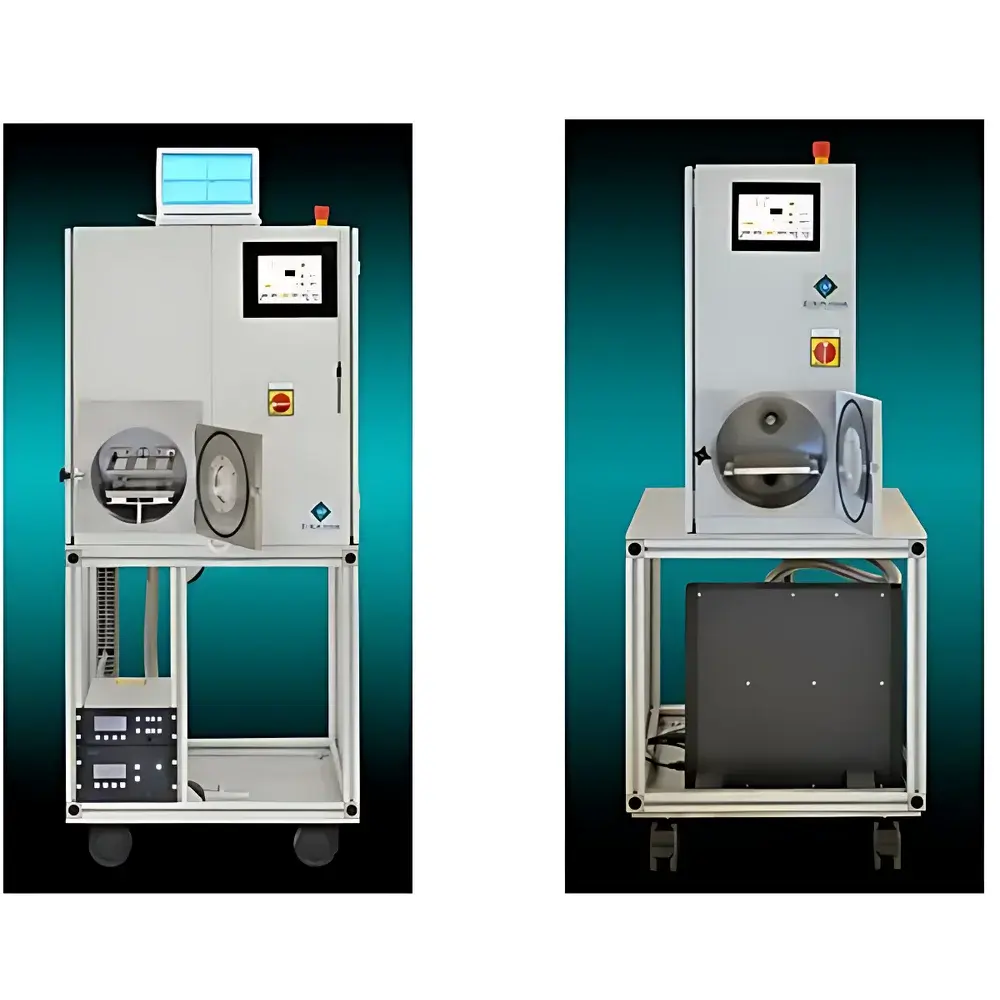
Europlasma JuniorPLC Low-Pressure Plasma Surface Treater
| Brand | Europlasma |
|---|---|
| Origin | Belgium |
| Model | JuniorPLC |
| RF Frequency | 50 Hz |
| Power Supply | 40 A (at 230 V AC, single-phase) |
| Chamber Dimensions | Ø230 mm × 250 mm depth |
| Chamber Volume | 10.4 L |
| Chamber Material | Anodized Aluminum |
| Control System | Microprocessor-Based Automatic Control |
| Maximum Operating Temperature | <40 °C during treatment |
| Application Scope | Surface cleaning, activation, and functionalization of polymeric, metallic, and ceramic substrates |
Overview
The Europlasma JuniorPLC is a compact, benchtop low-pressure plasma surface treater engineered for precision surface modification in R&D laboratories and small-batch production environments. It operates on the principle of capacitively coupled radio-frequency (RF) plasma generation under controlled vacuum conditions (typically 0.1–10 mbar), enabling reproducible, non-thermal plasma exposure to substrates. Unlike atmospheric plasma systems, the low-pressure configuration ensures uniform plasma density, minimal thermal load (<40 °C surface temperature rise), and high process repeatability—critical for sensitive polymers, thin-film coatings, and microfabricated components. The system is designed for applications requiring molecular-level surface engineering without bulk material alteration, including hydrophilization, removal of organic contaminants (e.g., oils, release agents), and introduction of reactive functional groups (–OH, –COOH, –NH₂) for enhanced adhesion in bonding, coating, or printing processes.
Key Features
- Compact chamber geometry (Ø230 mm × 250 mm depth) optimized for rapid pump-down and uniform plasma distribution across vertically or horizontally mounted samples.
- Anodized aluminum vacuum chamber offering excellent corrosion resistance, electrical grounding integrity, and compatibility with O₂, Ar, N₂, NH₃, and air-based process gases.
- Integrated microprocessor controller with pre-programmable recipes, real-time parameter monitoring (pressure, RF power, treatment time), and automatic safety interlocks (vacuum threshold, overtemperature, door open detection).
- Single-phase 230 V AC input with 40 A circuit requirement—designed for standard European laboratory power infrastructure; includes built-in RF matching network for stable impedance control.
- No external water cooling required; passive thermal management maintains chamber wall temperature below 45 °C during continuous operation.
- Modular tray system supports custom sample holders—compatible with wafers up to 6″, PCBs, medical device components, polymer films, and 3D-printed parts.
Sample Compatibility & Compliance
The JuniorPLC accommodates a broad range of non-volatile, thermally stable materials—including polypropylene (PP), polyethylene (PE), polytetrafluoroethylene (PTFE), silicon wafers, stainless steel, aluminum alloys, glass slides, and ceramic substrates. It is not suitable for solvents, volatile organics, or hygroscopic materials that outgas excessively under vacuum. The system complies with CE marking requirements (2014/30/EU EMC Directive and 2014/35/EU Low Voltage Directive). Vacuum and RF subsystems are engineered to meet ISO 8573-1 Class 4 compressed air purity standards when used with optional gas filtration modules. For regulated environments (e.g., medical device manufacturing), the control log can be exported as CSV for GLP/GMP audit trails; however, native 21 CFR Part 11 electronic signature capability requires third-party validation software integration.
Software & Data Management
The JuniorPLC operates via an embedded 4.3″ TFT touchscreen interface with intuitive icon-driven navigation. All process parameters—including vacuum setpoint (mbar), RF power level (% of max), treatment duration (s), gas type, and purge cycles—are stored in non-volatile memory with up to 99 user-defined protocols. Real-time event logging records timestamped operational states (pump start, plasma ignition, fault codes) with retention for ≥10,000 entries. Data export is supported via USB 2.0 port (FAT32 formatted drive); no proprietary software installation is required on host PCs. For integration into centralized lab information management systems (LIMS), ASCII-formatted logs can be parsed using standard Python or LabVIEW scripts.
Applications
- Plasma cleaning of optical components prior to anti-reflective coating deposition.
- Surface activation of polyolefin packaging films to improve ink adhesion in flexographic printing.
- Pre-treatment of PDMS microfluidic chips for irreversible bonding to glass or silicon.
- Enhancing wettability and cell attachment on tissue culture polystyrene (TCPS) surfaces in biomedical research.
- Removal of photoresist residues and native oxides from semiconductor test coupons.
- Functionalization of carbon fiber composites to strengthen epoxy matrix interfacial bonding.
FAQ
What vacuum level is required for stable plasma ignition?
Typical operating pressure ranges from 0.2 to 5 mbar, depending on gas type and desired plasma mode (glow vs. transition discharge). Base pressure should be ≤1 × 10⁻² mbar before gas introduction.
Can the JuniorPLC handle conductive and insulating samples simultaneously?
Yes—capacitive coupling enables uniform treatment of mixed-material loads; however, optimal results require homogeneous loading geometry and avoidance of shadowing effects.
Is ozone generation a concern during oxygen plasma operation?
Ozone forms in trace amounts during O₂ plasma; the system includes a catalytic ozone destruct unit integrated into the exhaust line, reducing ambient O₃ emissions to <0.1 ppm at 30 cm distance.
What maintenance intervals are recommended?
Chamber cleaning every 50 operating hours; RF electrode inspection and O-ring replacement every 500 hours; vacuum pump oil change per manufacturer schedule (typically every 3–6 months under continuous use).
Does Europlasma provide application support for process development?
Yes—Europlasma offers remote technical consultation and standardized protocol libraries (e.g., ASTM D726-03 adapted for plasma activation testing) upon equipment commissioning.



