
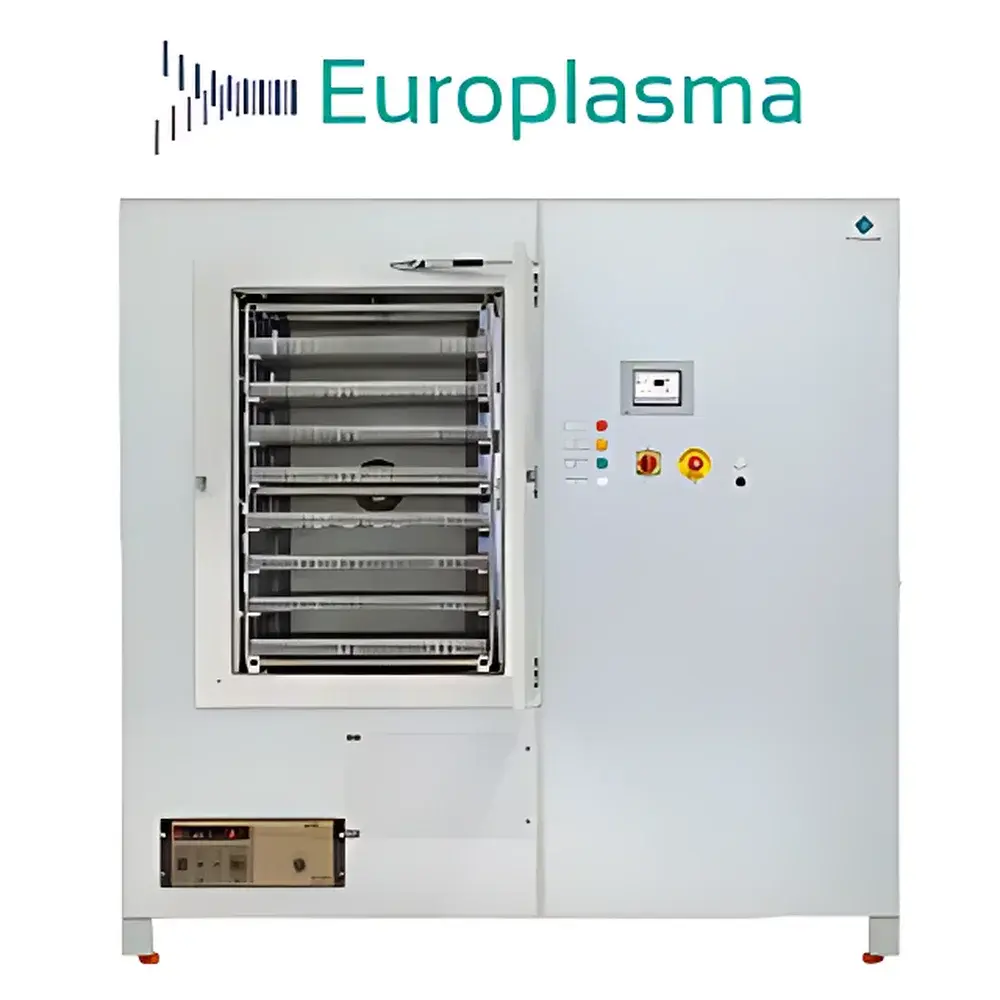
Europlasma PlasmaGuard CD1200 Halogen-Free Plasma Surface Treater
| Brand | Europlasma |
|---|---|
| Origin | Belgium |
| Model | CD1200 |
| Power | 5 kW |
| Dimensions (W×D×H) | 700 × 700 × 1200 mm |
| Chamber Volume | 490 L |
| Chamber Material | Anodized Aluminum |
| Process Gases | O₂, Ar, and other inert/reactive gases |
| Control System | PLC-based automation with 17″ HMI touchscreen |
| Vacuum System | Dry scroll pump set, 480 m³/h pumping speed |
| Vacuum Measurement | Pirani gauge |
| Gas Delivery | Single MFC-controlled inlet (1/4″ BSP, 1 bar max input pressure) |
| Exhaust Port | Ø28 mm |
| Safety Compliance | CE-marked, emergency stop, vacuum interlock, thermal overtemperature protection |
| Electrical Supply | 380 V AC, 3-phase, 50 Hz, 40 A |
Overview
The Europlasma PlasmaGuard CD1200 is a high-capacity, halogen-free plasma surface treatment system engineered for industrial-scale functionalization and nanocoating of sensitive components in regulated manufacturing environments. Utilizing low-pressure radiofrequency (RF) plasma generated in controlled O₂- or Ar-based atmospheres, the system modifies surface energy, enhances wettability, improves adhesion, and deposits ultra-thin, conformal barrier coatings—without introducing halogenated precursors or solvents. Unlike atmospheric plasma systems, the CD1200 operates under vacuum (typically 0.1–10 Pa), enabling uniform treatment of complex 3D geometries, recessed features, and porous substrates with exceptional reproducibility. Its 490 L aluminum chamber—designed for corrosion resistance and RF field homogeneity—supports batch processing of up to eight standard trays (620 × 675 mm each), making it suitable for pre-coating validation, QC lot processing, and pilot-line integration in electronics, medical device, and battery manufacturing.
Key Features
- Halogen-free surface activation and nano-coating via PlasmaGuard® technology—certified compliant with IEC 61249-2-21 and RoHS 3 directives for halogen content (<900 ppm Cl, <900 ppm Br, total halogens <1500 ppm)
- PLC-driven automation with 17″ industrial touchscreen HMI, supporting recipe-based process execution, real-time parameter logging, and user-level access control via password authentication
- Dry scroll vacuum pump system (480 m³/h) with integrated Pirani gauge for precise pressure regulation between 0.05–20 Pa during plasma ignition and sustained discharge
- RF generator with adjustable power output (0–5 kW) and frequency stability optimized for stable glow discharge across diverse dielectric and conductive substrates
- Chamber constructed from anodized aluminum alloy with RF-shielded viewport, ensuring electromagnetic compatibility and operator visibility without compromising vacuum integrity
- Comprehensive safety architecture: hardware-enforced emergency stop, vacuum loss interlock, temperature monitoring at critical zones (chamber wall, RF electrodes), and CE-certified electrical design per EN 61000-6-2/6-4
Sample Compatibility & Compliance
The CD1200 accommodates substrates ranging from rigid PCB assemblies and stainless-steel medical catheters to flexible textiles, lithium-ion battery separators, and polymer-based wearable housings. Its large-volume chamber enables simultaneous treatment of heterogeneous part families—e.g., mixed batches of silicone earbud gaskets and polyimide flex circuits—without cross-contamination. All process parameters (pressure ramp rate, gas flow profile, RF power ramp, dwell time) are fully configurable and auditable, supporting compliance with ISO 13485 (medical devices), IATF 16949 (automotive electronics), and GLP/GMP documentation requirements. The system’s data logging meets FDA 21 CFR Part 11 criteria when deployed with validated electronic signatures and audit trail configuration.
Software & Data Management
The embedded PLC firmware records all operational variables—including chamber pressure, RF forward/reflected power, gas flow rates, temperature gradients, and cycle timestamps—at 100 ms resolution. Data exports natively to CSV or OPC UA for integration into MES or LIMS platforms. Optional Ethernet/IP or Modbus TCP interfaces enable remote monitoring and centralized fleet management. Process recipes are version-controlled and stored with metadata (operator ID, timestamp, calibration status), facilitating traceability across production lots and regulatory audits.
Applications
- Pre-adhesive bonding activation of polypropylene housings for IPX7–IPX8-rated wearables
- Hydrophilic surface conditioning of PTFE vascular catheters prior to hydrogel coating
- Barrier layer deposition on Li-ion pouch cell separators to suppress dendrite penetration
- Surface cleaning and oxide removal from gold-plated RF connectors prior to conformal coating
- Functionalization of nonwoven meltblown fabrics for enhanced particle capture efficiency in N95-class respirators
- Plasma-assisted deposition of SiOₓ-like films on OLED encapsulation substrates
FAQ
What halogen-free coating chemistries are supported by PlasmaGuard® technology?
PlasmaGuard® exclusively employs oxygen, argon, nitrogen, or siloxane-based precursors—never fluorocarbons or chlorosilanes—to generate functional coatings. Coating composition is verified via XPS and FTIR per ASTM E1527.
Can the CD1200 be integrated into an automated production line?
Yes—the system supports SECS/GEM protocol and offers optional I/O modules for PLC-to-PLC handshaking, door position feedback, and cycle completion signaling.
Is validation support available for pharmaceutical or medical device applications?
Europlasma provides IQ/OQ documentation templates and collaborates with qualified third-party vendors for PQ execution under ISO 13485 and Annex 11 frameworks.
What maintenance intervals are recommended for the dry pump and RF generator?
Dry pump oil change every 3,000 operating hours; RF matching network inspection every 6 months; chamber cleaning recommended after every 200 cycles involving organic residue.
Does the system meet EMC requirements for laboratory installation near sensitive instrumentation?
Yes—tested to EN 61326-1:2013 Class A emission limits and EN 61000-4-2/3/4/6 immunity standards, with documented shielding effectiveness >40 dB across 30 MHz–1 GHz.



