
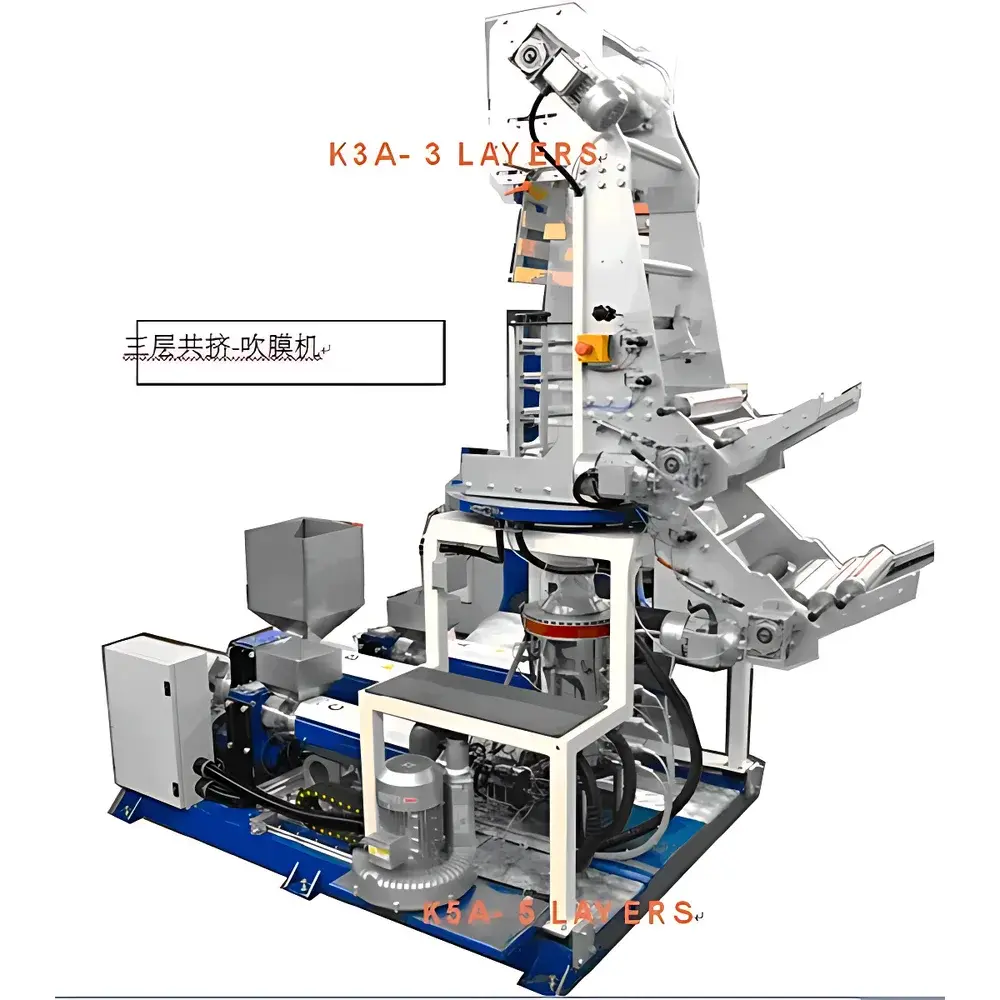
EUROTECH F3A-3LAYERS Triple-Layer Co-Extrusion Blown Film Extrusion Line
| Key | Brand: EUROTECH |
|---|---|
| Origin | Italy |
| Model | F3A-3LAYERS |
| Screw Diameter | 25–40 mm |
| L/D Ratio | 25–30 |
| Max. Extruder Torque | 500 N·m (closed-loop controlled) |
| Max. Barrel Temperature | 450 °C |
| Melt Pressure & Temperature Monitoring | Yes |
| Die Diameter Options | 50 / 60 / 80 mm |
| Die Gap | 1.0 mm & 1.5 mm |
| Bubble Diameter Control | Automatic |
| Max. Film Width | 300 mm |
| Haul-off Speed | Up to 15 m/min |
| Tension Control Range | 0–20 N |
| Cooling System | Julabo chiller-integrated air/water cooling |
| Remote Interface | Web-based HMI + OPC UA compliant |
| Compliance | CE, ISO 9001-aligned design principles |
| Drive System | Maintenance-free AC servo motors with vector control |
Overview
The EUROTECH F3A-3LAYERS Triple-Layer Co-Extrusion Blown Film Extrusion Line is a precision-engineered laboratory-scale system designed for R&D laboratories, polymer formulation centers, and quality assurance units within petrochemical, packaging, and advanced materials industries. It implements the fundamental principle of tubular blown film extrusion—where three independent polymer melts are simultaneously extruded through a concentric die, inflated into a stable bubble, cooled via radial air flow, and collapsed into a double-layered flat film with distinct functional layers (e.g., sealant/core/barrier). This architecture enables rigorous evaluation of co-extrudability, interlayer adhesion, melt strength, bubble stability, and layer symmetry under controlled thermal and rheological conditions—critical for validating new resin grades or optimizing multilayer film structures prior to full-scale production.
Key Features
- Modular triple-screw configuration with independently controlled single-screw extruders (D20 series), each equipped with nitrogen-hardened barrels (4-zone heating/cooling), integrated melt pressure and temperature sensors, and closed-loop torque regulation up to 500 N·m.
- High-precision co-extrusion die assembly with interchangeable diameters (50/60/80 mm) and adjustable gap settings (1.0 mm and 1.5 mm), engineered for uniform shear distribution and minimal layer distortion.
- Fully automated bubble stabilization tower (BFT-300) featuring six-channel circumferential airflow, motorized diameter adjustment (2100–3200 mm height range), and real-time bubble geometry feedback via optical monitoring interface.
- Haul-off and winding station (W-9) incorporating dual tension-controlled rubber-coated and chrome-plated nip rollers, automatic diameter calculation, and programmable torque-based winding profiles—all driven by maintenance-free AC servo motors with vector frequency control.
- Integrated electrostatic neutralization system (high-voltage type) and film-break detection circuitry ensure operational safety and process continuity during extended test runs.
- Unified color TFT touchscreen HMI with embedded web server functionality—supporting remote parameter configuration, real-time data streaming, alarm logging, and full OPC UA interoperability for integration into MES or LIMS environments.
Sample Compatibility & Compliance
The F3A-3LAYERS accommodates a broad spectrum of thermoplastic resins including LDPE, LLDPE, HDPE, PP, EVOH, PA6, PETG, and ionomer-based barrier polymers—provided they exhibit sufficient melt stability within the 200–450 °C processing window. Feedstock forms include pellets, granules, and masterbatches. All wetted components (barrels, screws, dies, and melt channels) utilize ion-nitrided special steel for enhanced corrosion resistance and dimensional stability under prolonged thermal cycling. The system conforms to CE Machinery Directive 2006/42/EC and electromagnetic compatibility standards EN 61000-6-2/-4. While not certified for GMP manufacturing, its architecture supports GLP-compliant documentation practices—including audit-trail-enabled parameter logging, user-access-level management, and timestamped data export in CSV/Excel format—making it suitable for method development under ASTM D2610, ISO 1133, and ISO 14214 frameworks.
Software & Data Management
Control firmware runs on a deterministic real-time OS with synchronized sampling across all analog inputs (melt pressure, temperature, torque, speed, tension). The embedded HMI provides dual-mode operation: local touch interface with intuitive tab-based navigation (Setup, Run, Diagnostics, History), and browser-accessible remote dashboard supporting Chrome, Edge, and Safari. All process variables—including screw RPM, zone temperatures, die pressure, bubble diameter, haul-off speed, and winding tension—are sampled at ≥10 Hz and stored with millisecond timestamps. Historical datasets can be filtered by batch ID, operator, date range, or alarm event; exported as time-stamped .csv files compatible with MATLAB, JMP, or Python pandas workflows. OPC UA server implementation allows seamless bidirectional communication with SCADA systems, enabling centralized KPI tracking (e.g., specific energy consumption, layer thickness deviation, bubble oscillation amplitude).
Applications
- Polymer blend compatibility screening and interfacial rheology assessment in multilayer architecture development.
- Resin supplier qualification—validating melt flow consistency, thermal degradation onset, and die swell behavior across lot batches.
- Process window mapping for critical parameters: blow-up ratio (BUR), frost line height (FLH), take-up ratio (TUR), and chill zone residence time.
- Functional film prototyping—e.g., peelable seals, anti-fog coatings, metallizable substrates, and recyclable mono-material structures.
- Root cause analysis of industrial line defects (gauge variation, helix lines, gels, delamination) via controlled replication under instrumented conditions.
- Training platform for extrusion engineers on co-extrusion dynamics, bubble instability modes (draw resonance, shark skin), and closed-loop tension control strategies.
FAQ
What is the maximum recommended throughput per layer?
The F3A-3LAYERS is optimized for R&D-scale operation; typical combined output ranges from 2 to 8 kg/h depending on material viscosity and die configuration. Individual layer mass flow is monitored via calibrated gear pump feeds (optional add-on) or inferred from screw speed/torque correlation models.
Can the system be upgraded to four-layer co-extrusion?
No—the mechanical and control architecture is specifically engineered for three-layer symmetric feedblock integration. Four-layer capability requires a different die manifold and feedblock design, which is not retrofittable to the F3A platform.
Is Julabo chiller included in the standard supply?
Yes—a Julabo PRESTO A45 chiller unit is factory-integrated into the cooling loop for barrel and die temperature stabilization, with setpoint resolution of ±0.5 °C and dynamic response time <30 seconds to 10 °C step changes.
How is layer thickness asymmetry quantified during operation?
While inline IR thickness gauging is not built-in, the system supports third-party NIR or beta-backscatter sensor integration via analog I/O expansion modules and synchronized data acquisition triggers.
What cybersecurity protocols are implemented for remote access?
Remote web interface operates over TLS 1.2 encrypted HTTP(S); default credentials must be changed on first login; session timeout is configurable (default 15 minutes); no default admin accounts remain active post-commissioning.




