
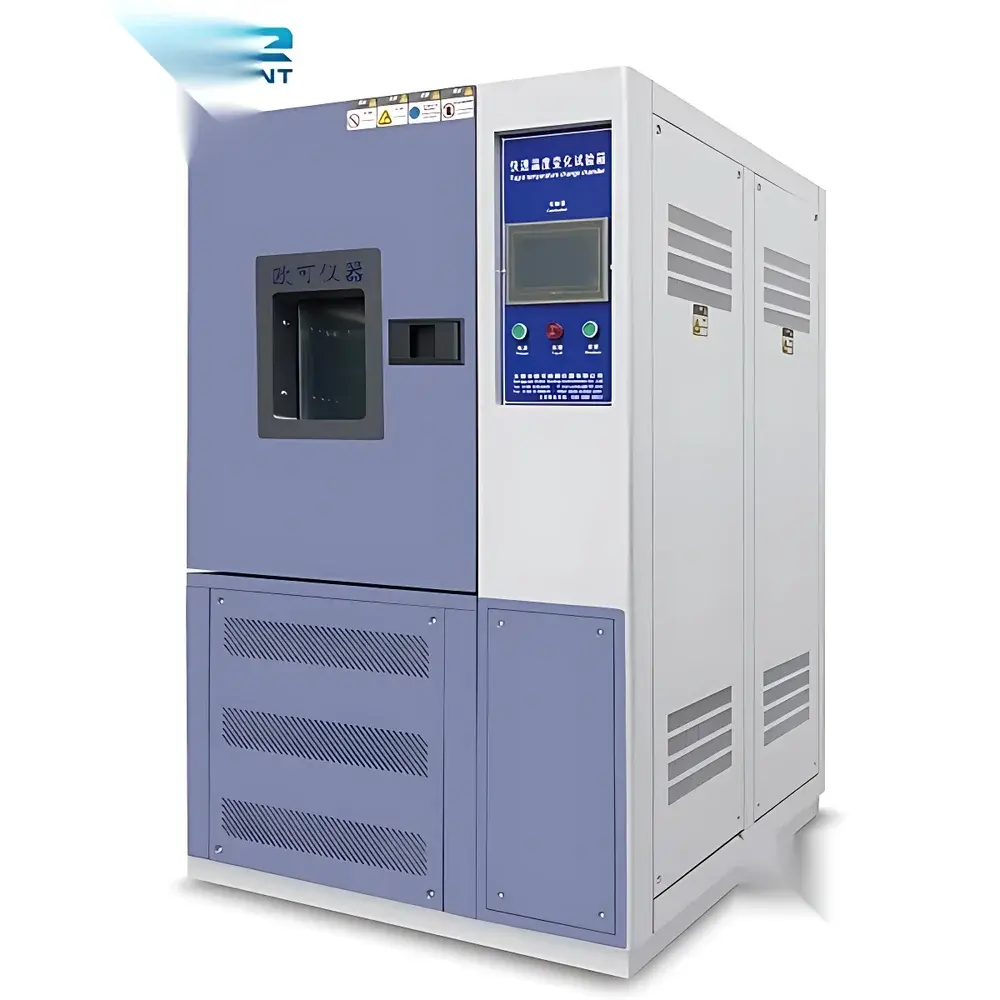
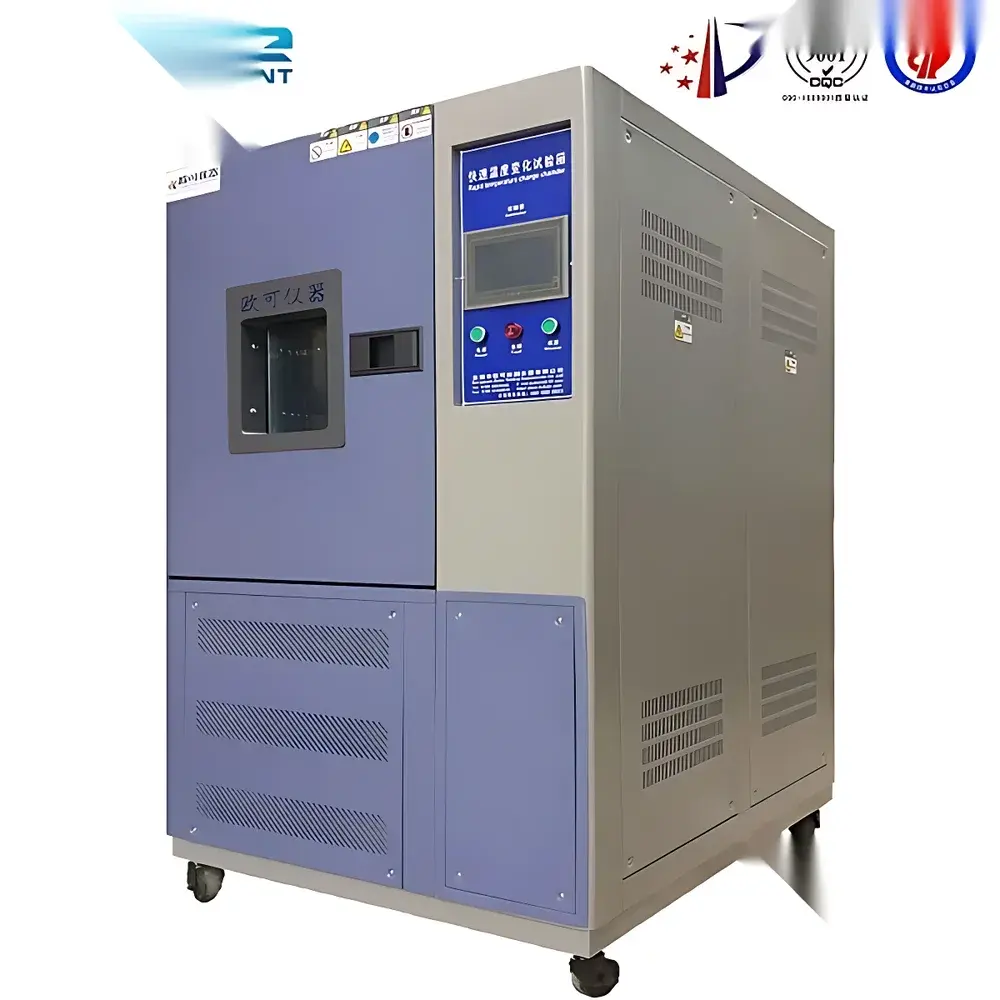
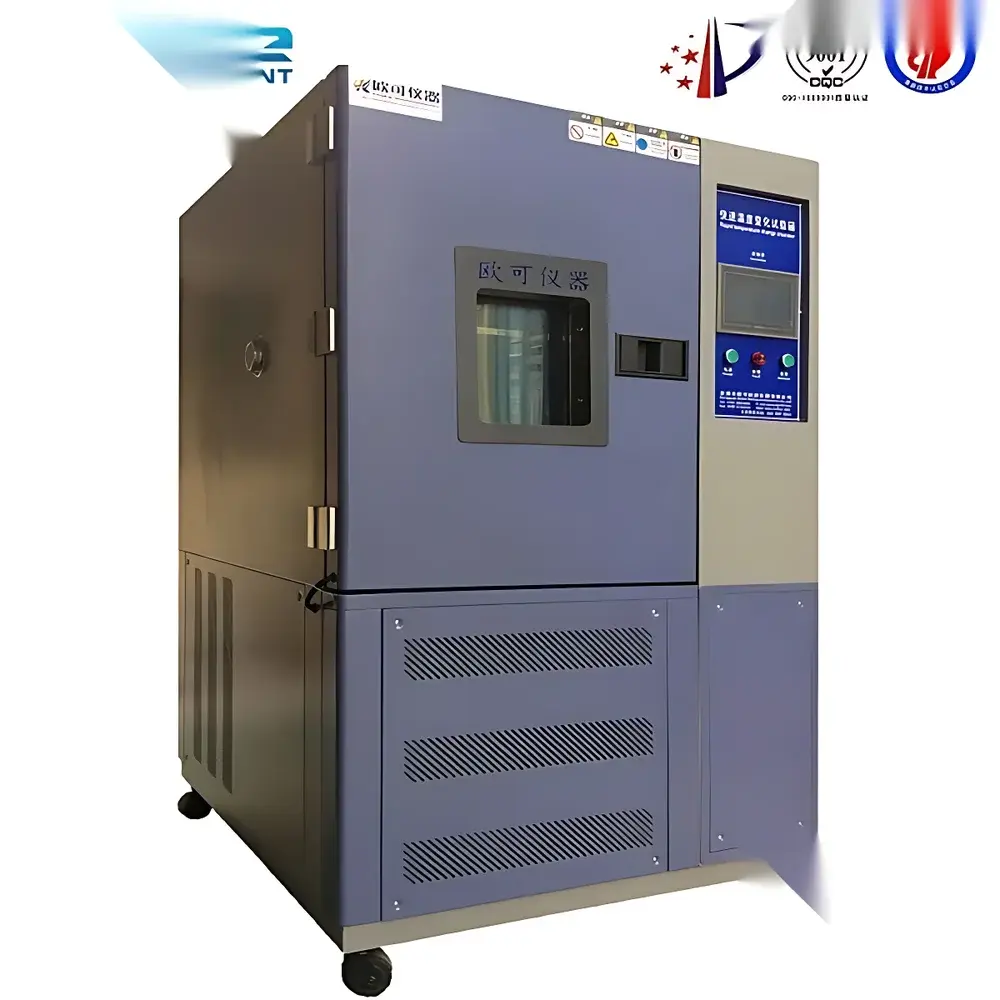
Eurotest QT-30 Rapid Temperature and Humidity Cycling Chamber
| Brand | Eurotest |
|---|---|
| Internal Dimensions (W×H×D) | 300 × 300 × 300 mm |
| External Dimensions (W×H×D) | 1400 × 1870 × 1350 mm |
| Inner Chamber Material | SUS#304 Stainless Steel |
| Outer Cabinet Finish | Textured Steel with Powder Coating |
| High-Temp Zone Insulation | Ceramic Fiber (Alumina-Silica) |
| Low-Temp Zone Insulation | High-Density Polyurethane Foam |
| Heating Capacity | 3.5 kW (High-Temp Zone) |
| Cooling Capacity | 2.5 kW (Low-Temp Zone) |
| Circulation Motor | 90 W, Single-Phase |
| Fan Type | Multi-blade Sirocco Fan with Stainless Steel Extended Shaft |
| Control Method | PID-controlled SSR for BTC (Balance Temperature Control) |
| Compliance | Designed per IEC 60068-2-14, IEC 60068-2-30, and ASTM D4332 environmental conditioning standards |
Overview
The Eurotest QT-30 Rapid Temperature and Humidity Cycling Chamber is an engineered environmental stress test system designed to accelerate aging and evaluate material reliability under extreme thermal and hygrothermal cycling conditions. It operates on a dual-chamber, basket-transfer principle—featuring physically separated high-temperature and low-temperature zones, each thermally insulated and independently controlled. A motorized stainless steel transfer basket rapidly shuttles test specimens between zones in ≤5 seconds, enabling temperature transition rates up to 15 °C/min (typical, measured at specimen center). Integrated humidity control (10–98% RH, ±2% RH accuracy) is achieved via steam injection and precision dehumidification, synchronized with thermal cycling to replicate real-world degradation mechanisms such as condensation-induced corrosion, polymer hydrolysis, and interfacial delamination. The chamber employs Balance Temperature Control (BTC), a closed-loop thermal management strategy where PID-regulated solid-state relays dynamically match heater output to instantaneous heat loss—ensuring long-term thermal stability (<±0.3 °C fluctuation) without overshoot or drift.
Key Features
- Dual-zone architecture with independent high-temp (up to +150 °C) and low-temp (down to −70 °C) chambers, minimizing cross-contamination and thermal inertia
- Stainless steel (SUS#304) inner chamber with seamless welding and electropolished finish for corrosion resistance and cleanroom-compatible operation
- Ceramic fiber insulation in the high-temp zone and high-density polyurethane foam in the low-temp zone ensure optimal thermal retention and energy efficiency
- Forced-air circulation via a 90 W Sirocco fan with stainless steel extended shaft and aerodynamically optimized multi-wing blades—delivering uniform airflow distribution (±1.0 °C spatial uniformity per IEC 60068-3-5)
- PID-based SSR control system with BTC algorithm enables stable, repeatable setpoint maintenance over extended test durations (72+ hours)
- Comprehensive safety architecture including over-temperature cut-off, refrigerant pressure monitoring, door interlock, and leak-detection circuitry for steam/humidity subsystems
Sample Compatibility & Compliance
The QT-30 accommodates samples up to 27 L volume (300 × 300 × 300 mm internal cavity) and supports standard test fixtures for PCB assemblies, automotive connectors, battery modules, medical device housings, and polymer packaging. Its operational envelope meets the thermal ramping and dwell requirements of IEC 60068-2-14 (change of temperature), IEC 60068-2-30 (damp heat, cyclic), and ASTM D4332 (conditioning containers prior to testing). All control firmware and data logging functions are structured to support GLP/GMP-aligned validation protocols—including IQ/OQ documentation templates, calibration traceability to NIST standards, and audit-ready event logs. While not FDA-certified as a standalone system, its architecture conforms to foundational requirements of 21 CFR Part 11 for electronic records when deployed with compliant software extensions.
Software & Data Management
The QT-30 integrates with Eurotest’s ETS-Link™ control suite (Windows-based, optional Ethernet/RS-485 interface), offering programmable multi-step profiles with up to 99 segments, real-time graphing of chamber temperature/humidity vs. time, and automatic generation of CSV-formatted test reports. Data integrity safeguards include write-protected storage, timestamped parameter changes, and user-level access controls (admin/operator/guest). Optional cloud-enabled telemetry allows remote monitoring and alarm notification via SMTP/SNMP. All logged data retains full metadata—operator ID, calibration status of sensors, ambient lab conditions, and firmware revision—supporting ISO/IEC 17025-compliant laboratory reporting workflows.
Applications
This chamber is routinely deployed in R&D labs and quality assurance departments for accelerated life testing of electronics (e.g., solder joint fatigue assessment per JEDEC JESD22-A104), qualification of aerospace composites (per MIL-STD-810H Method 503.6), validation of sterile barrier systems (ISO 11607-1), and durability screening of consumer appliance components. Its rapid cycling capability makes it especially valuable for identifying latent defects related to coefficient-of-thermal-expansion (CTE) mismatch, moisture diffusion kinetics, and phase-change-induced microcracking in multilayer structures.
FAQ
What is the typical temperature transition time between hot and cold zones?
Measured at specimen center, average transfer-to-stabilization time is ≤15 seconds for a −40 °C to +85 °C transition, and ≤20 seconds for +85 °C to −40 °C, per IEC 60068-2-14 Annex B.
Can the QT-30 perform non-cyclic humidity-only tests?
Yes—the humidity subsystem operates independently of thermal cycling; constant-humidity holds (10–98% RH) are fully programmable at any stable temperature setpoint.
Is third-party calibration certification available?
Eurotest provides factory calibration certificates traceable to national metrology institutes; optional UKAS-accredited calibration services are available through authorized partners.
What maintenance intervals are recommended for long-term reliability?
Compressor oil and refrigerant filter replacement every 24 months; steam generator descaling every 3 months under continuous RH operation; annual verification of PID tuning parameters and sensor linearity.
Does the system support custom test profile import via CSV or Excel?
Yes—ETS-Link™ accepts standardized CSV profile templates with columns for segment type, target T/RH, ramp rate, dwell time, and alarm thresholds.



