
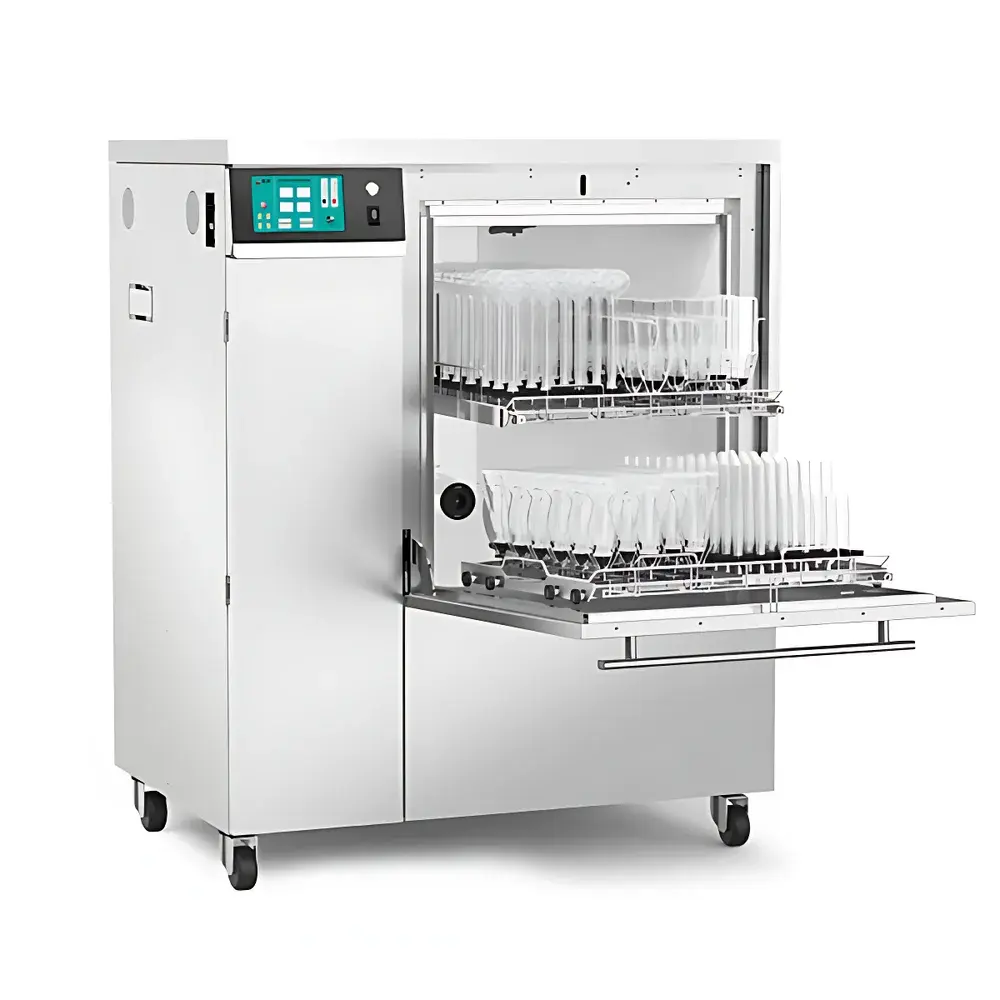
EURPING Q750D Laboratory Bottle Washer
| Brand | EURPING |
|---|---|
| Origin | Tianjin, China |
| Manufacturer Type | OEM/ODM Manufacturer |
| Product Origin | Domestic (China) |
| Model | Q750D |
| Chamber Volume | 223 L |
| Heating Power | 9 kW |
| Maximum Wash Temperature | 95 °C |
| Compatible Detergent Types | Acidic and Alkaline Solutions |
| External Dimensions (L×W×H) | 1015 × 760 × 1265 mm ±20 mm |
| Power Supply | 220 V, 50 Hz |
| Total Rated Power | 5 kW |
| Wash Cycle Data Logging | Yes, with full audit trail |
| Compliance | Designed for GLP/GMP environments |
Overview
The EURPING Q750D Laboratory Bottle Washer is an engineered solution for fully automated cleaning, thermal disinfection, and HEPA-filtered drying of precision glassware and plastic labware in regulated research, quality control, and clinical laboratory settings. It operates on a closed-loop, programmable aqueous cleaning principle—utilizing precisely controlled temperature, pressure, flow dynamics, and chemical compatibility to remove organic residues, particulates, and bioburden from complex geometries including volumetric flasks, pipettes, test tubes, Erlenmeyer flasks, beakers, graduated cylinders, wide-mouth bottles, and narrow-neck containers. Its 223 L monolithic chamber—formed via seamless deep-drawn 316L stainless steel molding—eliminates weld seams that could harbor contaminants or compromise cleanability, meeting stringent ISO 15195 and CLSI GP38 requirements for critical cleaning validation. The system integrates hardware-level process monitoring and software-defined traceability to support compliance with ISO 13485, ISO 9001, and EU GMP Annex 15 cleaning validation frameworks.
Key Features
- Monolithic 223 L wash chamber constructed from electropolished 316L stainless steel with zero internal welds; outer casing in 304 stainless steel for structural integrity and corrosion resistance.
- Dual independent circulation system: primary pump supplies high-velocity flow directly to the FL-EXCH modular basket rack; secondary pump drives upper and lower rotating spray arms—enabling independent flow modulation (0–600 L/min) and eliminating hydraulic imbalance inherent in single-pump architectures.
- 7-inch industrial-grade capacitive touchscreen interface with embedded microcontroller; preloaded with 30 validated standard cycles (e.g., ASTM D2247 for residue removal, USP for analytical instrument cleaning) and 120 customizable protocols.
- Three-tier user permission architecture with fingerprint biometric authentication and SD-card-based audit trail logging compliant with FDA 21 CFR Part 11 requirements for electronic records and signatures.
- Back-mounted water delivery system with real-time FL-EXCH basket recognition—ensuring correct rack configuration before cycle initiation and preventing misalignment-related wash failures.
- HEPA-filtered compressed-air drying system delivering ≥110 m³/h of heated air at vacuum pressure up to 110 mbar; direct injection through rack nozzles ensures complete internal and external desiccation of glassware (adjustable 20–120 °C, 0–300 min).
- Integrated dual-stage heat exchange (EU-W condensation technology) cools residual steam prior to final rinse and enables automatic condensate drainage—reducing water consumption by up to 35% versus conventional systems.
Sample Compatibility & Compliance
The Q750D accommodates a broad spectrum of laboratory vessels: Class A volumetric flasks (up to 2 L), serological and volumetric pipettes (0.1–100 mL), culture tubes (12–50 mm OD), conical flasks (50–2000 mL), borosilicate beakers (25–1000 mL), graduated cylinders (10–1000 mL), and narrow-neck reagent bottles (minimum ID: 8 mm). All cleaning cycles are designed to preserve calibration integrity and surface finish—validated per ISO 8573-1 for compressed air purity and ISO 14644-1 Class 5 during drying. The system conforms to IEC 61000-6-2/6-4 electromagnetic compatibility standards and carries CE marking under the EU Machinery Directive 2006/42/EC and Low Voltage Directive 2014/35/EU. Optional IQ/OQ documentation packages are available for GxP installation and operational qualification.
Software & Data Management
The embedded control firmware records timestamped operational metadata—including inlet water conductivity, detergent dosing volume, real-time pressure (±0.02 bar), spray arm rotational speed (±1 rpm), chamber temperature (±0.3 °C), and individual component runtime—for every cycle. All logs are stored on removable SD cards with SHA-256 hash verification and write-protection switches. The system supports configurable data export formats (CSV, PDF, XML) compatible with LIMS integration. Audit trails include operator ID, parameter modifications, alarm events, and emergency stop triggers—retained for ≥36 months as required under GLP Principle 5. Remote diagnostics via optional Ethernet module enable predictive maintenance alerts based on pump duty-cycle degradation or filter differential pressure thresholds.
Applications
- Pharmaceutical QC labs performing residual solvent analysis (ICH Q5C) and cleaning verification per PDA Technical Report No. 29.
- Clinical microbiology units requiring thermally validated decontamination of reusable culture media containers.
- Environmental testing laboratories processing EPA Method 500-series sample vials and autosampler vials under ISO/IEC 17025 accreditation.
- Academic core facilities supporting high-throughput proteomics workflows where carryover-free pipette tip and LC vial cleaning is mandatory.
- Biotech R&D labs validating cleaning processes for single-use bioreactor accessories and chromatography column housings.
FAQ
Does the Q750D support validation documentation for GMP environments?
Yes—EURPING provides IQ/OQ protocol templates, calibration certificates for all sensors (PT100, pressure transducers, flow meters), and cycle development reports aligned with ASTM E2996 and ISO 15883-1.
Can the system operate with deionized water only, without detergent?
Yes—the control software allows detergent-free ultrasonic-assisted rinsing cycles; however, thermal disinfection efficacy at 95 °C requires alkaline detergent for optimal endotoxin reduction per USP .
What is the expected service life of the 316L chamber under daily use?
Based on accelerated corrosion testing per ASTM G48, the chamber maintains structural integrity and surface passivation for ≥15 years at 8 cycles/day with pH 10–12 alkaline detergents.
Is remote monitoring capability built-in or optional?
Ethernet connectivity and Modbus TCP interface are standard; cloud-based fleet monitoring and email/SMS alerting require optional EURPING Connect gateway module.
How does the FL-EXCH basket system ensure repeatable positioning for automated loading?
Each FL-EXCH module features embedded RFID tags read by proximity sensors during insertion—verifying orientation, load capacity, and compatibility with selected wash programs before cycle start.



