
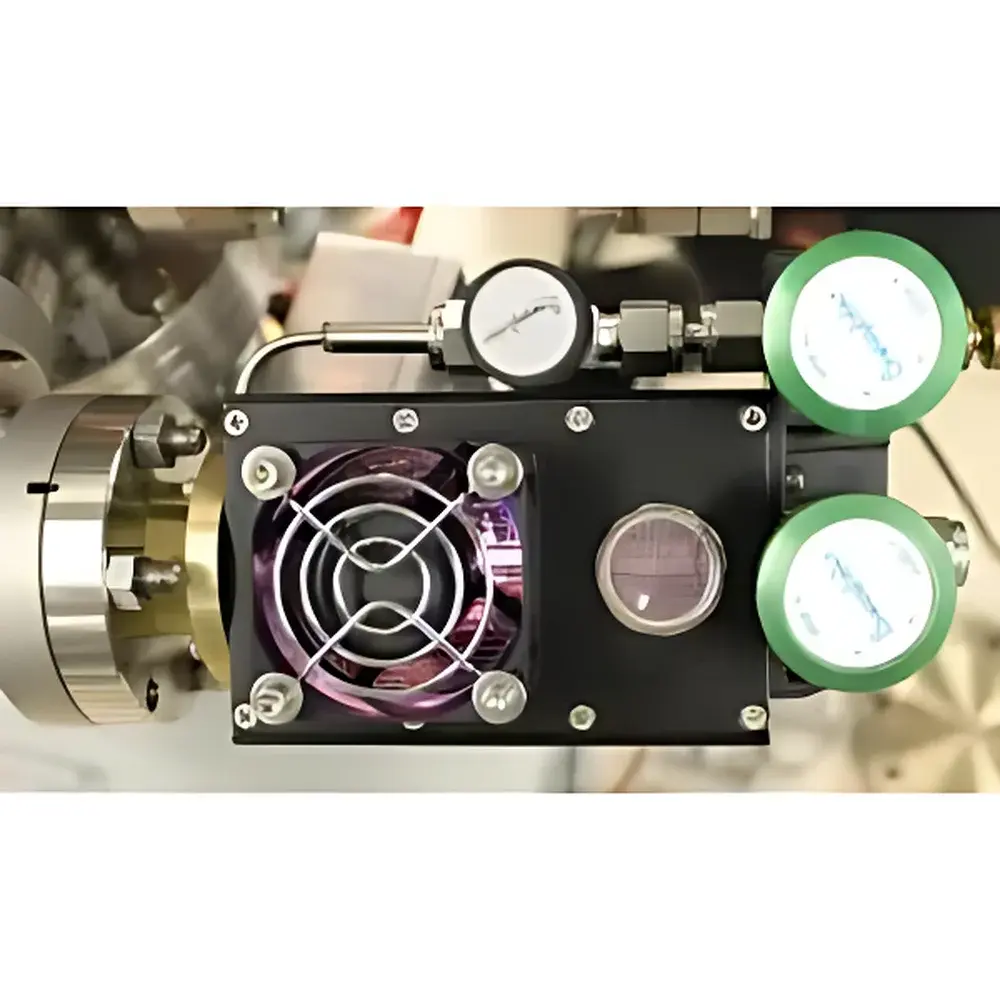
EUVlamp Portable Extreme Ultraviolet Light Source
| Origin | Canada |
|---|---|
| Manufacturer Type | Distributor |
| Origin Category | Imported |
| Model | EUVlamp |
| Price Range | USD 4,200–7,000 (FOB) |
| Optical Configuration | Single-Beam |
| Detector Type | CCD-Based Photoreceiver |
| Wavelength Range | 24–800 nm |
| Wavelength Adjustment | Manual |
| Spectral Bandwidth | <56 nm |
| Wavelength Accuracy | ±1 nm |
| Stray Light | ≤0.01% T |
Overview
The EUVlamp is a compact, high-brightness extreme ultraviolet (EUV) light source engineered for laboratory-scale spectroscopic and photoelectron studies requiring stable, narrow-band emission below 100 nm. Unlike conventional deuterium or xenon arc lamps, the EUVlamp leverages a micro-discharge plasma architecture optimized for efficient photon generation in the 24–100 nm spectral region—encompassing key absorption edges of carbon (4.4 nm), oxygen (2.3 nm), nitrogen (2.9 nm), and silicon (9.5 nm). Its operation is based on pulsed or continuous low-pressure gas discharge (typically He, Ne, or Ar), producing line-dominated spectra with peak radiant intensity exceeding 1×10¹⁵ photons/sec/ster at primary emission lines. The source is designed for integration into vacuum-compatible optical benches (UHV-rated to 1×10⁻⁷ mbar), supporting both direct illumination and coupling with monochromators for tunable output.
Key Features
- High-radiance EUV output: Primary spectral lines deliver >1×10¹⁵ photons/sec/ster under standard operating conditions, enabling signal-to-noise ratios suitable for time-resolved photoemission and absorption measurements.
- Extended spectral coverage: Continuous usable range from 24 nm (soft X-ray/EUV boundary) to 800 nm (visible), facilitating cross-regime calibration and broadband reference applications.
- Vacuum-compatible mechanical design: Entire housing constructed from non-magnetic, low-outgassing stainless steel; mass <1 mg (excluding baseplate and feedthroughs), enabling integration into compact end-stations and portable beamlines.
- Monochromator-ready interface: Standardized 25.4 mm (1″) flange with kinematic alignment pins allows direct mounting to grating-based monochromators (e.g., McPherson, Horiba iHR series) for wavelength selection down to ±0.2 nm resolution.
- Low stray light performance: Optical path engineered with multi-stage baffling and reflective coatings optimized for EUV rejection; measured stray light ≤0.01% T at 50 nm when used with calibrated photodiodes traceable to NIST SRM 2065.
- Manual wavelength selection via precision micrometer-driven filter wheel (optional): Supports discrete bandpass filtering using MgF₂, LiF, or CaF₂ substrates for fixed-wavelength experiments.
Sample Compatibility & Compliance
The EUVlamp is compatible with solid, liquid, and gaseous samples housed in UHV chambers, environmental cells, or ambient-pressure flow cells (when coupled with differential pumping stages). It meets ISO 17025-relevant optical stability requirements for calibration laboratories performing spectral irradiance validation. The device complies with IEC 61000-6-3 (EMC emissions) and IEC 61010-1 (safety for laboratory equipment). While not intrinsically certified for GMP environments, its hardware-level audit trail capability (via optional TTL-synchronized pulse logging) supports 21 CFR Part 11-compliant data acquisition when integrated with validated third-party DAQ systems.
Software & Data Management
No embedded firmware or proprietary GUI is included; the EUVlamp operates as a hardware-level light source requiring external control. Integration is supported via analog voltage input (0–10 V) for intensity modulation and TTL triggers (5 V CMOS) for pulse synchronization. Output intensity drift is monitored using an integrated Si photodiode (calibrated against NIST-traceable standards), with raw signals routed to user-supplied ADC modules. All calibration certificates—including spectral irradiance curves, wavelength accuracy verification reports, and stray light characterization—are provided in machine-readable CSV and PDF formats compliant with ASTM E275 and ISO/IEC 17025 documentation requirements.
Applications
- Photoelectron spectroscopy (PES) and angle-resolved PES (ARPES) source for lab-based surface electronic structure mapping.
- Calibration reference for EUV optics metrology, including reflectivity testing of Mo/Si multilayer mirrors and zone plates.
- Time-resolved transient absorption spectroscopy of ultrafast carrier dynamics in 2D materials (e.g., graphene, transition metal dichalcogenides).
- Ionization efficiency studies in atmospheric chemistry simulators and plasma diagnostics.
- Biochemical photolysis experiments targeting peptide bond cleavage thresholds (<30 nm) and DNA photodamage modeling.
- Validation of synchrotron beamline monochromator throughput during commissioning and maintenance cycles.
FAQ
Is the EUVlamp compatible with ultra-high vacuum (UHV) systems?
Yes—the source is bakeable to 150 °C and rated for continuous operation at pressures ≤1×10⁻⁷ mbar. All internal components are vacuum-compatible, and electrical feedthroughs meet ConFlat (CF) 16 or CF 25 standards.
Can the output be modulated for lock-in detection?
Yes—intensity can be modulated via analog voltage input (0–10 V, linear response) up to 1 kHz; TTL pulse triggering supports gated acquisition with jitter <50 ns.
What calibration documentation is supplied?
Each unit ships with NIST-traceable spectral irradiance data (24–800 nm), wavelength accuracy report (±1 nm, verified with calibrated spectrometer), and stray light characterization (≤0.01% T at 50 nm, measured per ASTM E387).
Does it require water cooling or external power supplies?
No—it operates from a single 24 V DC input (max 3 A) and is air-cooled; no chiller or RF generator is needed.
Is remote software control available?
Not natively—the EUVlamp is a hardware-only source. Full remote control requires integration with third-party motion controllers (e.g., Thorlabs KDC101) and DAQ platforms (e.g., National Instruments PXIe-6363) using provided analog/TTL interfaces.






