
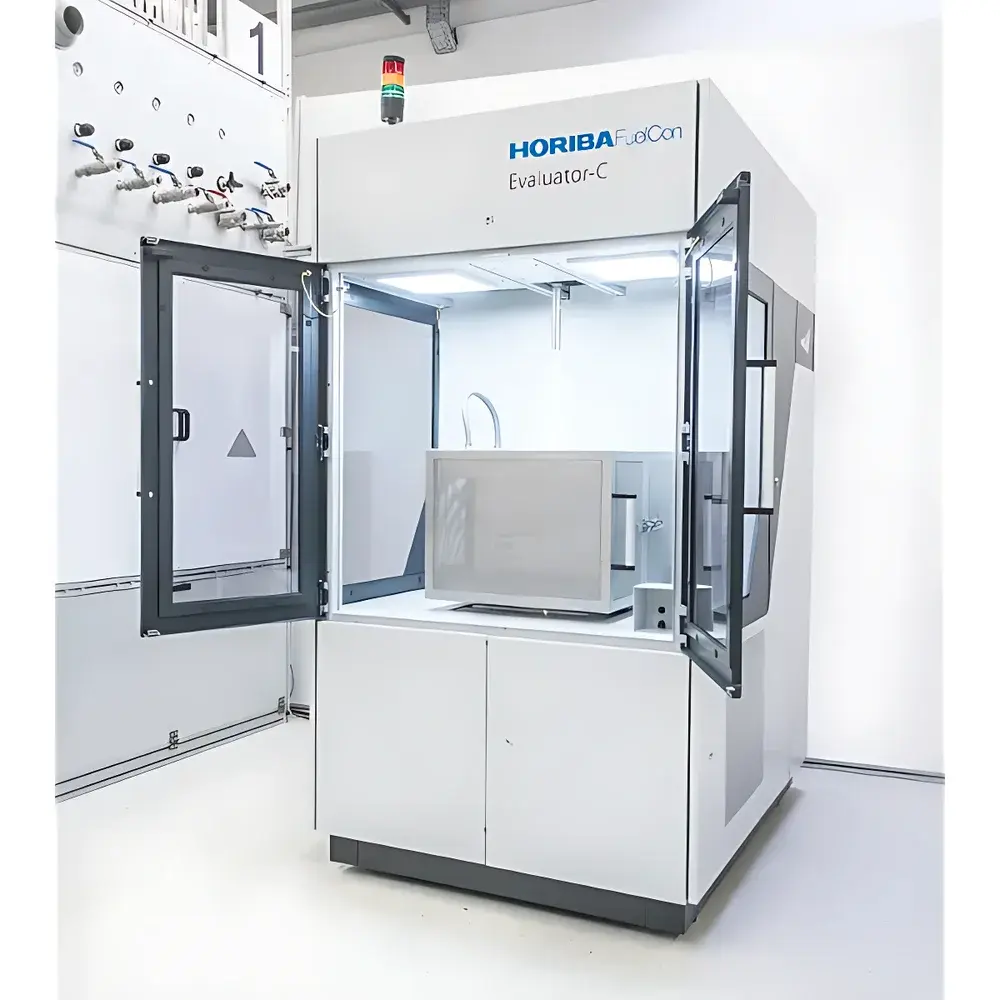
Evaluator HT Series SOFC/SOEC Testing & Sintering-Reduction Station
| Brand | HORIBA |
|---|---|
| Origin | Germany |
| Manufacturer Type | Manufacturer |
| Origin Category | Imported |
| Model | Evaluator HT Series |
| Pricing | Upon Request |
Overview
The Evaluator HT Series SOFC/SOEC Testing & Sintering-Reduction Station is a fully integrated, high-temperature electrochemical platform engineered for rigorous research, development, and manufacturing support of solid oxide fuel cells (SOFCs) and solid oxide electrolysis cells (SOECs). Built on a modular, dual-purpose architecture, it simultaneously serves two critical functions: (1) dynamic electrochemical performance evaluation—including polarization curve acquisition, impedance spectroscopy (EIS), load cycling, and long-term durability testing—and (2) controlled-atmosphere sintering and reduction of multi-cell stacks under precisely regulated thermal, mechanical, and gas-composition conditions. The system operates across a continuous power range from 300 W to 50 kW, enabling scalability from single-cell R&D to full-stack qualification and pilot-line production validation. Its core measurement principles include galvanostatic/potentiostatic control, four-wire voltage monitoring per cell (CVM), real-time gas composition analysis (via optional integrated GC or mass spectrometry interfaces), and in-situ thermal profiling using embedded thermocouple arrays.
Key Features
- Dual-mode operational flexibility: seamless transition between fuel cell (power generation) and electrolysis (H₂/O₂ production) modes without hardware reconfiguration
- Multi-zone programmable furnace with independent PID loops—ensuring ±1.5 °C uniformity across active stack height (up to 600 mm)
- High-precision steam delivery system with gravimetric vaporizer and inline humidity sensor (±0.5% RH accuracy), enabling precise H₂O partial pressure control for SOEC operation
- Electro-mechanical compression system delivering up to 40 kN axial force with closed-loop displacement feedback and load-rate programmability (0.1–10 kN/min)
- Integrated safety architecture: redundant overtemperature cutoffs, gas leak detection (H₂, CH₄, CO), emergency purge sequencing, and fail-safe valve interlocks compliant with IEC 61508 SIL2
- Modular gas conditioning train: configurable reformer modules for natural gas (NG) or biomass-derived syngas, sulfur-tolerant guard beds (<10 ppb breakthrough), and synthetic fuel gas blending capability
Sample Compatibility & Compliance
The Evaluator HT accommodates planar and tubular SOFC/SOEC configurations—including anode-supported, electrolyte-supported, and metal-supported cells—as well as full short-stacks (up to 16 cells per fixture) and sealed hot-box assemblies. It supports standardized test protocols aligned with ISO 14687 (hydrogen purity), ASTM D7892 (fuel cell durability), and IEC 62282-2 (performance testing of SOFC modules). All electrical, thermal, and gas interfaces comply with EN 61000-6-4 (EMC emissions) and EN 61000-6-2 (immunity). Data integrity and audit readiness are ensured via built-in 21 CFR Part 11–compliant electronic signatures, ALCOA+ data handling, and GLP/GMP-aligned metadata tagging (e.g., operator ID, calibration timestamp, environmental log).
Software & Data Management
Control and analysis are managed through HORIBA’s proprietary Evaluator Control Suite (v5.x), a deterministic real-time OS-based application supporting synchronized acquisition at up to 100 Hz across >200 channels (voltage, current, T, P, flow, gas composition). The software provides automated test sequence scripting (IEC 61131-3 Structured Text compatible), live Nyquist/Bode visualization, degradation trend modeling (voltage decay rate, ASR drift), and export to HDF5/CSV/Excel formats. For Industry 4.0 integration, native MQTT and OPC UA servers enable bidirectional communication with MES/SCADA platforms—supporting traceability of sintering cycles, stack build records, and qualification reports per lot number.
Applications
- Single-cell parametric studies: electrode kinetics, interfacial resistance mapping, redox cycling stability
- Stack-level system integration: thermal management validation, gas distribution uniformity assessment, bypass flow quantification
- Manufacturing process development: sintering profile optimization (heating/cooling ramp rates, dwell times, atmosphere transitions), reduction kinetics modeling, sealant curing verification
- Certification testing: UL 1973, CE conformity, and customer-specific acceptance criteria (e.g., 5,000-hr accelerated life testing with <5% voltage degradation)
- Hydrogen infrastructure R&D: co-electrolysis (CO₂ + H₂O), dynamic load-following under grid-balancing scenarios, transient response to renewable intermittency
FAQ
Can the Evaluator HT perform both SOFC and SOEC testing within the same experimental run?
Yes—hardware and firmware support real-time mode switching between galvanic and electrolytic operation without venting or cooldown.
What is the maximum stack height and cell count supported in sintering-reduction mode?
Standard fixtures accommodate stacks up to 400 mm tall; up to 16 cells can be processed simultaneously in batch configuration.
Is third-party gas analyzer integration supported?
Yes—RS-485, analog 4–20 mA, and Modbus TCP interfaces are provided for seamless connection to FTIR, GC-TCD, or QMS systems.
Does the system meet explosion-proof requirements for hydrogen-rich environments?
The gas-handling cabinet is certified ATEX Zone 2 / IECEx Zone 2 (II 2G Ex db IIB T3 Gb) with intrinsically safe signal wiring throughout.
Can custom sintering recipes be saved and reused across multiple users?
Yes—all thermal, pressure, gas flow, and mechanical load profiles are stored as version-controlled XML templates with user access permissions and change history logging.





