
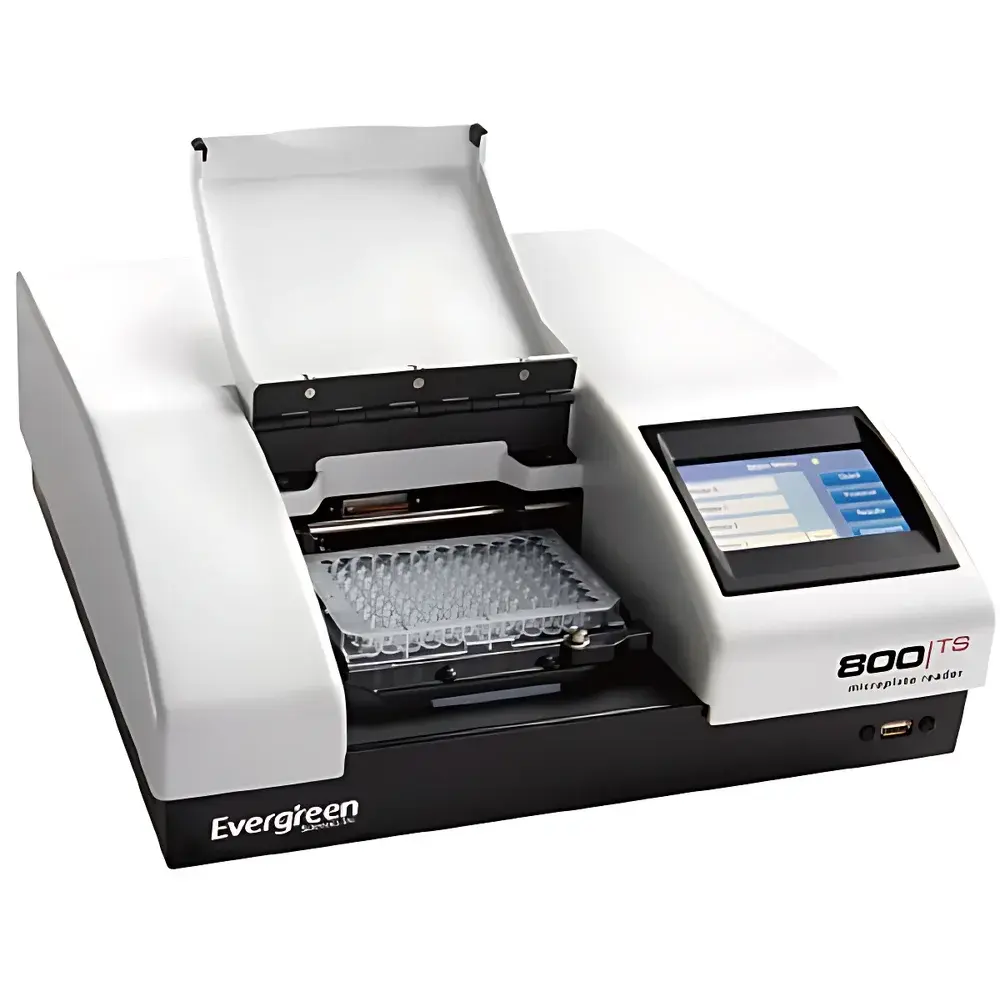
Evergreen 00000 Advanced Microplate Reader
| Brand | Evergreen |
|---|---|
| Origin | Germany |
| Model | 00000 |
| Function Type | Multimode |
| Automation Level | Fully Automated |
| Detection Method | Absorbance (Photometric) |
| Wavelength Range | 300–750 nm |
| Absorbance Range | 0–4.0 OD |
| Linearity | ±2.5% or ±0.010 OD (whichever is greater) |
| Wavelength Scanning Speed | 400–750 nm |
| Accuracy | ±0.010 OD (0–4.0 OD range) |
| Detection System | 8-Channel Fiber-Optic Array |
| Measurement Time | ≤5 s per 96-well plate |
| Plate Compatibility | Standard 96-well microplates (flat, round, or V-bottom) |
| Software Interface | Windows-based GUI with touch-screen support |
| Data Storage | ≥10,000 assay results and ≥100 user-defined protocols |
| Compliance | Designed for ISO 13485-aligned workflows |
Overview
The Evergreen 00000 Advanced Microplate Reader is a fully automated, absorbance-based photometric instrument engineered for precision, reproducibility, and operational efficiency in clinical diagnostics, pharmaceutical quality control, and academic life science laboratories. Utilizing an 8-channel fiber-optic detection architecture and dual-wavelength scanning capability, it measures optical density (OD) across a broad spectral range (300–750 nm), enabling quantitative analysis of enzyme-linked immunosorbent assays (ELISA), cell viability assays (e.g., MTT, CCK-8), protein quantification (Bradford, BCA), and nucleic acid concentration determination. Its core photometric design adheres to the Beer–Lambert principle, ensuring linear response within the validated 0–4.0 OD dynamic range. The system integrates hardware-level auto-centering of microplate wells—critical for minimizing positional variability—and features real-time self-diagnostic routines for optical path integrity, motorized stage alignment, and lamp stability monitoring.
Key Features
- Fully automated operation with intuitive Windows-based graphical user interface (GUI), optimized for touch-screen interaction and glove-compatible use in biosafety cabinets or cleanroom environments.
- High-throughput 96-well plate reading completed in ≤5 seconds using parallel 8-channel fiber-optic detection—eliminating sequential well-by-well scanning delays.
- Precision well-centering algorithm ensures consistent illumination and collection geometry across all wells, reducing inter-well coefficient of variation (CV) to <1.5% at 1.0 OD.
- Configurable vibration module with adjustable amplitude and duration (0–60 s), facilitating uniform mixing of stop solutions or substrate reagents prior to endpoint measurement.
- Intelligent light-source management system automatically powers the tungsten-halogen lamp only during measurement cycles, extending operational lifetime beyond 2,000 hours.
- Onboard storage capacity supports ≥100 customizable assay protocols and ≥10,000 result records, with timestamped metadata including operator ID, plate barcode, and environmental conditions (if integrated with external sensors).
Sample Compatibility & Compliance
The Evergreen 00000 accepts standard ANSI/SLAS-compliant 96-well microplates—including flat-bottom (cell culture), round-bottom (suspension assays), and V-bottom (sample storage)—with optional adapters for 384-well formats. It accommodates opaque, clear, and UV-transparent polystyrene and polypropylene plates. All firmware and software modules are developed under traceable version control aligned with ISO 13485:2016 principles for in vitro diagnostic (IVD) device manufacturers. While not FDA-cleared as an IVD device itself, the platform supports 21 CFR Part 11-compliant data handling when deployed with validated third-party LIMS or ELN systems. Built-in QC tools—including Levey-Jennings charting, Westgard multirule analysis, and “immediate” single-run statistical assessment—enable laboratories to meet CLIA, CAP, and ISO 15189 internal quality assurance mandates.
Software & Data Management
The embedded software provides native support for 12 distinct curve-fitting algorithms (linear, logarithmic, exponential, power, polynomial, sigmoidal 4PL/5PL), threshold-based classification, and multi-parameter result derivation per well. Raw OD values are stored with full audit trail: every modification, calibration event, or protocol edit is time-stamped and attributed to a unique user account. Export options include CSV, Excel (.xlsx), PDF report templates (customizable with institutional headers), and HL7-compatible structured output for integration into hospital information systems (HIS) or enterprise laboratory information systems (LIS). All data exports retain original acquisition metadata—wavelength settings, gain factor, read mode (kinetic/static), and plate map configuration—to ensure analytical traceability.
Applications
This reader serves as a primary endpoint detection platform in regulated and research-grade applications: ELISA quantification for infectious disease serology (e.g., anti-HIV, HBsAg); cytotoxicity screening in drug discovery pipelines; kinetic monitoring of β-galactosidase or horseradish peroxidase (HRP) activity; colorimetric detection of ATP levels (CellTiter-Glo®-compatible protocols); and high-volume IgG titer verification in bioprocess development. Its linearity performance (±2.5% or ±0.010 OD) meets ASTM E275 and ISO 10993-12 validation benchmarks for optical density instrumentation used in medical device biocompatibility testing.
FAQ
Does the Evergreen 00000 support kinetic measurements?
No—it is configured exclusively for endpoint absorbance readings. Kinetic or time-resolved modes are not implemented in this model.
Can the instrument be integrated with a Laboratory Information Management System (LIMS)?
Yes, via configurable RS-232, USB, or Ethernet interfaces using ASCII-based command protocols and delimited text export formats compatible with common LIMS ingestion modules.
Is wavelength calibration traceable to NIST standards?
Factory calibration uses certified neutral-density filters and holmium oxide reference standards; users may perform verification with optional NIST-traceable calibration kits (sold separately).
What maintenance is required for long-term accuracy?
Annual optical path verification and lamp intensity profiling are recommended; no routine alignment or mechanical recalibration is needed due to solid-state optical mounting and factory-laser-aligned mechanics.
Are software updates provided post-purchase?
Yes—Evergreen offers free firmware and application software upgrades for the first two years following installation, delivered via secure encrypted download portal with version-controlled release notes.



