
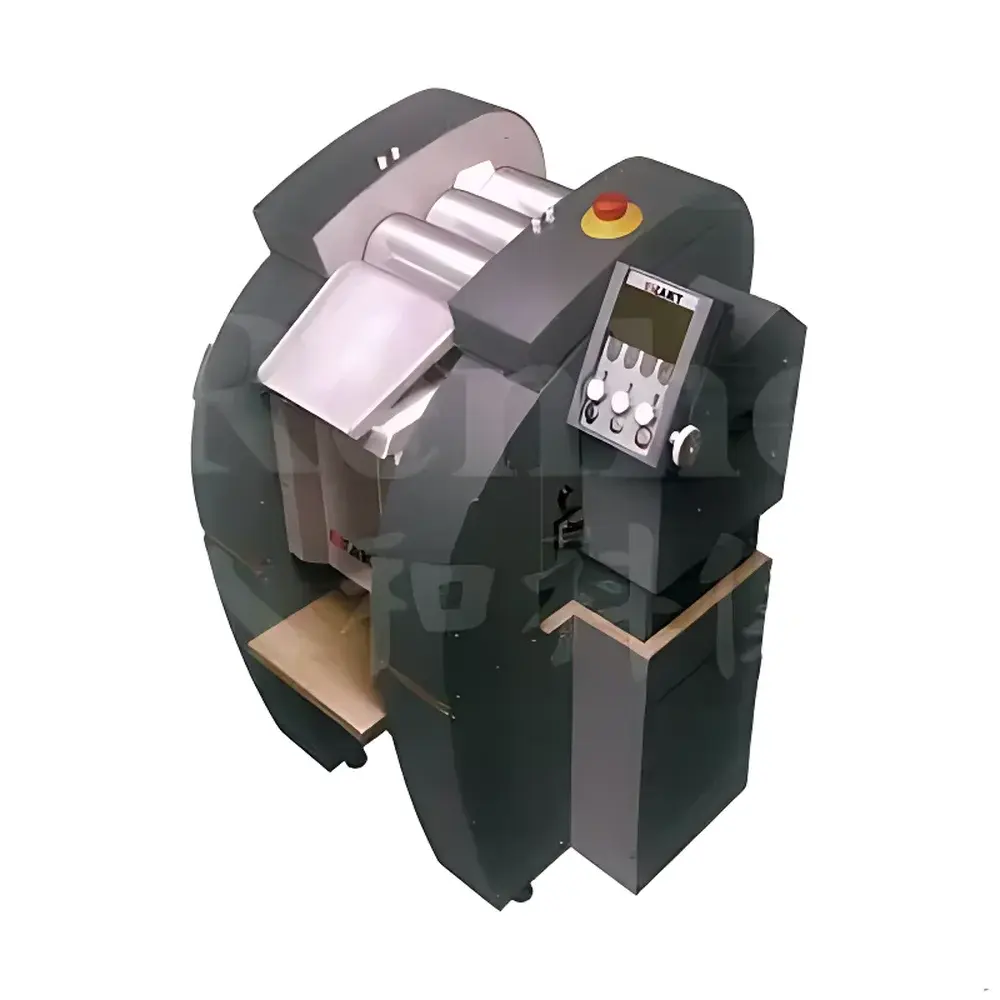
EXAKT 120EH-250 Electronic Control Three-Roll Mill
| Brand | EXAKT |
|---|---|
| Origin | Germany |
| Model | 120EH-250 |
| Roller Diameter | 120 mm |
| Roller Length | 250 mm |
| Speed Ratio (n₁ | n₂:n₃): 9:3:1 |
| Feed Particle Size | 5–180 µm |
| Final Output Particle Size | ≤1 µm |
| Throughput Capacity | 0.5–30 L/h |
| Roller Material Options | Hard-chrome-plated stainless steel / Alumina / Polished alumina / Zirconia / Silicon carbide |
| Doctor Blade Material Options | Stainless steel / Plastic / Alumina / Zirconia |
| Motor Power | 3.0 kW |
| Max. Roller Temperature | 80 °C (heating/cooling capable) |
| Dimensions (W×D×H, incl. blade & hopper) | 870 × 950 × 1320 mm |
| Weight | 320 kg |
Overview
The EXAKT 120EH-250 is a precision-engineered, electronically controlled three-roll mill designed for laboratory-scale dispersion, homogenization, and particle size reduction of high-viscosity pastes and suspensions. Operating on the principle of shear-induced mechanical attrition between three horizontally aligned, counter-rotating rollers with precisely defined speed ratios (9:3:1), the system generates controlled laminar shear stress fields that deagglomerate particles, break down agglomerates, and achieve uniform distribution within viscous matrices. Unlike conventional batch mills, the 120EH-250 integrates real-time electronic speed regulation, thermal management (±0.5 °C stability from ambient to 80 °C), and programmable process sequencing—enabling reproducible, scalable development workflows in formulation R&D labs across electronics, pharmaceuticals, cosmetics, and advanced ceramics.
Key Features
- Three-roller architecture with adjustable gap control (0–3 mm range) and precision-machined roller surfaces (Ra < 0.05 µm for polished alumina/zirconia variants)
- Electronically synchronized AC servo drives with independent frequency inverters for each roller, ensuring stable speed ratio maintenance under variable load conditions
- Integrated thermal management system: dual-mode (cooling/heating) jacketed rollers with PID-controlled fluid circulation, compatible with water/glycol or silicone oil media
- Safety-certified operational modes including emergency stop (EN ISO 13850 compliant), electronic braking, reversible roller rotation for cleaning, and interlocked safety guard with optical curtain
- Modular construction using corrosion-resistant materials: base frame in welded steel with epoxy-powder coating; optional AlSi5Mg alloy housing for weight-sensitive installations
- Ergonomic feed system with manually adjustable hopper, integrated material dam, and vibration-dampened mounting to minimize feed pulsation
Sample Compatibility & Compliance
The 120EH-250 accommodates a broad spectrum of soft-to-medium consistency materials—including conductive pastes (e.g., Ag, Cu, Ni inorganic inks), dental composites, cosmetic emulsions, food-grade suspensions (e.g., chocolate mass, pigment dispersions), ceramic slurries, and nanomaterial-based adhesives. Its design conforms to EU Machinery Directive 2006/42/EC and carries CE marking. All wetted components meet FDA CFR Title 21 Part 177 requirements for indirect food contact where applicable. Process documentation supports GLP-compliant environments through traceable parameter logging (speed, temperature, time, torque), and optional integration with LIMS via RS485/Modbus RTU or Ethernet/IP protocols.
Software & Data Management
The embedded control unit features a 7-inch TFT touchscreen HMI with intuitive workflow navigation and password-protected user levels (Operator, Technician, Administrator). Predefined process recipes can be stored (up to 99 profiles), each containing multi-step ramp/hold sequences for roller speed, temperature setpoints, and dwell times. All operational data—including real-time torque feedback, thermal deviation alerts, and cycle completion timestamps—are logged internally (SD card) with CSV export capability. Optional PC software enables remote monitoring, statistical process control (SPC) charting, and audit trail generation compliant with 21 CFR Part 11 requirements when paired with digital signature modules.
Applications
- Development of fine-particle electronic inks for screen, gravure, and inkjet printing processes requiring sub-micron dispersion stability
- Formulation optimization of dental restorative composites to ensure filler-matrix interface integrity and mechanical longevity
- Rheological conditioning of cosmetic creams and ointments to eliminate grittiness while preserving active ingredient bioavailability
- Preparation of homogeneous ceramic green tapes and battery electrode slurries with narrow particle size distribution (PSD) and minimized void content
- Scale-down validation of industrial three-roll milling parameters for technology transfer to production-grade EXAKT systems (e.g., 150/300 series)
FAQ
What materials are compatible with the 120EH-250’s roller surfaces?
Hard-chrome-plated stainless steel rollers suit general-purpose applications; alumina and zirconia variants are recommended for abrasive or chemically aggressive formulations.
Can the machine operate continuously for extended periods?
Yes—designed for intermittent R&D use up to 8 hours/day; continuous operation requires optional enhanced cooling package and scheduled maintenance per EXAKT Service Bulletin SB-TRM-2023.
Is the system suitable for GMP-regulated environments?
With validated software configuration, electronic audit trail, and documented IQ/OQ protocols, it meets foundational requirements for Stage 1–2 pharmaceutical process development.
How is cleaning efficiency verified after processing different batches?
The reversible roller function, combined with solvent dosing port compatibility and visual inspection access via hinged safety guards, enables rapid cleaning verification per internal SOPs.
Does EXAKT provide application support for method development?
Yes—application engineers offer remote and on-site technical assistance, including shear rate profiling, residence time distribution analysis, and dispersion efficiency benchmarking against laser diffraction or SEM-based PSD validation.



