
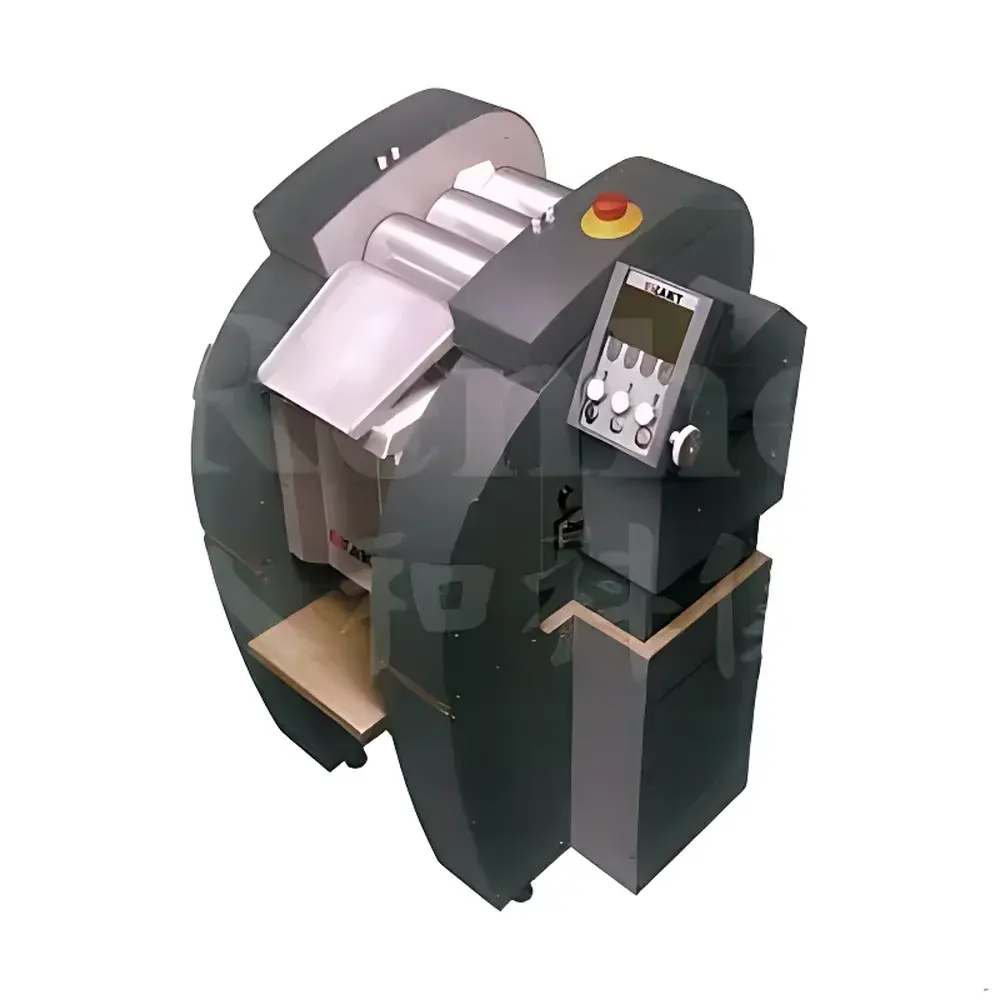
EXAKT 120EH-450 Electronic Control Three-Roll Mill
| Brand | EXAKT |
|---|---|
| Origin | Germany |
| Model | 120EH-450 |
| Instrument Type | Three-Roll Mill |
| Sample Applicability | Soft and semi-viscous materials |
| Feed Particle Size | 5–180 µm |
| Final Output Particle Size | ≤1 µm |
| Throughput Capacity | 1–60 L/h |
| Roller Diameter | 120 mm |
| Roller Length | 450 mm |
| Speed Ratio | 9:3:1 |
| Roller Material | Hard-chrome-plated stainless steel / Alumina / Polished alumina / Silicon carbide |
| Doctor Blade Material | Stainless steel / Plastic / Alumina / Zirconia |
| Drive | Inverter-controlled electronic speed regulation |
| Motor Power | 3 kW |
| Roller Temperature Control | Cooled or heated up to 80 °C |
| Dimensions (W×D×H) | 1070 × 950 × 1320 mm |
| Weight | 390 kg |
Overview
The EXAKT 120EH-450 is a precision-engineered, electronically controlled three-roll mill designed for laboratory-scale dispersion, homogenization, and particle size reduction of soft, paste-like, and highly viscous materials. Operating on the principle of shear-induced mechanical attrition between three horizontally aligned, counter-rotating rolls with precisely defined speed ratios (9:3:1), the system generates high shear gradients across narrow nip gaps—enabling consistent deagglomeration and submicron particle size refinement. Unlike conventional mills relying on fixed mechanical gearing, the 120EH-450 integrates fully programmable inverter-driven motors for independent, real-time speed adjustment of each roll—ensuring reproducible process parameters across batches. Its rigid, torque-resistant frame—fabricated to DIN-compliant mechanical tolerances—minimizes deflection under load, preserving gap stability and surface parallelism critical for uniform shear distribution. The mill is engineered for operation under GLP-compliant workflows and supports integration into regulated environments requiring audit-trail-capable process documentation.
Key Features
- Electronically synchronized triple-roll drive system with independent inverter control per roll, enabling precise speed ratio maintenance (9:3:1) and dynamic adjustment during operation.
- Modular roller configuration: interchangeable roll surfaces—including hard-chrome-plated stainless steel, technical alumina, polished alumina, and silicon carbide—to match material abrasivity and chemical compatibility requirements.
- Advanced multi-function doctor blade assembly featuring self-aligning geometry, damped lateral movement, adjustable attack angle, and tool-free replaceable cutting edges—optimized for consistent material metering and minimal roll wear.
- Thermally managed rolls with integrated fluid channels supporting active cooling or heating (up to 80 °C), facilitating temperature-sensitive formulations and viscosity control during milling.
- Human-centered ergonomics: tilting control panel for operator accessibility; wheeled base with standardized height for seamless integration into fume hoods or containment enclosures; emergency stop button and electronic braking system compliant with EN 60204-1.
- Robust structural architecture meeting ISO 14001 and ISO 9001 manufacturing standards; CE-marked and designed in accordance with Machinery Directive 2006/42/EC.
Sample Compatibility & Compliance
The 120EH-450 is validated for processing soft, non-friable, and cohesive materials—including polymer pastes, pigment dispersions, battery electrode slurries, pharmaceutical ointments, and cosmetic bases—where preservation of rheological integrity and avoidance of thermal degradation are essential. It accepts feed particles ranging from 5 to 180 µm and consistently delivers final dispersions with D90 ≤ 1 µm, verified via laser diffraction (ISO 13320) or electron microscopy (ISO 13322-2). All wetted components comply with USP Class VI biocompatibility testing where applicable. The system supports cleaning-in-place (CIP) protocols using the supplied safety grid guard and conforms to ATEX Zone 22 requirements when equipped with optional explosion-proof motor variants. Documentation packages include Factory Acceptance Test (FAT) reports and material traceability certificates per EN 10204 3.1.
Software & Data Management
While the 120EH-450 operates as a stand-alone instrument with analog/digital I/O interfaces, it is compatible with third-party SCADA and MES platforms via Modbus RTU/TCP protocol. Process parameters—including individual roll speeds, surface temperatures, torque load feedback, and runtime—are logged at user-defined intervals (1–60 s) and exportable in CSV or XML format. Optional EXAKT Connect Module enables secure remote monitoring, parameter archiving, and electronic signature functionality aligned with FDA 21 CFR Part 11 requirements—supporting audit-ready data integrity for regulated QC/QA laboratories. Calibration records, maintenance logs, and operational SOPs can be embedded directly into the device metadata.
Applications
- Development and scale-down validation of industrial three-roll milling processes for lithium-ion battery cathode/anode slurries.
- High-shear dispersion of organic pigments and carbon blacks in water- or solvent-based vehicle systems (ASTM D1210, ISO 8781-3).
- Preparation of stable nanocomposite pastes for printed electronics and functional coatings.
- Rheological conditioning of topical pharmaceutical formulations requiring precise particle size distribution and absence of grittiness (USP ).
- Refinement of dental composites and restorative materials prior to mechanical property testing (ISO 4049).
FAQ
What is the minimum achievable particle size with the 120EH-450?
Under optimized process conditions—including appropriate roll surface selection, temperature control, and multi-pass recirculation—the system achieves a D90 value of ≤1 µm for suitable soft-matrix materials.
Can the mill be integrated into an automated production line?
Yes—via its Modbus-enabled I/O interface and optional EXAKT Connect Module, the unit supports PLC synchronization, batch tracking, and upstream/downstream equipment handshaking.
Is operator training provided with installation?
EXAKT-certified field engineers conduct on-site commissioning, safety briefing, and SOP-based operational training covering maintenance routines, gap calibration, and emergency response protocols.
Does the system meet FDA or EU GMP requirements for pharmaceutical use?
The base configuration complies with GMP Annex 15 design principles; full Part 11 compliance requires the EXAKT Connect Module with electronic signatures, audit trail, and role-based access control.
What maintenance intervals are recommended for long-term reliability?
Roll surface inspection and doctor blade replacement every 500 operating hours; gearbox oil change every 2,000 hours; full alignment verification annually or after transport/relocation.



