
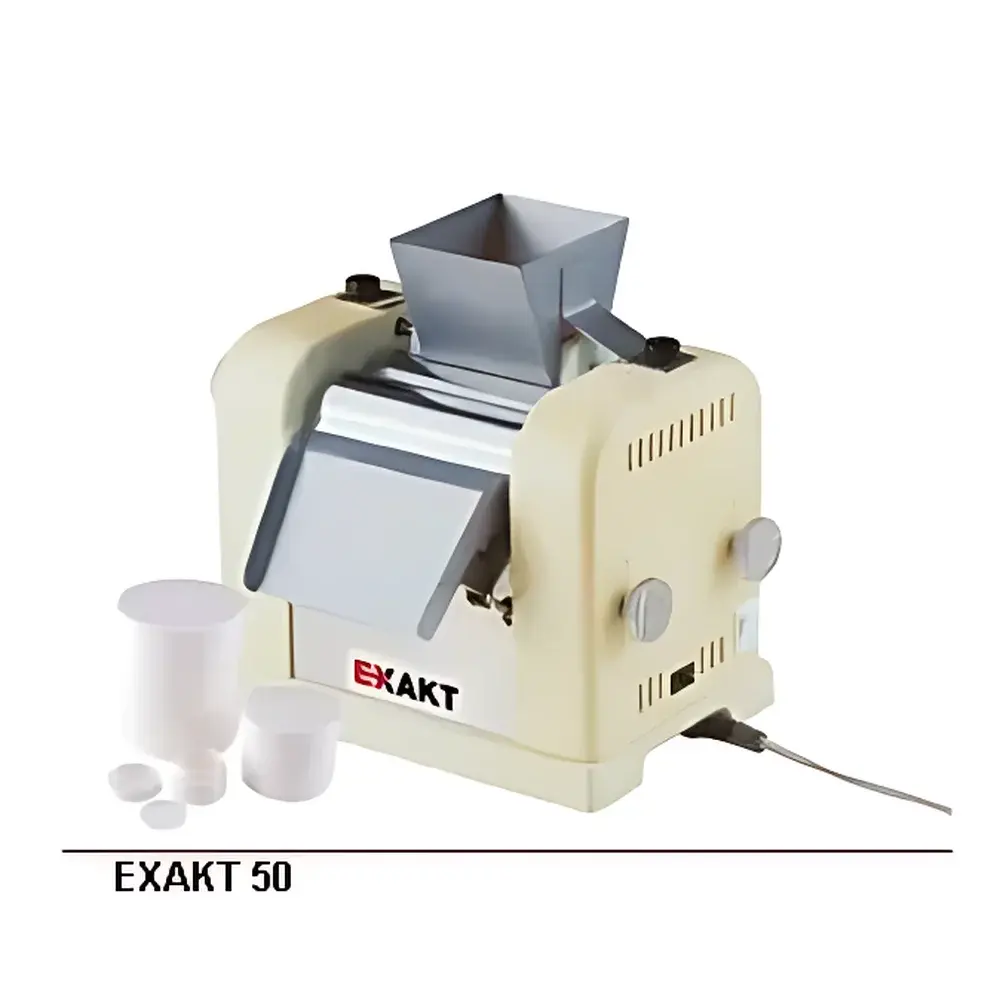
EXAKT Basic Three-Roll Mill Model 50
| Brand | EXAKT |
|---|---|
| Origin | Germany |
| Model | Basic Model 50 |
| Instrument Type | Three-Roll Mill |
| Sample Applicability | Soft materials |
| Feed Particle Size | 5–180 µm |
| Final Output Particle Size | ≤5 µm |
| Throughput | 0.5 L/h |
| Minimum Output Particle Size | <0.01 mm |
| Drive Configuration | Dual-speed, adjustable timing belt (replaces V-belt) |
| Roll Dimensions | 150 mm length |
| Roll Speed Ratio | 3.3 : 1.8 : 1 |
| Roll Material | Hard-chrome-plated stainless steel or anodized aluminum |
| Blade Material Options | Stainless steel, PFA-coated, or anodized aluminum |
| Motor | Single-speed (0.12 kW) or variable-speed option (output power 0.08 kW) |
| Dimensions (W×D×H, including blade and hopper) | 320 × 280 × 320 mm |
| Electrical Supply | 230 V / 50 Hz or 400 V / 50 Hz |
| Optional Accessories | Solvent dispenser, roll-gap guard, stainless-steel hopper, PFA-coated universal blade holder, temperature-controlled rolls (cooling/heating to 80 °C standard |
| Safety Features | Magnetic safety switch on hopper, splash-resistant tray with emergency stop button, adjustable gap guard with pointer-scale indication, dust shields, IP-rated enclosure components |
Overview
The EXAKT Basic Three-Roll Mill Model 50 is a precision-engineered laboratory-scale dispersion and particle size reduction system designed for controlled, high-shear processing of soft, viscous, or paste-like materials. Operating on the principle of laminar shear between three horizontally aligned, counter-rotating rolls—each rotating at a precisely defined speed ratio (3.3 : 1.8 : 1)—the mill subjects material to progressive mechanical shearing as it passes through two sequential nip zones. This geometry enables deterministic control over residence time, shear rate, and thermal input, making it particularly suited for applications requiring narrow particle size distribution, homogeneous pigment dispersion, or consistent film thickness development (e.g., inks, pastes, electrode slurries, and pharmaceutical ointments). As a desktop unit with compact footprint (320 × 280 × 320 mm), the Model 50 integrates seamlessly into regulated lab environments—including ISO 17025-accredited testing labs and GMP-compliant R&D facilities—without compromising structural rigidity or process repeatability.
Key Features
- Modular dual-speed drive system with adjustable timing belt transmission—reducing energy loss, acoustic noise, and maintenance frequency compared to legacy V-belt configurations.
- Manually adjustable roll gap with calibrated pointer-and-scale mechanism, enabling reproducible setting of shear intensity and final film thickness down to sub-micron control levels.
- Rolls constructed from either hard-chrome-plated stainless steel or anodized aluminum—both offering high surface hardness (>60 HRC equivalent), dimensional stability, and resistance to abrasive wear.
- Universal blade holder system compatible with stainless steel, plastic, or PFA-coated blades—supporting material compatibility across aggressive solvents, food-grade formulations, and electrochemical slurries.
- Integrated solvent dispenser for in-process liquid addition, mitigating thermal drying effects during extended milling cycles and ensuring uniform rheological behavior and particle deagglomeration.
- Enhanced safety architecture: magnetic interlock on stainless-steel hopper, splash-resistant collection tray with integrated emergency stop, adjustable gap guard with tactile feedback, and full dust shielding around drive and exit zones.
Sample Compatibility & Compliance
The Model 50 is validated for use with soft, non-fibrous, low-to-medium viscosity materials—including polymer pastes, ceramic slips, conductive inks, cosmetic bases, and pharmaceutical semi-solids. Its ≤5 µm final output particle size specification aligns with ASTM D2818 (standard test method for particle size of carbon black by electron microscopy) and supports QC workflows compliant with USP (light scattering particle size analysis of injectables). All wetted surfaces are available in FDA-compliant materials (e.g., PFA-coated components meet 21 CFR 177.1550); optional temperature-controlled rolls (−20 to +100 °C) allow thermally sensitive formulations to be processed under GLP-auditable conditions. The unit meets CE Machinery Directive 2006/42/EC and carries optional ATEX Zone 22 certification for explosive dust environments when specified.
Software & Data Management
While the Basic Model 50 operates via manual controls, its mechanical design incorporates traceability-ready features essential for regulated environments: calibrated gap scale markings, fixed-speed motor with documented torque curve, and serial-numbered component tagging (rolls, blades, housings). For laboratories requiring electronic audit trails, EXAKT offers optional integration with third-party SCADA systems via analog 0–10 V speed interface (on variable-speed variant) and digital I/O for status monitoring. All accessories—including solvent dispensers and temperature modules—are supplied with calibration certificates traceable to national standards (DAkkS or UKAS), supporting 21 CFR Part 11 compliance when paired with validated LIMS platforms.
Applications
- Pigment dispersion and stabilization in water-based and solvent-based inks, coatings, and adhesives.
- Electrode slurry homogenization for lithium-ion battery R&D, ensuring uniform carbon-black distribution and binder matrix integrity.
- Pharmaceutical ointment and gel formulation, where controlled shear prevents API degradation and ensures batch-to-batch rheological consistency.
- Food-grade paste processing (e.g., chocolate, nut butters), leveraging PFA-coated components and non-metallic blade options to eliminate metal contamination risk.
- Ceramic and electronic paste development, where precise film thickness control (<10 µm) directly correlates with green tape density and sintering performance.
FAQ
What is the minimum achievable particle size with the Model 50?
Final particle size is application-dependent but routinely achieves ≤5 µm for soft, dispersible materials; sub-100 nm dispersion may be attained with optimized solvent-assisted multi-pass protocols.
Can the rolls be heated or cooled during operation?
Yes—standard configuration supports roll temperature control from −20 °C to +80 °C; custom designs extend range to +100 °C upon request.
Is the unit suitable for GMP manufacturing environments?
It is designed for R&D and pilot-scale QC use; full GMP validation support—including IQ/OQ documentation packages and material traceability logs—is available through EXAKT’s certified service partners.
What safety certifications does the Model 50 hold?
CE-marked per Machinery Directive 2006/42/EC; optional ATEX Zone 22 certification available for combustible dust handling.
How is cleaning efficiency improved with the PFA-coated blade holder?
PFA reduces surface adhesion by >70% versus bare stainless steel, cutting cleaning time by up to 60% and eliminating need for aggressive solvents—validated per ISO 14644-1 Class 5 cleanroom wipe tests.
Related Products



