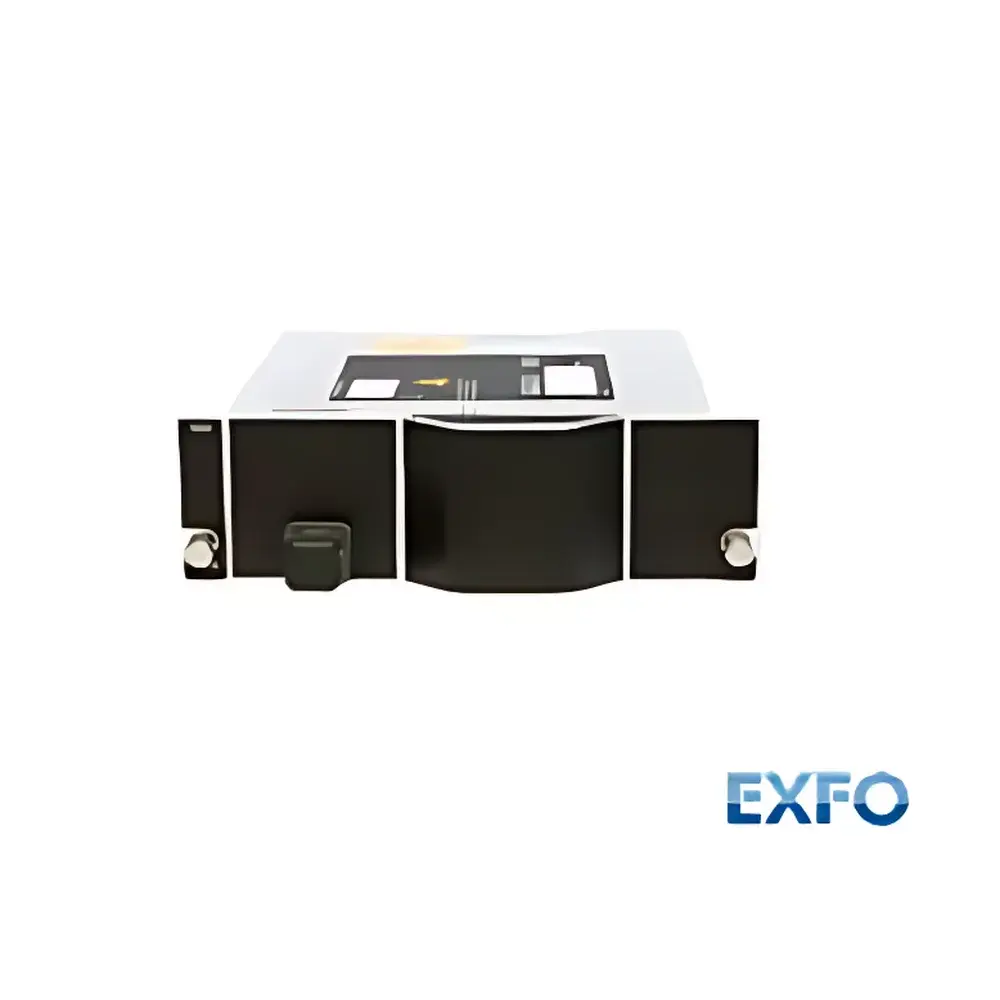
EXFO FTBx-5245/5255 Portable Optical Spectrum Analyzer
| Brand | EXFO |
|---|---|
| Origin | Canada |
| Model | FTBx-5245/5255 |
| Compliance | IEC 61282-12 (Pol-Mux OSNR) |
| Platform Compatibility | FTB-2, FTB-2 Pro, FTB-4 Pro, LTB-8 |
| Display | 10-inch high-resolution touchscreen (on FTB-4 Pro) |
| Measurement Bands | O-band (1260–1360 nm), C-band (1530–1565 nm), L-band (1565–1625 nm) |
| Signal Support | 10G to 400G coherent and direct-detect signals |
| OSNR Method | In-Service Polarization-Multiplexed OSNR (INSPM) |
| Application Scope | In-service DWDM, CWDM, pluggable transceiver characterization (CFP, XFP, QSFP-DD, etc.) |
Overview
The EXFO FTBx-5245/5255 Portable Optical Spectrum Analyzer (OSA) is a field-deployable, high-performance spectral measurement module engineered for precision characterization of modern optical communication networks. Based on diffraction-grating optical architecture with thermally stabilized wavelength calibration, it delivers traceable, repeatable spectral power distribution data across the O-, C-, and L-bands—enabling full-spectrum analysis from 1260 nm to 1625 nm. Unlike legacy benchtop OSAs, the FTBx-5245/5255 is purpose-built for in-service network validation, supporting non-intrusive, real-time measurements on live DWDM and CWDM links without service interruption. Its core innovation lies in the INSPM (In-Service Polarization-Multiplexed OSNR) method—a standardized, physics-based algorithm compliant with IEC 61282-12—that enables accurate Pol-Mux OSNR determination for 40G, 100G, 200G, and 400G coherent signals under operational conditions. This capability directly addresses critical pain points in coherent network maintenance: amplifier fault isolation, channel drift detection, and post-deployment signal integrity verification.
Key Features
- Field-rugged, modular OSA design compatible with EXFO’s FTB-2, FTB-2 Pro, FTB-4 Pro, and LTB-8 test platforms
- In-service Pol-Mux OSNR measurement (INSPM) with >35 dB dynamic range and sub-0.1 nm wavelength accuracy
- Full-band spectral coverage: O-band (1260–1360 nm), C-band (1530–1565 nm), and L-band (1565–1625 nm)
- Support for dense and coarse WDM systems—including 25 GHz, 50 GHz, and 100 GHz channel spacing—as well as CWDM grids (18-channel, 20 nm spacing)
- Pluggable transceiver analysis mode for CFP, CFP2, CFP4, XFP, SFP+, QSFP+, QSFP28, and QSFP-DD form factors
- Integrated 10-inch high-resolution capacitive touchscreen on FTB-4 Pro platform for intuitive waveform navigation and marker-based analysis
- Real-time spectral monitoring with configurable alarm thresholds and automated pass/fail reporting per ITU-T G.698.x and G.694.1 specifications
Sample Compatibility & Compliance
The FTBx-5245/5255 is validated for use across heterogeneous optical infrastructure, including amplified and unamplified point-to-point, ring, and mesh topologies. It supports both linear and nonlinear signal regimes typical of EDFAs, Raman amplifiers, and hybrid amplification stages. All OSNR measurements adhere strictly to IEC 61282-12 Annex A for polarization-multiplexed signal evaluation, ensuring auditability in GLP/GMP-regulated environments. The instrument’s firmware and calibration certificates are maintained under EXFO’s ISO/IEC 17025-accredited metrology program. No external reference sources or manual recalibration are required between scheduled maintenance intervals—wavelength stability is actively compensated via internal temperature-controlled etalon referencing.
Software & Data Management
Controlled via EXFO’s FiberComplete™ software suite, the FTBx-5245/5255 provides comprehensive data governance features aligned with FDA 21 CFR Part 11 and EU Annex 11 requirements. Audit trails record all user actions—including parameter changes, measurement triggers, and report exports—with immutable timestamps and operator authentication. Spectral datasets are stored in vendor-neutral .sxp format (compatible with MATLAB, Python SciPy, and commercial network planning tools) and can be exported with embedded metadata (GPS coordinates, fiber ID, timestamp, operator ID). Remote operation is supported via secure TLS 1.2–encrypted Ethernet or Wi-Fi connections, enabling centralized fleet management through EXFO’s CloudLink™ portal for multi-site calibration tracking and firmware version control.
Applications
- Pre-commissioning spectral verification of DWDM/CWDM line systems prior to traffic turn-up
- In-service OSNR trending for predictive amplifier health assessment in ROADM-based networks
- Characterization of O-band PON upstream spectra in NG-PON2 and XGS-PON deployments
- L-band extension validation for submarine and long-haul terrestrial upgrades
- Transceiver interoperability testing during hardware qualification (e.g., MSA compliance checks)
- Root-cause analysis of spectral tilt, gain ripple, and ASE noise accumulation across cascaded amplification stages
- Integration with EXFO’s FTBx-88200NGE Power Blazer for synchronized optical power, OSNR, and BER correlation in 40G/100G circuit commissioning
FAQ
Does the FTBx-5255 support in-service OSNR measurement on live 400G ZR+ links?
Yes—the INSPM algorithm is validated for DP-QPSK, DP-16QAM, and probabilistic constellation shaping (PCS) modulation formats used in 400G-ZR and OpenZR+ implementations.
Can the module be calibrated independently of the host platform?
No—calibration is performed at the system level (FTB-4 Pro + FTBx-5255 combination) and includes platform-specific thermal and electrical compensation matrices.
Is L-band spectral analysis limited to 1625 nm, or does it extend into the U-band?
The standard configuration covers up to 1625 nm; extended-range variants supporting up to 1675 nm (U-band) are available under custom order (FTBx-5255-U).