
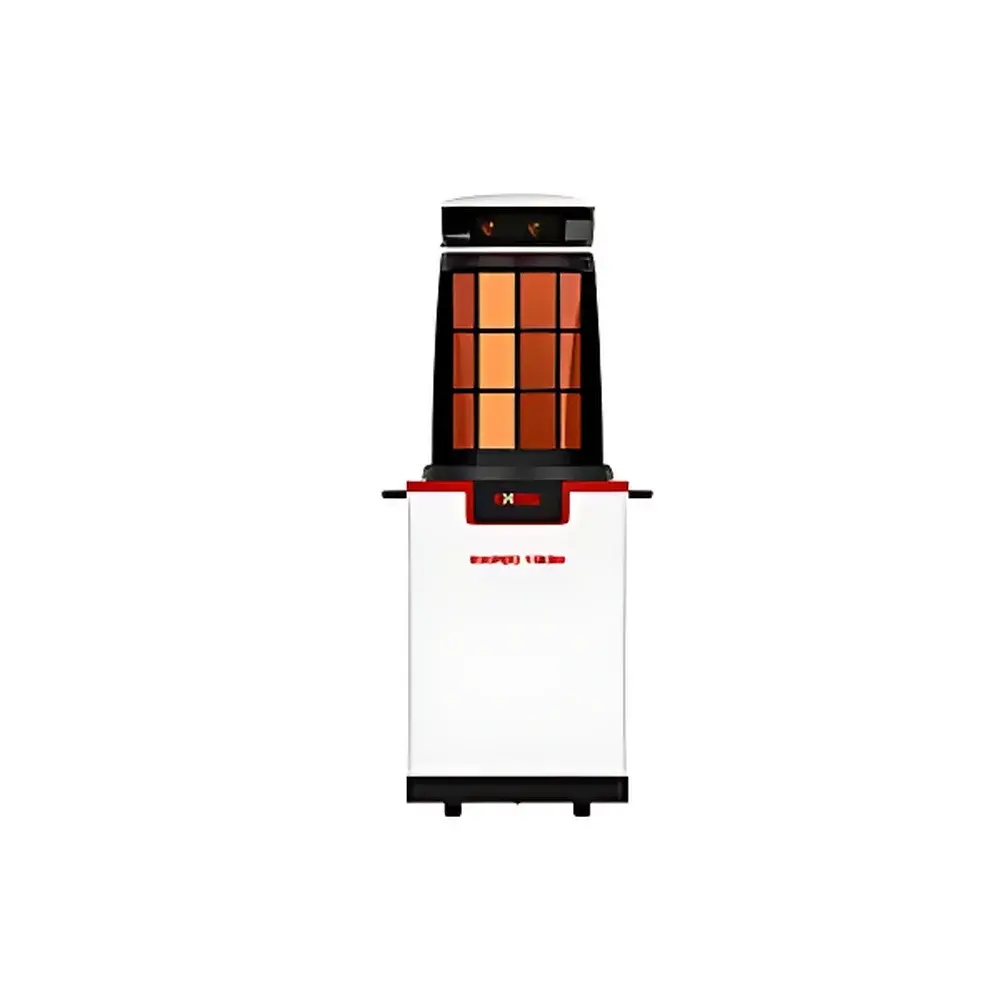
EXPEC 1900 Fourier Transform Infrared (FTIR) Open-Path Gas Remote Sensing System
| Brand | EXPEC / Superspectra Technology |
|---|---|
| Origin | Zhejiang, China |
| Instrument Type | Online FTIR Remote Sensor |
| Design | Open-Path, Non-Contact, Real-Time Chemical Imaging System |
| Core Detector | Stirling-Cooled MCT (Operating at –200 °C) |
| Gas Library Capacity | >400 Target Compounds (TICs, VOCs, Chemical Warfare Agents, Industrial Solvents) |
| Operational Range | Up to 10 km Diameter Coverage |
| Scanning Capability | 360° Azimuthal Rotation, ±30° Vertical Elevation (60° Total Vertical FOV) |
| Imaging Modalities | Simultaneous Visible Video, Thermal IR Imaging, and Quantitative Chemical Mapping |
| Compliance Framework | Designed for EPA Method 320 & ASTM D6348 Alignment |
Overview
The EXPEC 1900 is an open-path, real-time Fourier Transform Infrared (FTIR) remote sensing system engineered for quantitative, non-contact detection and spatial mapping of gaseous compounds across extended atmospheric paths. Unlike extractive or point-sampling analyzers, the EXPEC 1900 operates on the principle of passive or active infrared absorption spectroscopy over distances up to 10 km—measuring spectral attenuation of ambient IR radiation (or a co-located broadband IR source) as it traverses the atmosphere. By applying high-resolution interferometric signal acquisition and chemometric inversion algorithms, the system reconstructs concentration distributions of multiple gases simultaneously in two-dimensional chemical images—co-registered with visible and thermal infrared video streams. This enables time-resolved visualization of plume dynamics, dispersion behavior, and source localization without physical intrusion—critical for applications where access is restricted, hazardous, or logistically impractical.
Key Features
- Stirling-cooled mercury cadmium telluride (MCT) detector operating at –200 °C, delivering high thermal stability and low dark current for enhanced signal-to-noise performance in field-deployed open-path configurations.
- Automated 360° azimuthal scanning with programmable vertical sweep (±30°), supporting both continuous surveillance and pre-defined patrol routes with auto-repositioning to designated watch points.
- Integrated multimodal imaging: synchronized visible-light camera, uncooled microbolometer-based thermal imager (640 × 480 resolution), and pixel-level FTIR spectral mapping—enabling correlative analysis of temperature gradients, visual obstructions, and chemical composition.
- Real-time alarm logic with adaptive thresholding: automatic detection of spectral anomalies exceeding user-configurable concentration limits, followed by directional source triangulation and persistent tracking via motorized pan-tilt-zoom (PTZ) control.
- Extensible spectral library architecture compliant with IUPAC nomenclature standards; supports import of custom reference spectra (e.g., NIST, HITRAN, PNNL libraries) and user-generated calibration datasets.
Sample Compatibility & Compliance
The EXPEC 1900 is optimized for ambient air monitoring under variable meteorological conditions—including low-light, fog, light rain, and moderate turbulence. It detects gases via fundamental vibrational absorption bands in the mid-infrared region (typically 600–4000 cm⁻¹), with demonstrated sensitivity for over 400 analytes including toxic industrial chemicals (TICs), volatile organic compounds (VOCs), sulfur- and nitrogen-containing species, and regulated pollutants such as CO, NO₂, SO₂, NH₃, and CH₄. The system’s optical path design minimizes interference from particulate scattering through dual-beam referencing and background subtraction protocols. From a regulatory standpoint, its data output structure aligns with EPA Method 320 (for open-path FTIR) and ASTM D6348 (for gaseous emission measurements), while its software architecture supports audit trail logging, electronic signatures, and role-based access control—meeting foundational requirements for GLP-compliant environmental monitoring and incident response documentation.
Software & Data Management
The proprietary EXPEC RemoteView™ software provides full instrument control, spectral processing, and georeferenced visualization in a unified interface. Raw interferograms are processed using phase-corrected Fourier transformation, baseline correction, and atmospheric compensation (via MODTRAN-based radiative transfer modeling). Quantitative analysis employs classical least-squares (CLS) and partial least-squares (PLS) regression against reference libraries. All measurement sessions are timestamped, GPS-tagged (when integrated with GNSS module), and archived in HDF5 format—ensuring traceability and long-term interoperability. Data export options include CSV, NetCDF, and XML schemas compatible with third-party GIS platforms (e.g., ArcGIS, QGIS) and enterprise LIMS environments. Software validation documentation is available upon request for laboratories operating under ISO/IEC 17025 or FDA 21 CFR Part 11 frameworks.
Applications
- Environmental Monitoring: Continuous perimeter surveillance of petrochemical complexes, landfill gas migration studies, stack emission verification, and fugitive leak quantification across industrial zones.
- Homeland Security & Emergency Response: Rapid deployment for CBRN threat assessment, post-blast residue characterization, crowd safety monitoring during mass gatherings, and battlefield hazard mapping.
- Scientific Research: Volcanic plume composition analysis, combustion diagnostics (e.g., aircraft engine exhaust, rocket test stands), boundary-layer atmospheric chemistry investigations, and climate-relevant trace gas flux estimation.
- Infrastructure Protection: Pipeline corridor monitoring, LNG terminal perimeters, and nuclear facility exclusion zone surveillance—leveraging non-intrusive standoff capability to reduce operational risk.
FAQ
What gases can the EXPEC 1900 detect?
It identifies and quantifies over 400 gases—including TICs (e.g., Cl₂, HCN, PH₃), VOCs (e.g., benzene, toluene, formaldehyde), acid gases (SO₂, HCl, HF), greenhouse gases (CO₂, CH₄, N₂O), and common industrial solvents.
Does the system require a retroreflector or external IR source?
No—it operates in passive mode using natural atmospheric IR background radiation; optional active mode uses an integrated broadband IR emitter for improved SNR in low-radiance conditions.
How is concentration accuracy validated in open-path configurations?
Through periodic calibration using certified gas cells (e.g., NIST-traceable multi-component mixtures) and cross-validation against co-located point sensors under controlled release trials.
Can the EXPEC 1900 be integrated into existing SCADA or command-and-control platforms?
Yes—via Modbus TCP, OPC UA, or RESTful API interfaces; metadata and alarm events are transmitted in standardized JSON payloads for seamless ingestion into central monitoring systems.
Is the system suitable for mobile deployment on vehicles or UAVs?
It is designed for vehicular mounting (vibration-damped chassis, wide-input DC power conditioning); UAV integration is feasible for smaller variants but requires custom stabilization and thermal management solutions.






