
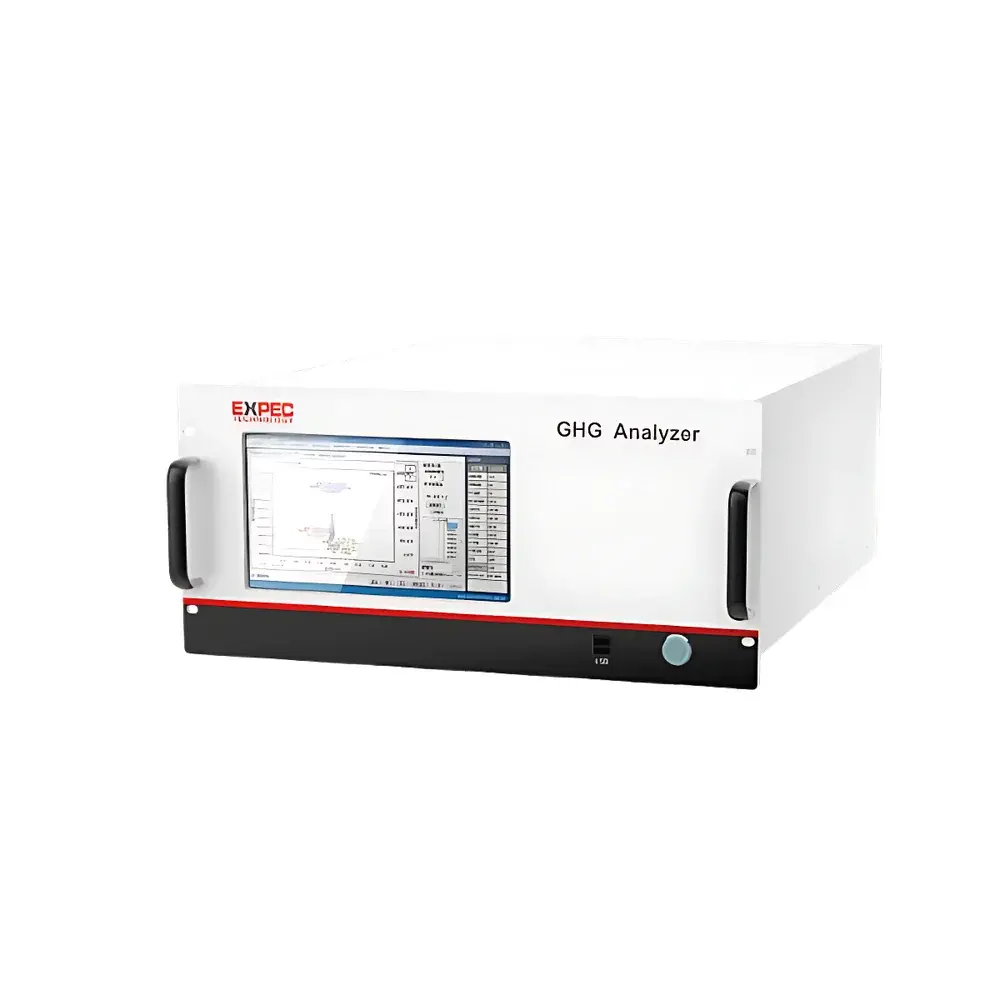
EXPEC 2000-810 Greenhouse Gas Online Continuous Monitoring System by EXPEC Technology
| Brand | EXPEC Technology |
|---|---|
| Origin | Zhejiang, China |
| Model | EXPEC 2000-810 |
| Detection Principle | Gas Chromatography with Flame Ionization Detection (GC-FID) and Methanizer-based CO/CO₂ Conversion |
| Compliance | GB/T 31705–2015 |
| Sample Inlet | Ambient Air |
| Detection Targets | CH₄, CO, CO₂, (expandable to SF₆) |
| Detector Configuration | Dual FID (standard), optional integrated methanizer with Ni catalyst at >360 °C |
Overview
The EXPEC 2000-810 Greenhouse Gas Online Continuous Monitoring System is an industrial-grade, rack-mounted gas chromatograph engineered for unattended, long-term quantification of key atmospheric greenhouse gases—methane (CH₄), carbon monoxide (CO), and carbon dioxide (CO₂)—in ambient air. It implements a validated dual-detection GC-FID architecture: CH₄ is directly resolved and quantified via high-stability flame ionization detection, while CO and CO₂ are catalytically converted to CH₄ in a high-temperature nickel-based methanizer (operating ≥360 °C) prior to FID analysis. This configuration ensures consistent molar response factors and eliminates detector nonlinearity associated with direct CO/CO₂ measurement. The system utilizes a precisely timed six-port injection valve with a fixed-volume sampling loop (typically 1–5 mL), coupled with a dedicated capillary or packed column optimized for polar/nonpolar greenhouse gas separation under isothermal or temperature-programmed conditions. All hardware modules—including carrier gas control (high-purity He or N₂), oven temperature regulation (±0.1 °C stability), and detector electronics—are integrated into a single chassis with industrial-grade environmental hardening (IP54 enclosure, -10 °C to 50 °C operational range).
Key Features
- Compliance-certified design meeting the analytical requirements of GB/T 31705–2015, including minimum detection limits (MDLs), repeatability (<2% RSD), and calibration traceability protocols for background atmospheric monitoring.
- Dual-FID configuration: one detector dedicated to direct CH₄ analysis; the second configured with integrated methanizer for sequential CO → CH₄ and CO₂ → CH₄ conversion—enabling simultaneous, stoichiometrically equivalent quantification of all three species on a single chromatographic run.
- Robust pneumatic architecture featuring mass flow controllers (MFCs) for carrier, makeup, and hydrogen gases, ensuring stable retention times and peak area reproducibility over extended deployment cycles (≥30 days without manual intervention).
- Modular column oven with programmable ramp rates (0.1–20 °C/min) and multi-zone thermal management, supporting method flexibility for future expansion to SF₆ or other halogenated GHGs using compatible stationary phases (e.g., Porapak Q, Hayesep D).
- Onboard diagnostics including real-time pressure monitoring, detector baseline drift tracking, and valve cycle logging—facilitating remote health assessment and predictive maintenance scheduling.
Sample Compatibility & Compliance
The EXPEC 2000-810 accepts uncompressed ambient air samples drawn via a certified particulate filter (0.3 µm), moisture trap (Nafion or chilled condenser), and calibrated mass flow meter. It is validated for use in background monitoring stations (e.g., WMO GAW sites), urban and rural ambient networks, industrial fence-line monitoring, and eddy covariance research platforms. Its analytical methodology aligns with internationally recognized frameworks: retention time alignment and calibration procedures follow ISO 10156 principles for gas standard certification; data integrity workflows support GLP-compliant audit trails per ISO/IEC 17025:2017. While GB/T 31705–2015 is its primary domestic reference, the underlying GC-FID/methanizer approach is functionally equivalent to EPA Method TO-11A and ASTM D6348–22 for hydrocarbon and CO/CO₂ speciation in air matrices.
Software & Data Management
Control and data acquisition are managed through EXPEC’s proprietary ChromaView™ software suite (v3.2+), deployed on an embedded Linux platform. The interface provides real-time chromatogram visualization, automated peak integration using iterative Gaussian deconvolution, and configurable reporting intervals (1-min to 1-hr averages). Raw chromatographic data (time-stamped .CDF files) and processed concentration tables (.CSV) are stored locally on redundant SSDs with 90-day circular buffer. Remote access is enabled via TLS-secured HTTP API and Modbus TCP, allowing integration into SCADA systems or central environmental data hubs (e.g., EPA AIRNow, EEA Copernicus). Audit logs record all user actions, method changes, calibration events, and instrument faults—fully compliant with FDA 21 CFR Part 11 requirements when operated in electronic record mode with role-based authentication.
Applications
- Long-term atmospheric composition monitoring at national background stations and regional air quality networks.
- Fence-line and stack emission verification for petrochemical, landfill, and wastewater treatment facilities under regulatory GHG reporting schemes (e.g., China’s National Carbon Market, EU ETS).
- Scientific field campaigns requiring high-temporal-resolution GHG flux characterization, including aircraft-based vertical profiling and mobile lab deployments.
- Calibration transfer and intercomparison studies between reference instruments (e.g., CRDS analyzers) and GC-based platforms in metrology laboratories.
- Method development for emerging GHGs (e.g., NF₃, HFC-23) using column chemistry adaptation and retention time validation against certified standards.
FAQ
What carrier gases are supported, and what purity is required?
High-purity helium (99.999%) or nitrogen (99.999%) is recommended; hydrogen (99.999%) and synthetic air (for FID makeup) must meet ASTM D1946 specifications.
Can the system operate unattended for extended periods?
Yes—designed for continuous 24/7 operation with automatic zero/span calibration cycles, onboard gas cylinder monitoring, and remote alarm notification via SNMP or email.
Is third-party calibration gas certification accepted?
Yes—certified reference materials from NIST-traceable providers (e.g., Linde, Air Liquide, Scott-Marrin) are fully compatible when delivered in aluminum cylinders with stainless-steel valves and documented uncertainty budgets.
How is data integrity ensured during power interruption?
The system features non-volatile memory for method parameters and last-known calibration coefficients, plus UPS-ready power input (100–240 VAC, 50/60 Hz) with graceful shutdown protocol to preserve active chromatograms.
Does the EXPEC 2000-810 support remote firmware updates?
Firmware updates are performed via secure SFTP upload with SHA-256 signature verification; rollback capability is retained for all previous three versions.







