
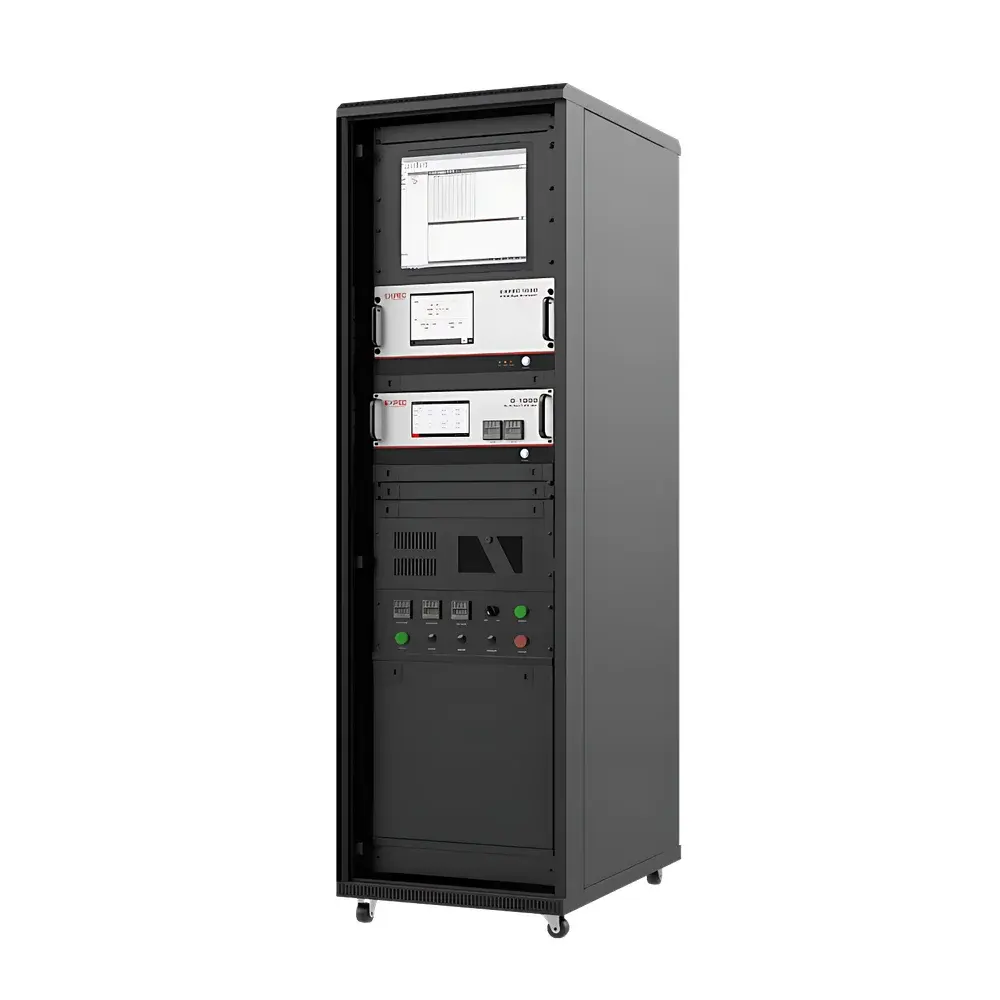
EXPEC 2000 FT Flue Gas Continuous Emission Monitoring System (CEMS)
| Brand | EXPEC |
|---|---|
| Origin | Zhejiang, China |
| Model | EXPEC 2000 FT |
| Instrument Type | In-situ Extractive Hot-Wet CEMS |
| Measurement Principle | Fourier Transform Infrared (FTIR) Spectroscopy for Gaseous Pollutants & Moisture |
| Operating Temperature | Full-path 180 °C High-Temperature Heating |
| Spectral Resolution | Standard FTIR Configuration |
| Multi-component Capability | Simultaneous Quantification of ≥12 Gases |
| Compliance | Designed to Meet GB/T 16157, HJ 75–2017, HJ 76–2017, and EU EN 15267 / EN 14181 Requirements |
Overview
The EXPEC 2000 FT Flue Gas Continuous Emission Monitoring System (CEMS) is an in-situ extractive hot-wet analytical platform engineered for regulatory-grade, real-time quantification of gaseous pollutants and process parameters in industrial flue gas streams. It operates on the principle of Fourier Transform Infrared (FTIR) spectroscopy — a non-dispersive, multi-wavelength absorption technique that exploits the unique vibrational-rotational absorption signatures of target molecules across the mid-infrared region (typically 4000–600 cm⁻¹). Sample gas is continuously extracted from the stack via a high-temperature probe and conveyed through a fully heated (180 °C) sample line to prevent condensation and analyte loss. The conditioned stream enters a thermostatically stabilized measurement cell where broadband infrared radiation — generated by a silicon carbide source and modulated by a robust Michelson interferometer — passes through the gas matrix. Absorption-induced intensity attenuation at specific wavenumbers is captured by a liquid-nitrogen-cooled MCT detector. Raw interferograms are digitized and subjected to Fast Fourier Transformation (FFT), yielding high-fidelity single-beam spectra. Quantitative analysis is performed using multivariate calibration models (e.g., classical least squares or partial least squares regression) trained against reference spectra, enabling simultaneous, interference-corrected concentration determination of up to twelve gases without physical filter changes.
Key Features
- Full-path 180 °C high-temperature heating architecture ensures complete prevention of water vapor condensation and acid gas deposition, eliminating bias from phase change and adsorption losses.
- Michelson interferometer with monolithic mirror mounts and active alignment compensation delivers exceptional resistance to shear motion and mechanical vibration — critical for long-term stability in harsh industrial environments.
- Optical cavity mirrors feature proprietary anti-corrosion coating (multi-layer dielectric over gold substrate), optimized for resistance to SO₃, HCl, HF, and NH₃ exposure, extending optical lifetime beyond 5 years under continuous operation.
- Modular sensor integration: Zirconia electrochemical cell for O₂ (0–25% v/v, ±0.1% accuracy); Pt100 Class A RTD for temperature (−20 to 200 °C, ±0.15 °C); piezoresistive pressure transducer (0–10 kPa, ±0.5% FS); and traceable S-type Pitot tube assembly for velocity profiling (5–30 m/s, ±1.5% reading).
- Onboard spectral library builder allows users to acquire, process, and validate custom reference spectra for emerging or site-specific compounds — supporting method development under ISO/IEC 17025-compliant QA/QC protocols.
Sample Compatibility & Compliance
The EXPEC 2000 FT is validated for use with flue gases containing particulate loadings ≤100 mg/m³ (dry, standard conditions) and moisture content up to 25% v/v. It meets the technical requirements of China’s HJ 75–2017 (Technical Specification for Quality Assurance of CEMS) and HJ 76–2017 (Technical Specification for CEMS Operation and Maintenance), including 7-day zero/span drift limits (<±2.5% F.S.), linearity error (<±5% F.S.), and response time (<200 s). Its design aligns with European standards EN 15267 (Performance Certification of Automated Measuring Systems) and EN 14181 (Quality Assurance of Automated Measuring Systems), supporting QAL1 certification when deployed with certified reference materials and documented uncertainty budgets. The system supports audit-ready data logging compliant with GLP/GMP principles, including electronic signatures, user access levels, and immutable event logs.
Software & Data Management
The embedded CEMS operating software (v3.2+) provides ISO/IEC 17025-aligned instrument control, real-time spectral visualization, automated calibration scheduling, and compliance reporting templates for HJ 75–2017 Annex D and EU MRV frameworks. All raw interferograms, processed spectra, and quantitative results are stored with full metadata (timestamp, operator ID, ambient conditions, maintenance events). Data export conforms to EPA Method 205 and EU Commission Regulation (EU) No 601/2012 formats. Remote diagnostics, firmware updates, and secure TLS 1.2–encrypted data transmission to central EMS platforms are supported via optional OPC UA or Modbus TCP interfaces.
Applications
The EXPEC 2000 FT is deployed across thermal power plants (coal, biomass, waste-to-energy), iron & steel sintering and coke ovens, cement kilns, petrochemical crackers and reformers, and municipal solid waste incinerators. It enables continuous monitoring of regulated species including SO₂, NO, NO₂, CO, CO₂, NH₃ (for SCR optimization), HCl, HF, CH₄, and H₂O vapor — with demonstrated performance in ultra-low emission scenarios (<35 mg/m³ SO₂, <50 mg/m³ NOₓ) and carbon accounting workflows requiring CO₂ mass flow rate reconciliation. Its multi-component capability reduces need for parallel analyzers, lowering total cost of ownership and footprint.
FAQ
What is the minimum detectable concentration (MDC) for SO₂ and NO under standard conditions?
The MDC is application-dependent and calibrated per site-specific stack conditions; typical values range from 0.5–2.0 mg/m³ for SO₂ and 0.3–1.5 mg/m³ for NO when configured with 10-m pathlength cell and 4 cm⁻¹ resolution.
Does the system support automatic zero/span calibration with certified gases?
Yes — integrated dual-gas manifold supports programmable zero air and span gas injections (NIST-traceable), with validation per HJ 76–2017 Section 6.3.
Can the FTIR module be reconfigured for different gas panels post-installation?
Yes — spectral library and quantification models can be updated remotely or locally without hardware modification, provided the target gases exhibit absorbance within the instrument’s operational spectral window.
Is the system compatible with third-party data acquisition systems (e.g., SCADA, DCS)?
Yes — native support for Modbus TCP, OPC UA, and 4–20 mA analog outputs ensures seamless integration into existing plant automation infrastructure.
What maintenance intervals are recommended for routine operation?
Filter replacement every 3 months; optical alignment verification annually; full system QAL2 verification every 6 months per HJ 75–2017 requirements.
Related Products







