
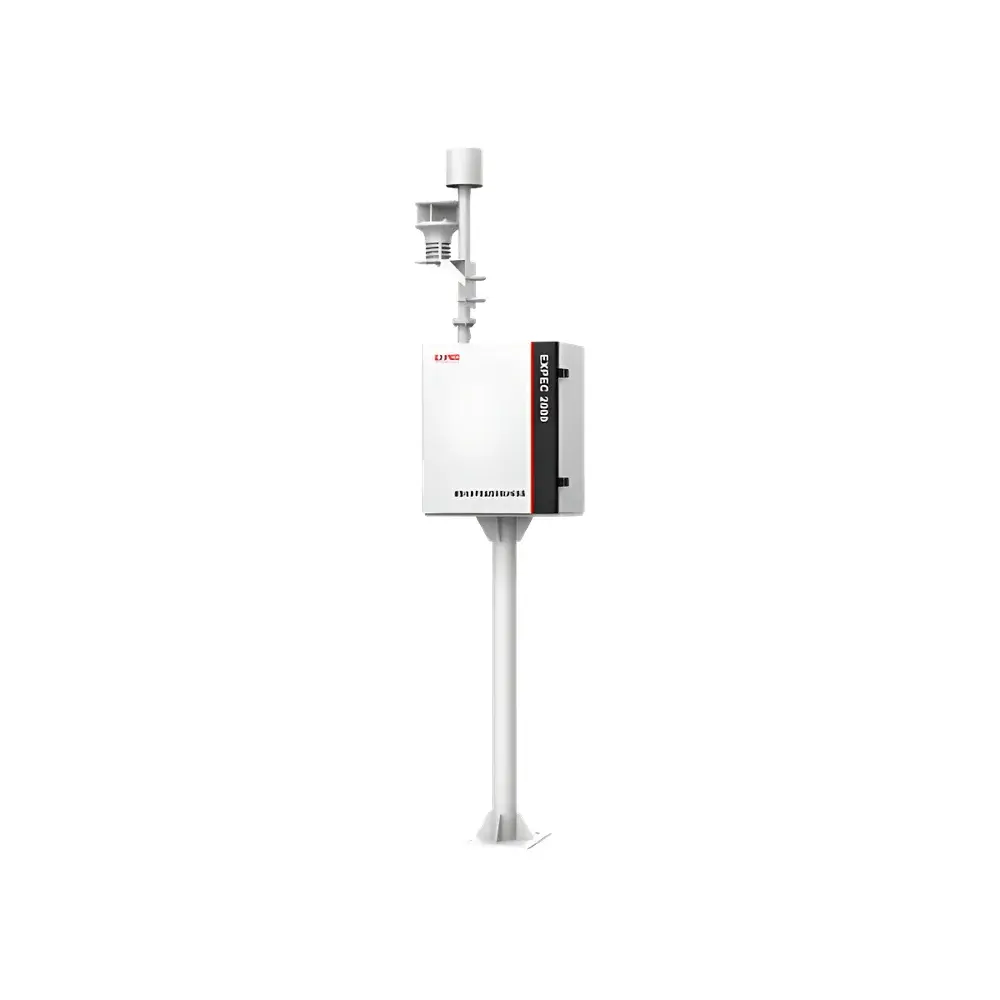
EXPEC 2000 (Model 112) Miniaturized Online Total Hydrocarbons (Non-Methane) Analyzer
| Brand | EXPEC / Puyu Technology |
|---|---|
| Origin | Zhejiang, China |
| Manufacturer Type | Authorized Distributor |
| Country of Origin | China |
| Model | EXPEC 2000 (Spec. 112) |
| Pricing | Available Upon Request |
Overview
The EXPEC 2000 (Model 112) Miniaturized Online Total Hydrocarbons (Non-Methane) Analyzer is a compact, wall-mountable gas chromatography–flame ionization detection (GC-FID) system engineered for continuous, unattended monitoring of non-methane total hydrocarbons (NMHC) in ambient air and fugitive emission streams. It implements the direct measurement methodology specified in the *Technical Specification for Continuous Automatic Monitoring of Non-Methane Total Hydrocarbons in Ambient Air (Trial Version)*, issued by the China National Environmental Monitoring Centre (CNEMC) in January 2021. NMHC quantification is achieved by cryogenic pre-concentration followed by thermal desorption and GC-FID separation, while methane is introduced via a fixed-volume sampling loop to enable precise subtraction from total hydrocarbon signal. This dual-path architecture ensures compliance with regulatory requirements for NMHC reporting in industrial boundary and area monitoring applications, particularly where space-constrained or distributed sensor deployment is required.
Key Features
- Compact wall-mount design (no dedicated shelter or conditioned room required), enabling rapid deployment across industrial perimeters and micro-grid monitoring nodes
- Cryogenic trapping at –30 °C combined with rapid resistive heating (>500 °C/s ramp rate) for high-fidelity NMHC enrichment and reproducible thermal desorption
- Dedicated methane quantification using a 1 mL stainless-steel quantitative loop, minimizing cross-interference and supporting accurate NMHC calculation (NMHC = THC − CH₄)
- Integrated hydrogen generator producing ≥30 mL/min H₂ at >99.999% purity—serving simultaneously as carrier gas for GC separation and combustion gas for FID operation
- FID detector with auto-ignition recovery, flame-out detection, and self-diagnostic readiness protocol to ensure uninterrupted data continuity during remote operation
- Embedded environmental compensation algorithms correcting for ambient temperature (−20 °C to +50 °C) and barometric pressure (60–110 kPa) variations
Sample Compatibility & Compliance
The EXPEC 2000 (112) is validated for real-time analysis of ambient air, stack effluents (diluted to ≤10% VOC concentration), and fugitive emissions from process vents, storage tanks, and loading/unloading interfaces. It meets the performance criteria outlined in CNEMC’s 2021 Technical Specification—including detection limit ≤20 ppb (as propane equivalent), linearity R² ≥0.999 over 0–10 ppm range, and 7-day stability drift <±5%. While developed against Chinese regulatory benchmarks, its GC-FID architecture aligns with internationally recognized principles in ISO 8573-5 (compressed air purity), ASTM D6348 (gaseous hydrocarbon analysis), and US EPA Method 25A for NMHC determination. Data integrity protocols support audit-ready logging compatible with GLP-compliant environmental laboratories.
Software & Data Management
The system runs on an embedded Linux-based controller with a web-accessible interface (HTTPS-enabled) supporting remote configuration, calibration scheduling, and diagnostic logs. Raw chromatograms, peak integration parameters, and QA/QC flags (e.g., FID baseline noise, trap desorption efficiency, loop injection precision) are stored locally for ≥90 days and exportable in CSV/NetCDF formats. Optional OPC UA and Modbus TCP integration enables seamless ingestion into SCADA, DCS, or centralized environmental data management platforms (EDMP). All calibration events—including span gas verification, zero-air validation, and system suitability tests—are timestamped and cryptographically signed to satisfy traceability requirements under ISO/IEC 17025 and FDA 21 CFR Part 11 (when deployed in regulated manufacturing environments).
Applications
- Distributed fence-line monitoring across chemical parks and integrated refining complexes
- Real-time NMHC mapping for leak detection and repair (LDAR) program verification
- Compliance-driven ambient air quality monitoring at plant boundaries per local environmental permits
- Source attribution studies integrating with meteorological data and dispersion modeling tools
- Mobile monitoring deployments on vehicles or portable trailers for temporary site assessments
FAQ
What is the minimum detection limit for NMHC, and how is it verified?
The system achieves a method detection limit (MDL) of ≤20 ppb (as propane), validated per EPA 40 CFR Part 136 procedures using seven replicate low-level injections and standard deviation multiplication.
Does the analyzer require external hydrogen supply or compressed air?
No—integrated electrolytic hydrogen generation eliminates dependency on cylinders or external gas lines; ambient air is used for FID make-up and detector cooling.
Can the EXPEC 2000 (112) be integrated into existing environmental monitoring networks?
Yes—it supports industry-standard communication protocols including Modbus TCP, OPC UA, and HTTP RESTful APIs for interoperability with central data acquisition systems.
Is routine maintenance required beyond scheduled calibration?
Scheduled maintenance includes quarterly FID nozzle cleaning, semi-annual GC column conditioning, and annual trap cartridge replacement—documented in the onboard maintenance log with automated reminders.
How does the system handle high-humidity or particulate-laden sample streams?
An optional heated sample line (60 °C) and Nafion™ membrane dryer are available to prevent condensation; a 5-µm particulate filter is installed upstream of the inlet manifold as standard.
Related Products







