
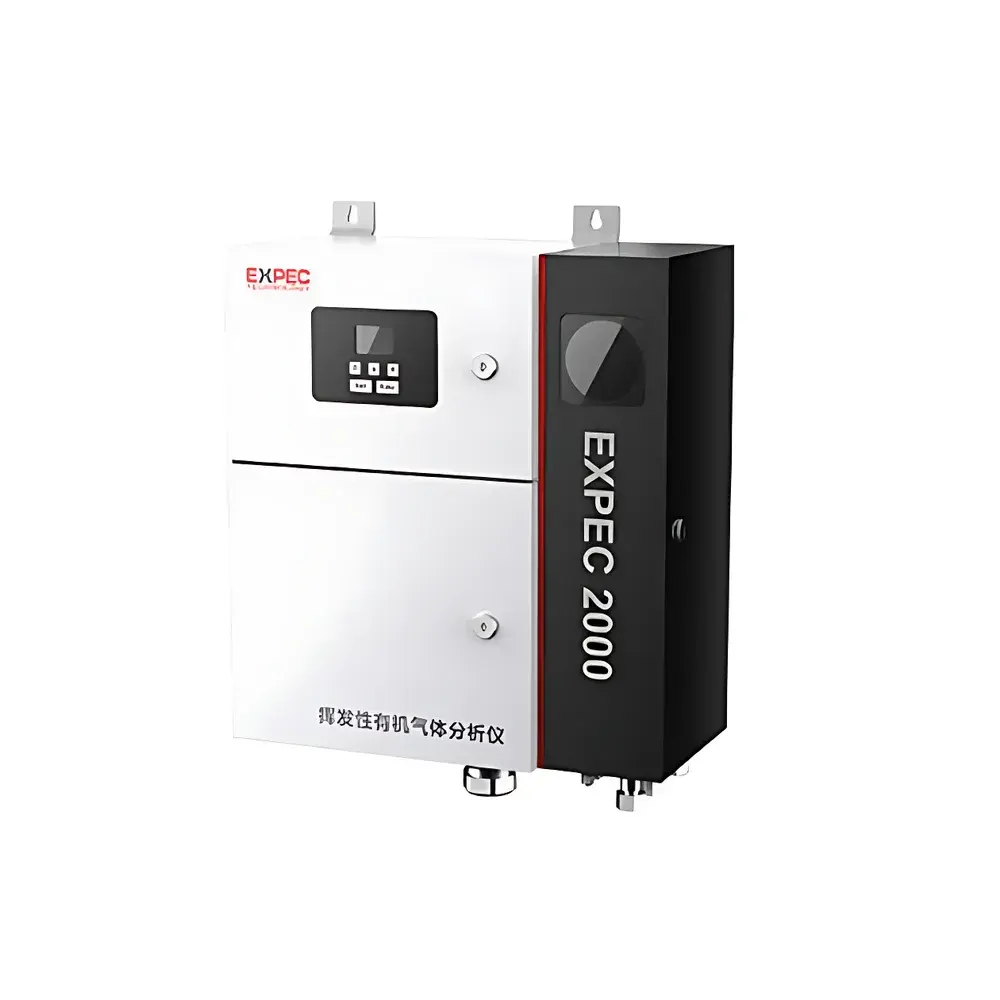
EXPEC 2000 (Model 113) Intrinsically Safe FID-Based Total Hydrocarbon Online Monitoring System
| Brand | EXPEC / Puyu Technology |
|---|---|
| Origin | Zhejiang, China |
| Manufacturer Type | Authorized Distributor |
| Regional Classification | Domestic (China) |
| Model | EXPEC 2000 (Specification 113) |
| Instrument Type | Online Gas Chromatograph |
| Certifications | Ex d IIB T4 Gb (IEC/EN 60079-1), IP66 |
| Detection Principle | Flame Ionization Detection (FID) |
| Sample Interface | Direct high-flow sampling with heated sample line (180 °C) |
| Response Time (T₉₀) | ≤2 s |
| Operating Environment | Zone 1 hazardous area (ATEX/IECEx compliant) |
| Installation Mode | Outdoor wall-mounted, no analyzer shelter required |
| Compliance | GB/T 16157–1996, HJ 38–2017, HJ 1012–2018 |
Overview
The EXPEC 2000 (Model 113) Intrinsically Safe FID-Based Total Hydrocarbon Online Monitoring System is a certified Zone 1 hazardous-area gas chromatograph engineered for continuous, real-time quantification of total hydrocarbons (THC) in industrial process and emission streams. It employs a flame ionization detector (FID) housed in an explosion-proof enclosure conforming to IEC/EN 60079-1 (Ex d IIB T4 Gb) and IP66 ingress protection. Unlike conventional lab-based GC-FID systems or non-certified online analyzers, the EXPEC 2000 (113) integrates full-system intrinsic safety at the hardware level — including the detector, column oven, sample introduction module, and signal processing unit — eliminating the need for external purging, pressurized enclosures, or dedicated analyzer shelters. Its measurement principle relies on catalytic combustion of organic compounds in a hydrogen–air flame, generating ions proportional to carbon mass flow; this provides near-universal response across volatile organic compounds (VOCs) with detection sensitivity down to sub-ppm levels (as methane equivalent) and linear dynamic range exceeding 10⁶. The system is specifically validated per Chinese national standards GB/T 16157–1996 (determination of THC in exhaust gas), HJ 38–2017 (ambient air and waste gas analysis), and HJ 1012–2018 (online monitoring technical specifications for fixed pollution sources).
Key Features
- Zone 1-certified explosion-proof architecture: All critical components — FID detector, GC column oven, solenoid valves, and electronics — meet Ex d IIB T4 Gb requirements for use in flammable gas environments.
- Full-path high-temperature sample conditioning: Heated sample lines (180 °C), heated transfer tubing, and thermostatically controlled GC oven minimize condensation, adsorption losses, and memory effects — improving accuracy and extending maintenance intervals by up to 40% compared to ambient-path systems.
- Direct high-flow sampling: Integrated diaphragm pump delivers ≥1.2 L/min volumetric flow directly into the GC inlet, achieving T₉₀ ≤2 seconds for rapid process feedback and transient event capture.
- Compact wall-mountable design: Footprint of 480 × 320 × 220 mm (W × H × D); weight <18 kg — enables installation on pipe racks, flare headers, tank rooftops, or fenceline monitoring points without structural reinforcement.
- Self-diagnostic firmware with fault logging: Monitors detector flame status, carrier gas pressure, oven temperature stability, and FID baseline drift; logs events with timestamps for GLP-compliant audit trails.
Sample Compatibility & Compliance
The EXPEC 2000 (113) accepts gaseous samples containing C₁–C₁₂ hydrocarbons, oxygenates (e.g., methanol, acetone), aromatics (benzene, toluene), and halogenated VOCs (e.g., chloromethane) without pre-concentration or derivatization. It is validated for use with humid, particulate-laden, or mildly corrosive streams typical of refinery off-gas, biogas upgrading lines, chemical reactor vents, and storage tank breathing emissions. Regulatory alignment includes compliance with China’s Ministry of Ecology and Environment (MEE) technical guidelines for fixed-source emission monitoring (HJ 1012–2018), as well as compatibility with ISO 11843–2 (detection capability estimation) and ASTM D6348–21 (standard test method for gaseous hydrocarbons via GC-FID). Optional integration with MEE-approved data acquisition modules supports automatic reporting to provincial environmental monitoring platforms.
Software & Data Management
The embedded Linux-based controller runs EXPEC Analytical Suite v3.2, supporting local touchscreen operation (7″ resistive LCD), remote web interface (HTTPS/SSL), and Modbus TCP/RTU output for DCS/SCADA integration. Data logging occurs at user-configurable intervals (1 s to 1 hr), with raw chromatograms, peak integrations, calibration curves, and system diagnostics stored onboard (16 GB eMMC) for ≥18 months. Audit-trail functionality complies with GLP and basic GMP documentation requirements: all parameter changes, calibration actions, and alarm acknowledgments are timestamped, user-ID stamped, and immutable. Export formats include CSV, PDF reports, and XML (compatible with China’s national emission monitoring platform data schema).
Applications
- Real-time THC monitoring at inlet/outlet of thermal oxidizers, RTOs, and catalytic incinerators for performance verification and DRE calculation.
- Fenceline and tank farm monitoring per MEE’s “Guidance on Unorganized Emission Control” — detecting fugitive releases from flanges, pumps, and vapor recovery units.
- Continuous analysis of flare gas composition to ensure destruction efficiency and support environmental reporting under China’s Pollutant Discharge Permit System.
- Process optimization in petrochemical units (e.g., FCCU, hydrotreaters) where THC spikes indicate catalyst deactivation or feedstock contamination.
- Compliance monitoring for VOCs abatement systems subject to local environmental enforcement (e.g., Jiangsu, Guangdong VOCs Special Action Plans).
FAQ
Does the EXPEC 2000 (113) require external hydrogen supply?
Yes — it uses ultra-high-purity (99.999%) hydrogen as both fuel gas for the FID and carrier gas; integrated H₂ generators are not supported due to ATEX certification constraints.
Can the system be calibrated remotely?
Manual span calibration requires physical access for standard gas injection; however, zero drift compensation and electronic gain adjustment can be performed remotely via secure web interface.
What maintenance intervals are recommended?
FID nozzle cleaning every 3 months; GC column replacement every 12–18 months depending on sample matrix; full system verification annually per HJ 1012–2018 Annex D.
Is the system compatible with third-party data acquisition systems?
Yes — Modbus TCP register mapping is documented in the Engineering Integration Manual; optional OPC UA gateway available upon request.
Does it support multi-point sampling?
No — it is a single-stream analyzer; multiplexed sampling requires external valving manifolds (not included) and must maintain Zone 1 integrity throughout the extended sample path.





