
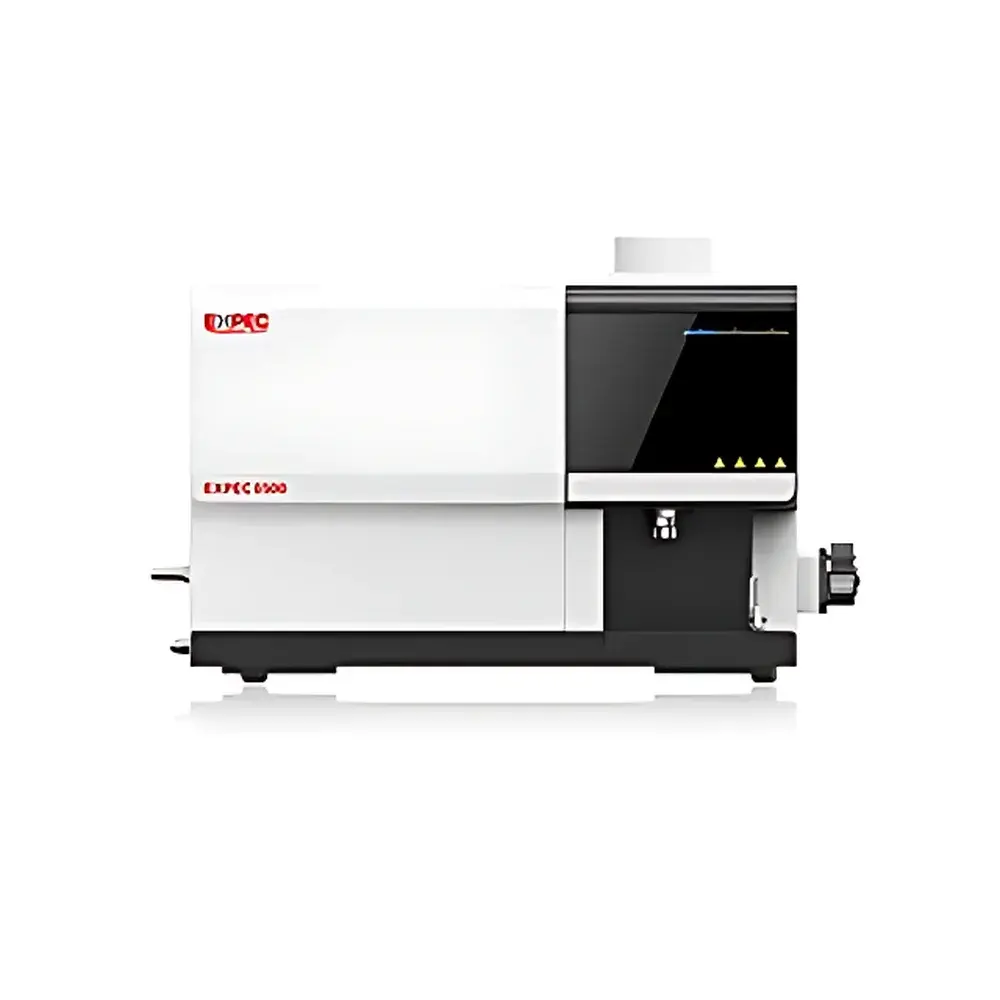
EXPEC 6500 Series High-Sensitivity Inductively Coupled Plasma Optical Emission Spectrometer (ICP-OES)
| Brand | EXPEC / Superspectro |
|---|---|
| Origin | Zhejiang, China |
| Manufacturer Type | Authorized Distributor |
| Product Origin | Domestic (China) |
| Model | EXPEC 6500 |
| Instrument Type | Full-Spectrum Simultaneous Readout |
| Detection Limit | μg/L-level |
| Repeatability | <0.5% RSD |
| 8-h Stability | <1% RSD |
| Wavelength Range | 165–900 nm (extendable to 130 nm) |
| Optical Resolution | <7 pm at 200 nm |
Overview
The EXPEC 6500 Series High-Sensitivity ICP-OES is a third-generation inductively coupled plasma optical emission spectrometer engineered by Superspectro (EXPEC) based on over a decade of fundamental research and industrial deployment in atomic emission spectroscopy. It operates on the principle of high-temperature plasma atomization and excitation—where sample aerosols are introduced into an argon-supported 6,000–10,000 K inductively coupled plasma, inducing element-specific line emissions across the UV-Vis-NIR spectrum. The instrument employs vertical torch dual-view geometry (axial and radial observation), enabling users to select optimal viewing modes per analyte: axial for ultra-trace detection (e.g., Al, Ca, Mg in ultrapure water), radial for high-matrix samples (e.g., seawater, digested sludge, or saline brines) to minimize spectral interferences and polyatomic oxide formation. Its core architecture integrates a digitally controlled self-excited solid-state RF generator, a custom large-format back-illuminated E-CCD detector, and a thermally stabilized Czerny-Turner optical bench with optimized aberration correction—collectively delivering sub-μg/L detection limits, a linear dynamic range exceeding 6 orders of magnitude, and robust 8-hour measurement stability under routine laboratory conditions.
Key Features
- Digital self-excited solid-state RF generator (500–1600 W, fully programmable), featuring iStandby mode that reduces argon consumption by >50% during idle periods without compromising ignition reliability or plasma thermal equilibrium
- Vertically oriented plasma torch with dual-view capability: axial observation for maximum sensitivity; radial observation for enhanced matrix tolerance and reduced salt deposition—extending torch lifetime and lowering operational cost
- Proprietary large-area E-CCD detector (2048 × 512 pixels) with deep-UV quantum efficiency (>25% at 130 nm), low read noise (<3 e⁻ RMS), and anti-blooming architecture—enabling true full-spectrum acquisition in a single exposure across 165–900 nm
- Thermally optimized optical housing incorporating CFD-modeled airflow paths and precision temperature-gradient compensation, ensuring wavelength calibration drift <0.5 pm/h over ambient fluctuations of ±5 °C
- Modular RF matching network and ceramic injector design compatible with organic solvents (e.g., kerosene, xylene) and high-TDS aqueous matrices (up to 25% w/v total dissolved solids)
Sample Compatibility & Compliance
The EXPEC 6500 accommodates liquid samples introduced via concentric glass or quartz nebulizers (including microflow and high-solids variants), as well as laser ablation solid sampling (with optional LA interface). It supports direct analysis of filtered environmental waters, acid-digested soils/sediments (EPA Method 6010D, 6020B), petroleum distillates (ASTM D5185), pharmaceutical excipients (USP ), and high-purity metals (ASTM E2857). All firmware and data handling modules comply with GLP/GMP documentation requirements, including audit-trail logging, electronic signature support (aligned with FDA 21 CFR Part 11 Annex 11 principles), and secure user-role management. Optical performance validation follows ISO 17025:2017 clause 5.9 and IUPAC guidelines for analytical instrument qualification.
Software & Data Management
Control and data reduction are performed using EXPEC’s proprietary SpectraPro Suite v4.x—a Windows-based platform supporting method development, real-time spectral visualization, interference correction (including internal standard normalization and background subtraction algorithms), and automated QC/QA reporting. Raw spectral data are stored in vendor-neutral HDF5 format with embedded metadata (wavelength calibration, integration time, RF power, gas flows). The software includes built-in compliance tools: method locking, change history tracking, and report generation compliant with ISO/IEC 17025 accredited laboratories. Optional LIMS integration is supported via ASTM E1461-compliant API and ODBC connectivity.
Applications
The EXPEC 6500 serves as a primary elemental quantification platform across regulated and research environments: trace metal monitoring in drinking water (EPA 200.7, ISO 11885), multi-element profiling of geological digests (ISO 13877), speciation-ready analysis of catalysts and battery materials (Ni, Co, Mn, Li), quality control of semiconductor-grade chemicals (SEMI C12 purity grading), and routine screening of nutritional elements in fortified foods (AOAC 984.27). Its extended deep-UV capability (down to 130 nm) enables reliable determination of P, S, and Cl—critical for petrochemical and polymer additive analysis. When coupled with EXPEC’s SmartPrep automated sample introduction system, it supports walk-away operation from weighing through digestion, dilution, and final analysis—reducing analyst intervention and minimizing contamination risk.
FAQ
What plasma viewing configurations does the EXPEC 6500 support?
It features vertical torch dual-view geometry: axial for highest sensitivity (ideal for environmental trace analysis); radial for improved robustness against complex matrices (e.g., brines, biological digests).
Is the instrument capable of analyzing halogens and non-metals?
Yes—its extendable 130–900 nm spectral coverage enables quantitative determination of P, S, Cl, and I using appropriate line selection and background correction strategies.
How is long-term wavelength stability maintained?
Through active thermal management of the optical bench, CFD-optimized air circulation, and real-time wavelength reference tracking using internal Hg/Ar emission lines.
Can the EXPEC 6500 be integrated into an automated laboratory workflow?
Yes—it supports RS-232, Ethernet, and Modbus TCP interfaces for synchronization with autosamplers, robotic sample prep stations, and central LIMS infrastructure.
Does the system meet regulatory requirements for pharmaceutical testing?
It complies with USP , EP 2.4.20, and ICH Q2(R2) guidelines for elemental impurities when operated with validated methods, calibrated standards, and documented instrument qualification (IQ/OQ/PQ).
Related Products





