
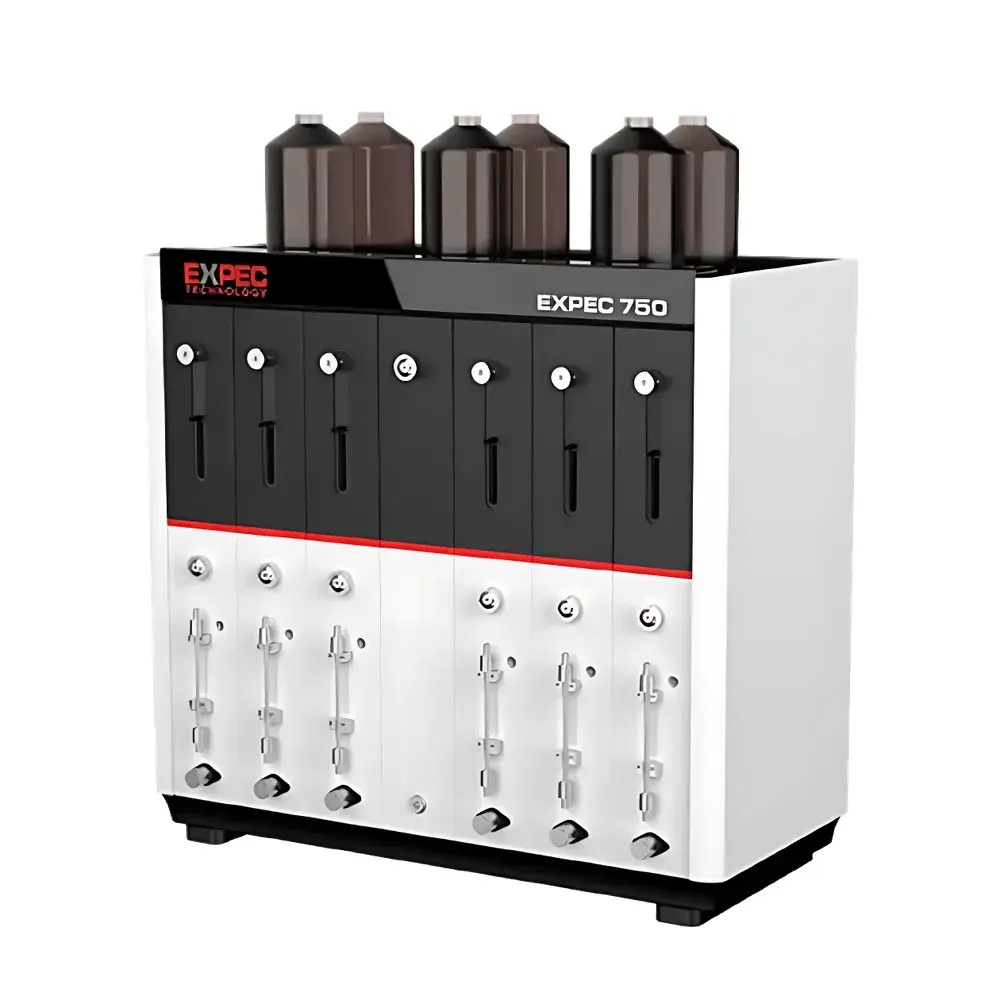
EXPEC 750 Automated Ion Exchange System
| Brand | EXPEC (Puyu Technology) |
|---|---|
| Origin | Zhejiang, China |
| Model | EXPEC 750 |
| Flow Rate Range | 0.5–600 mL/min |
| Channel Capacity | 6 parallel channels |
| Operation Modes | Fully automated activation, sample loading, washing, and elution with programmable sequence editing |
| Sample Processing Time | 10–20 min per batch |
| Compatibility | Integrated interface for AFS, ICP-OES, and ICP-MS instrumentation |
| Column Type | Pressure-rated separation column with closed-loop fluidic control |
| Precision Feature | Automatic final volume adjustment (auto-dilution/evaporation compensation) |
| Regulatory Context | Designed to support GLP-compliant workflows and traceable sample preparation under ISO/IEC 17025 laboratory accreditation requirements |
Overview
The EXPEC 750 Automated Ion Exchange System is an engineered solution for high-precision, reproducible sample pre-concentration and matrix separation in trace elemental analysis. Based on classical ion exchange chromatography principles—where analyte ions are selectively retained on a functionalized resin bed according to charge density, ionic radius, and hydration energy—the system enables quantitative isolation of target elements (e.g., As, Se, Cr, U, rare earth elements) from complex, high-salt, or organic-rich matrices. Unlike manual or semi-automated approaches, the EXPEC 750 implements full process control over all four critical ion exchange steps: column conditioning (activation), sample loading, matrix removal (washing), and analyte elution. Its pressure-rated column architecture ensures consistent linear velocity across variable flow rates (0.5–600 mL/min), minimizing band broadening and maximizing recovery reproducibility—particularly essential when handling sub-ppt level analytes in environmental water, geological digests, biological tissues, or semiconductor-grade reagents.
Key Features
- Fully programmable workflow engine supporting customizable sequences for activation, loading, washing, and elution—with real-time monitoring of pressure, flow rate, and valve position.
- Six independent processing channels operating in parallel, enabling throughput scaling without cross-contamination; each channel features dedicated pump, detector, and fraction collector modules.
- Closed-loop fluidic architecture with integrated pressure sensors and proportional flow control valves to maintain ±1.5% volumetric accuracy across the full operational range.
- Auto-final-volume adjustment function: post-elution fractions are automatically diluted or concentrated to a user-defined target volume (e.g., 1.0 mL or 5.0 mL), ensuring compatibility with downstream instrumental injection volumes.
- Modular hardware design compliant with standard laboratory bench footprint (W × D × H: 720 × 600 × 650 mm); CE-marked power supply and low-voltage actuation meet IEC 61010-1 safety requirements.
Sample Compatibility & Compliance
The EXPEC 750 accommodates aqueous samples with total dissolved solids (TDS) up to 15 wt%, including acid-digested soils, seawater filtrates, enzymatic tissue lysates, and high-purity chemical reagents. It supports common ion exchange resins—including strong cation exchangers (e.g., AG-MP-50), chelating resins (e.g., Nobias Chelate-PA1), and anion exchangers (e.g., AG-MP-1)—via standardized 10–25 mm ID column adapters. All fluid-contact surfaces are constructed from PEEK, ETFE, and sapphire to resist corrosion by HNO₃, HCl, and HF at concentrations up to 6 mol/L. The system logs timestamped audit trails for every step (including reagent lot numbers, operator ID, and column cycle count), satisfying documentation requirements for ISO/IEC 17025 accredited laboratories and supporting FDA 21 CFR Part 11 compliance when paired with validated LIMS integration.
Software & Data Management
Control and method development are performed via EXPEC PrePrep Studio—a Windows-based application supporting IEC 62443-aligned secure authentication (LDAP/Active Directory), role-based access control, and electronic signature capture. Methods include built-in validation templates aligned with ASTM D5673 (for trace metal speciation in water) and ISO 17294-2 (for ICP-MS sample introduction). Raw event logs (valve switching, pump strokes, pressure spikes) are exported in CSV/JSON format; processed data files embed MD5 checksums and digital signatures to ensure integrity during transfer to ICP-MS data systems (e.g., Thermo Fisher Qtegra, Agilent MassHunter). Software updates follow a formal change control process documented per ISO 9001:2015 clause 8.5.6.
Applications
- Environmental Monitoring: Speciation of Cr(III)/Cr(VI), As(III)/As(V), and Sb(III)/Sb(V) in wastewater and groundwater prior to hydride generation-AFS or collision-cell ICP-MS.
- Geochemical Analysis: Matrix removal and REE pre-concentration from silicate rock leachates containing >10% Al and Fe oxides.
- Food Safety Testing: Cadmium and lead isolation from cereal extracts with co-extracted phytates and polyphenols.
- Nuclear Materials Assay: Uranium/plutonium separation from spent fuel dissolution solutions using TEVA® resin protocols.
- Semiconductor Metrology: Ultra-trace boron and phosphorus purification from high-purity H₂O₂ and NH₄OH used in wafer cleaning.
FAQ
Can the EXPEC 750 be integrated with third-party autosamplers?
Yes—via RS-232, Ethernet TCP/IP, or dry-contact trigger signals, it synchronizes start/stop commands with PerkinElmer, Agilent, and Shimadzu autosamplers.
Is method validation support available?
Puyu Technology provides application notes compliant with AOAC 2020.01 and EPA Method 200.8, including spike recovery, MDL verification, and carryover assessment protocols.
What maintenance intervals are recommended for long-term reliability?
Resin column replacement every 200–500 cycles depending on matrix load; pump tubing inspection every 3 months; annual calibration of flow sensors against gravimetric standards.
Does the system support gradient elution?
No—EXPEC 750 implements isocratic elution only, optimized for robustness and regulatory acceptance in routine QA/QC environments.
How is carryover minimized between samples?
Each channel includes a dedicated post-elution purge with ≥5 column volumes of blank solution, followed by real-time conductivity monitoring to confirm baseline restoration before next run initiation.



