
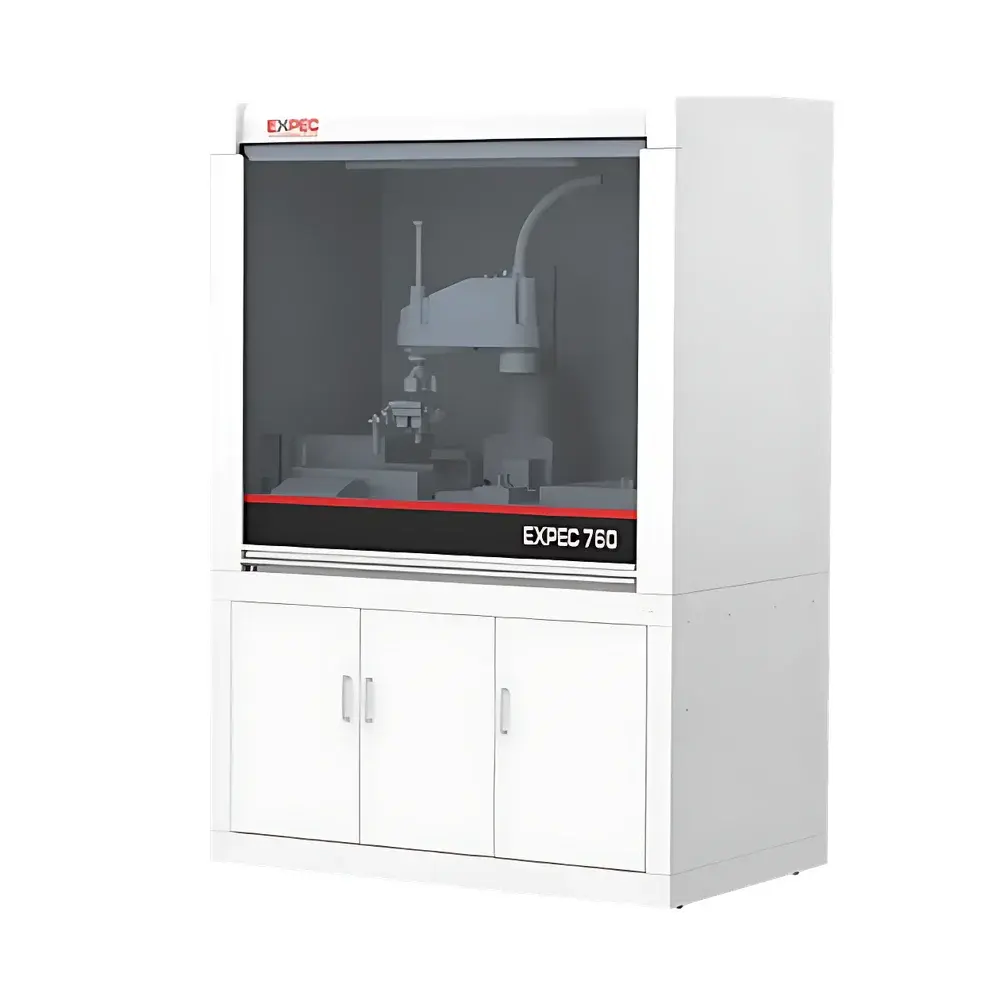
EXPEC 760 Automated Powder Weighing System
| Brand | EXPEC (Hangzhou Superspectra Technology Co., Ltd.) |
|---|---|
| Origin | Zhejiang, China |
| Model | EXPEC 760 |
| Balance Options | 0.01 mg (10 µg) or 0.1 mg resolution |
| Anti-static Ionizer | Integrated dual-nozzle air ionization system |
| Robotic Arm | 4-axis articulated robot with ±0.05 mm repeatability |
| Vibration Isolation | Triple-stage passive damping platform |
| Weighing Enclosure Control | Motorized draft shield door actuation synchronized with weighing cycle |
| Sample Tube Handling | Barcode-scanned vial identification, automated cap removal/placement in dedicated sterile zone |
| Data Output | CSV/Excel export, audit-trail-enabled database logging compliant with GLP requirements |
| Compliance | Designed to support ISO/IEC 17025 workflows and FDA 21 CFR Part 11–ready data integrity architecture |
Overview
The EXPEC 760 Automated Powder Weighing System is an integrated laboratory workstation engineered for high-precision, trace-level mass measurement of dry solid powders in regulated analytical environments. It operates on the principle of electromagnetic force compensation (EMFC) balance technology, combined with closed-loop robotic sample handling and real-time environmental stabilization. Unlike manual or semi-automated weighing procedures, the EXPEC 760 eliminates operator-induced variability—including static charge accumulation, mechanical vibration transmission, inconsistent pouring dynamics, and transcription errors—by executing the entire weighing sequence within a controlled microenvironment. The system is purpose-built for applications requiring strict mass traceability, such as certified reference material (CRM) preparation, nuclear fuel assay standards, geochemical standardization, and regulatory-compliant QC/QA protocols in environmental and industrial laboratories.
Key Features
- High-resolution weighing module: Configurable with either 0.01 mg (10 µg) or 0.1 mg readability EMFC balances, each calibrated per ISO 17025-accredited procedures and equipped with internal automatic calibration weights.
- Integrated anti-static management: Dual-nozzle ionized airflow system actively neutralizes electrostatic charge on powder surfaces and container walls prior to and during dispensing—critical for cohesive, low-mass samples (e.g., uranium oxides, rare-earth compounds, or fine tobacco alkaloid extracts).
- Four-axis robotic manipulator: Precision-engineered arm with repeatable positioning accuracy of ±0.05 mm; designed to emulate human wrist articulation for controlled vial orientation, cap torque application, and vibrational powder release.
- Triple-stage passive vibration isolation platform: Composed of elastomeric mounts, tuned mass dampers, and constrained-layer damping layers—reducing floor-borne and acoustic interference below 1 Hz to preserve balance stability during sub-milligram measurements.
- Automated draft shield control: Motor-driven transparent enclosure doors open only during vial placement and removal, minimizing air turbulence and thermal drift while enabling rapid stabilization (< 3 s settling time post-door closure).
- Barcode-driven workflow engine: Supports GS1-128, Code 128, and DataMatrix symbologies; validates tube identity against LIMS or ELN databases before initiating any operation, ensuring full chain-of-custody compliance.
Sample Compatibility & Compliance
The EXPEC 760 accommodates standard 10–20 mL screw-cap vials (e.g., Wheaton, Kimble Chase), 13–32 mm diameter cylindrical containers, and custom-designed powder transfer tubes with integrated RFID tags (optional). It supports hygroscopic, abrasive, and mildly radioactive powders (up to Class III non-sealed source handling per IAEA SSG-30 guidelines) when used with appropriate containment accessories. All firmware and software modules are developed under a documented design control process aligned with ISO 13485 principles. Data capture includes timestamped operator ID, balance serial number, environmental sensor readings (temperature, humidity, barometric pressure), and digital signatures—enabling full audit trail reconstruction required for GLP, GMP, and nuclear regulatory audits (e.g., NRC 10 CFR Part 21, CNSC REGDOC-2.5.2).
Software & Data Management
The embedded EXPEC WeighSuite™ software provides role-based access control (RBAC), electronic signature enforcement, and configurable SOP-driven method templates. Each weighing event generates a structured XML metadata file containing raw balance output, robotic motion logs, ionizer status, and environmental telemetry. Data export options include secure HTTPS push to LIMS (via ASTM E1384-compliant interfaces), local encrypted SQLite storage with SHA-256 hash verification, and PDF report generation with embedded QR-coded audit trails. The system maintains full 21 CFR Part 11 readiness through built-in electronic signature validation, biometric or PKI-authenticated login, and immutable log archiving with write-once-read-many (WORM) policy enforcement.
Applications
- Nuclear materials laboratories: Preparation of uranium/plutonium oxide standards for gamma spectrometry calibration and isotopic dilution mass spectrometry (IDMS).
- Geochemical reference labs: Homogenization and gravimetric sub-sampling of soil, sediment, and rock powders for multi-element ICP-MS analysis per ISO 13528 and ASTM D7286 protocols.
- Tobacco research facilities: Accurate dosing of nicotine alkaloids, nitrosamines, and flavor compounds into GC-MS vials under ISO 46001-compliant workflows.
- Environmental testing labs: Gravimetric preparation of PM2.5/PM10 filter load standards and certified dust reference materials per EN 12341 and EPA Method IO-3.2.
- Pharmaceutical R&D: Excipient blending studies and early-phase API dose formulation where batch-to-batch mass consistency impacts dissolution kinetics and bioavailability modeling.
FAQ
Does the EXPEC 760 support integration with third-party LIMS or ELN platforms?
Yes—the system offers native RESTful API endpoints and pre-certified drivers for Thermo Fisher SampleManager, LabVantage, and Agilent OpenLab ECM, all conforming to ASTM E1578 and ISO/IEC 17025 Annex A.3 interoperability requirements.
Can the robotic arm handle irregularly shaped or non-standard containers?
Standard operation supports cylindrical vials with flat bottoms and uniform thread geometry. Custom end-effectors and vision-guided alignment modules are available under OEM engineering services agreement.
Is the ionization system compatible with inert-atmosphere gloveboxes?
The ionizer may be retrofitted with nitrogen-purged nozzles and explosion-proof enclosures for Class I, Division 2 environments; full glovebox integration requires mechanical interface review and pressure differential validation.
How frequently must the balance module be recalibrated?
Internal auto-calibration triggers every 2 hours or after temperature shifts >0.5 °C; external verification using NIST-traceable weights is recommended daily for GLP work or per ISO 9001 Clause 7.1.5.2.
What cybersecurity measures are implemented in the control software?
Firmware employs TLS 1.3 encryption for network communications, secure boot with signed code verification, and runtime memory protection (ARM TrustZone). All user actions generate immutable Syslog entries with cryptographic hashing for forensic auditing.



