
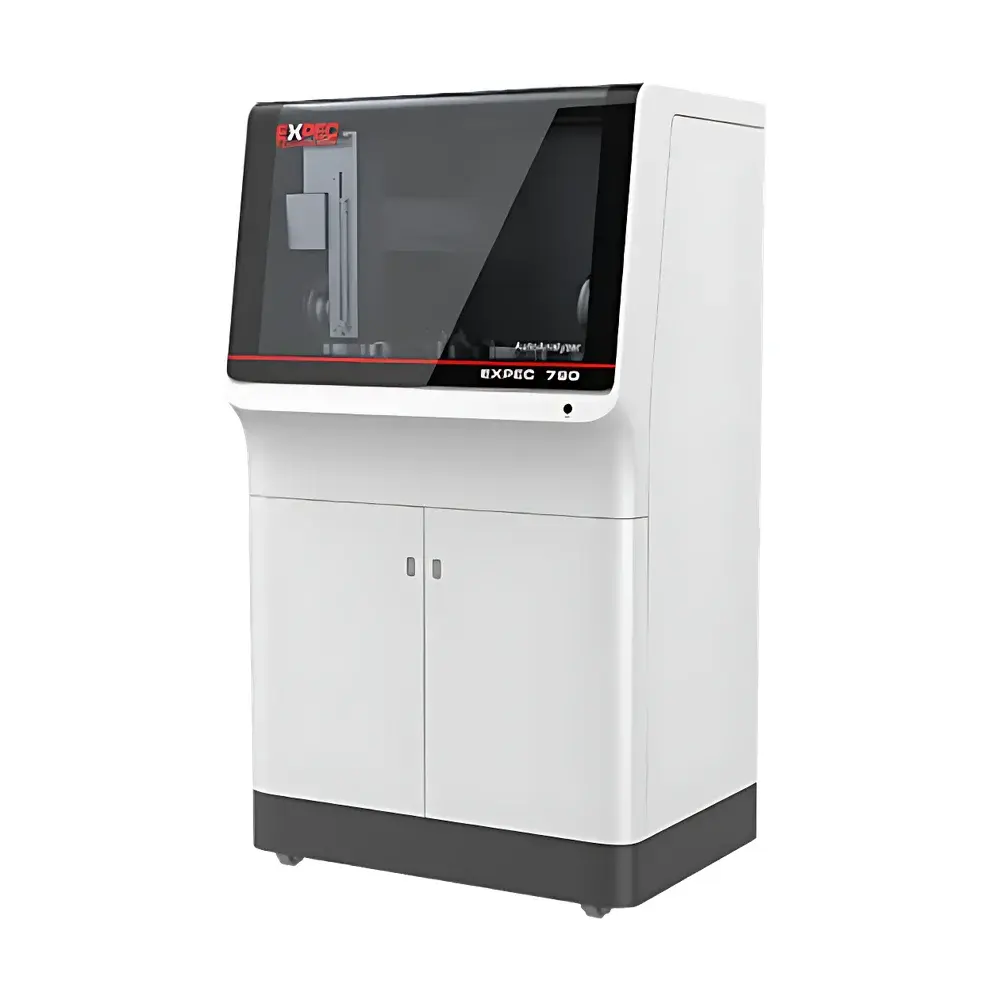
EXPEC 790F Fully Automated High-Pressure Microwave Digestion System
| Brand | EXPEC (Puyu Technology) |
|---|---|
| Origin | Zhejiang, China |
| Model | EXPEC 790F |
| Maximum Operating Temperature | 300 °C |
| Maximum Operating Pressure | 20 MPa |
| Safety Vessel Rating | 30 MPa |
| Digestion Cavity | Single-zone, uniform temperature/pressure |
| Sample Capacity | Up to 96 samples per batch (configurable rotor: 6/8/18/24 positions) |
| Acid Volume Range | 2–3 mL per sample |
| Final Volume Accuracy | <1% RSD at 50 mL (5–50 mL range) |
| Reagent Delivery | PTFE-lined peristaltic pumps & precision syringe pump |
| Filtration | Auto-replacement disposable filter cartridges |
| Interface | ICP-OES/ICP-MS direct coupling support |
| Compliance | Designed for GLP/GMP-aligned workflows |
Overview
The EXPEC 790F Fully Automated High-Pressure Microwave Digestion System is an engineered solution for trace-element sample preparation in modern analytical laboratories. Based on closed-vessel microwave-assisted acid digestion principles, it employs controlled electromagnetic energy absorption within pressurized TFM, quartz, or borosilicate glass vessels to achieve complete matrix decomposition under precisely regulated thermal and pressure conditions. Operating up to 300 °C and 20 MPa, the system enables rapid, reproducible mineralization of refractory organic and inorganic matrices—critical for accurate quantification by ICP-OES, ICP-MS, AAS, and other elemental analysis platforms. Its single-chamber architecture ensures uniform thermal distribution and synchronized pressure profiles across all samples, eliminating inter-vessel variability commonly observed in multi-cavity systems. The design adheres to fundamental safety and metrological principles of microwave digestion: controlled power ramping, real-time pressure/temperature feedback, and fail-safe mechanical interlocks.
Key Features
- Fully automated workflow integration: robotic lid actuation, reagent dispensing (via syringe and PTFE-peristaltic pumps), post-digestion ultrasonic-assisted volumetric定容 (5–50 mL, <1% RSD), homogenization, filtration with auto-filter cartridge replacement, and sample transfer to autosamplers or ICP interfaces.
- High-integrity pressure containment: dual-phase stainless steel cavity rated to 30 MPa, incorporating redundant pressure relief mechanisms and hardware-enforced safety interlocks that prevent operation outside certified parameters.
- Programmable pre-pressurization protocol: mitigates violent boiling during ramp-up by establishing initial inert gas or vapor-phase equilibrium—reducing risk of vessel failure and cross-contamination without requiring outer protective sleeves.
- Modular rotor compatibility: supports interchangeable rotors with 6, 8, 18, or 24 positions; scalable configuration allows batch processing of up to 96 samples using standardized consumables and method templates.
- Chemical-resistant fluid path: all wetted components—including tubing, valves, and injector nozzles—are constructed from PTFE or equivalent fluoropolymer materials, ensuring long-term stability against concentrated HNO₃, HCl, HF, and HClO₄.
Sample Compatibility & Compliance
The EXPEC 790F accommodates diverse sample types including foodstuffs, soil/sediment, polymer composites, pharmaceutical excipients, geological silicates, petrochemical residues, and cosmetic formulations. Its high-temperature/pressure capability meets or exceeds digestion requirements specified in ASTM D5511, ISO 11885, USP , and EPA Methods 3050B, 3051A, and 3052. The system’s architecture supports compliance-driven laboratory practices: electronic method storage, user-access logging, parameter change tracking, and exportable audit trails aligned with FDA 21 CFR Part 11 and GLP/GMP documentation standards. All consumables—including TFM digestion tubes and disposable filters—are traceably sourced and certified for low-background elemental contamination.
Software & Data Management
The embedded control software provides intuitive method creation, scheduling, and remote monitoring via Ethernet or Wi-Fi. Each digestion run generates a timestamped metadata record containing setpoints, real-time sensor logs (pressure, temperature, power), alarm events, and completion status. Method libraries are exportable/importable in XML format for cross-instrument standardization. Software supports role-based access control (administrator, analyst, reviewer) and integrates with LIMS through configurable API endpoints. Raw data files include checksums and digital signatures to ensure integrity during archival or regulatory submission.
Applications
This system serves as a core front-end module in laboratories performing elemental impurity testing per ICH Q3D, heavy metal screening in consumer products (CPSIA, RoHS), nutrient profiling in agricultural commodities, speciation studies requiring quantitative recovery, and environmental monitoring of regulated metals (As, Cd, Cr, Pb, Hg, Ni). Its automation fidelity enables unattended overnight operation—particularly valuable in high-throughput QA/QC environments such as contract testing labs, national reference facilities, and pharmaceutical manufacturing sites implementing Quality by Design (QbD) frameworks.
FAQ
What vessel materials are supported?
TFM, quartz, and borosilicate glass digestion tubes are compatible—each validated for pressure and chemical resistance under specified operating conditions.
Does the system require external cooling or ventilation?
Yes: installation requires connection to a dedicated fume hood or active exhaust system rated for acidic vapors; ambient operating temperature must remain between 15–30 °C.
Can digestion methods be transferred between EXPEC 790F units?
Yes: method files are portable across instruments of the same firmware version and can be validated per ISO/IEC 17025 clause 7.2.2.
Is remote diagnostics supported?
Field-service engineers may initiate secure remote sessions with user authorization for troubleshooting and calibration verification.
How is filter integrity verified during operation?
The system performs real-time differential pressure monitoring across each filter cartridge and triggers automatic replacement upon reaching predefined clogging thresholds.



