
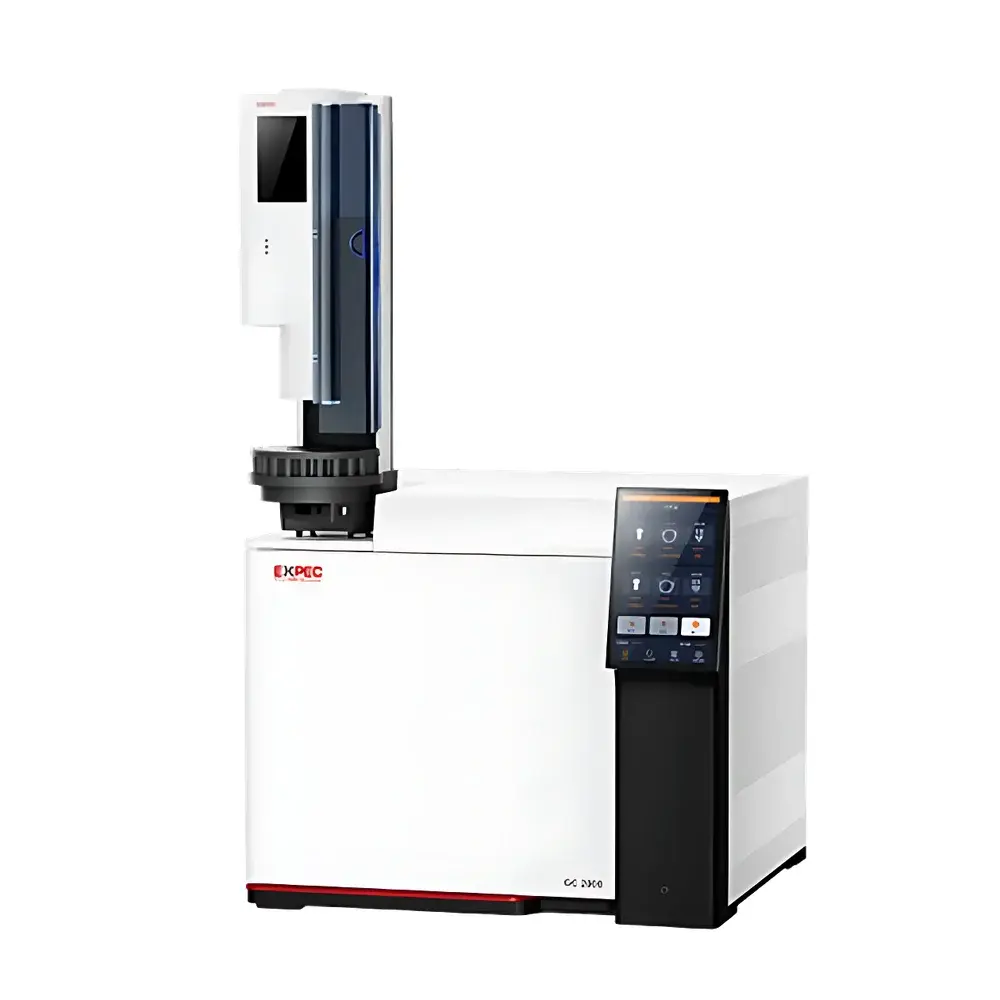
EXPEC GC 2000 Laboratory Gas Chromatograph
| Brand | EXPEC (Puyu Technology) |
|---|---|
| Origin | Zhejiang, China |
| Model | GC 2000 |
| Instrument Type | Benchtop Laboratory Gas Chromatograph |
| Electronic Pressure Control (EPC) | Up to 6 modules, controlling up to 18 gas channels |
| EPC Precision | 0.001 psi |
| Sample Path Surface Treatment | Ultra-inert deactivation for N/O/S/P-containing compounds |
| Operating System | Android-based open platform with touch interface |
| Software | Legacy-compatible workstation with sequence/method editing, real-time chromatogram display, multi-sample statistical comparison and trend visualization |
| Compliance Support | Designed for GLP/GMP environments |
Overview
The EXPEC GC 2000 is a benchtop laboratory gas chromatograph engineered for high reproducibility, operational consistency, and analytical flexibility in regulated and research-intensive environments. Built upon over a decade of gas chromatography R&D by Puyu Technology, the GC 2000 implements a fully digital electronic pressure control (EPC) architecture—capable of managing up to 18 independent gas flow paths via six modular EPC units. Each EPC module utilizes ruby-based microfluidic components, selected for dimensional stability, chemical inertness, and resistance to thermal drift. This design enables precise pneumatic regulation at ±0.001 psi resolution, directly contributing to retention time stability (<0.02% RSD) and peak area repeatability (<0.5% RSD) across extended sequences. The instrument operates on a carrier gas–driven separation principle, where volatile and semi-volatile analytes are partitioned between a mobile phase (inert carrier gas, e.g., He, H₂, or N₂) and a stationary phase coated inside a fused-silica capillary column. Separation efficiency is governed by compound volatility, polarity, and interaction kinetics with the column chemistry—making the GC 2000 suitable for applications ranging from residual solvent analysis to environmental VOC profiling.
Key Features
- Digital EPC architecture with ruby-core flow controllers ensuring long-term pressure stability and minimal calibration drift
- Ultra-inert sample pathway: all surfaces contacting the analyte—including inlet liners, transfer lines, and detector interfaces—are subjected to proprietary surface deactivation treatment, minimizing adsorption and catalytic degradation of labile compounds containing nitrogen, oxygen, sulfur, or phosphorus
- Front-panel 10.1-inch capacitive touchscreen running a custom Android-based UI, supporting real-time status monitoring, contextual fault diagnostics, and adaptive parameter logging
- Backward-compatible workstation software preserving decades of user workflow conventions—integrated method editor, sequence scheduler, and live chromatogram viewer with baseline correction and peak integration tools
- Modular expansion capability: compatible with EXPEC’s HS-2000 headspace sampler, NMHC-1000 non-methane hydrocarbon autoinjector, single-quadrupole MS (GC-MS), and triple-quadrupole tandem MS (GC-MS/MS) systems
- Embedded data analytics engine enabling cross-sample statistical comparison (e.g., %RSD, fold-change, PCA-ready export) and time-series trend visualization without external spreadsheet manipulation
Sample Compatibility & Compliance
The GC 2000 accommodates liquid, gaseous, and solid-phase extracted samples introduced via split/splitless, PTV, or cold-on-column inlets. Its ultra-inert flow path ensures reliable quantification of thermally labile, polar, or reactive species—including amines, mercaptans, organophosphates, and heterocyclic compounds—without peak tailing or sensitivity loss. The system meets functional requirements for ISO 17025-accredited laboratories and supports documentation practices aligned with FDA 21 CFR Part 11 (when paired with validated software configurations), EU Annex 11, and ICH Q2(R2) method validation guidelines. Audit trail functionality, electronic signatures, and version-controlled method storage are implemented at the firmware level to facilitate GLP and GMP compliance audits.
Software & Data Management
The GC 2000’s native software suite comprises two integrated layers: the instrument control layer (running on the Android OS touchscreen) and the desktop data processing layer (Windows-based workstation). The control interface provides real-time feedback on oven temperature, detector status, EPC setpoints, and active method parameters—displayed through intuitive iconography and color-coded alerts. The workstation software maintains full backward compatibility with legacy EXPEC method files and supports automated report generation compliant with LIMS integration standards (ASTM E1482, ASTM E2500). Raw data (.CDF) and processed results (.CSV, .PDF) are stored with embedded metadata (operator ID, instrument serial, calibration date, audit log hash), satisfying traceability requirements under ISO/IEC 17025 Clause 7.7.
Applications
The GC 2000 serves as a primary analytical platform across multiple regulated and exploratory domains: pesticide residue screening in fruits and vegetables (aligned with EU MRLs and EPA Method 8081B); disinfection by-product analysis (e.g., trihalomethanes, haloacetic acids) in drinking water per EPA Method 524.3; volatile organic compound (VOC) profiling in ambient air and industrial emissions (per EPA TO-17 and ISO 16017-1); forensic toxicology screening for drugs of abuse and accelerants; and polymer additive migration studies in food contact materials (per EU Regulation 10/2011). Its modularity allows seamless transition from routine QC to advanced identification workflows when coupled with mass spectrometric detection.
FAQ
Is the GC 2000 compliant with 21 CFR Part 11 for electronic records and signatures?
Yes—when deployed with validated software configuration and appropriate administrative controls (e.g., role-based access, audit trail activation, and electronic signature protocols), the system supports Part 11 compliance.
Can the GC 2000 be integrated into an existing LIMS environment?
Yes—the workstation exports structured data in ASTM E1482-compliant formats and supports ODBC connectivity for direct LIMS ingestion.
What carrier gases are supported, and how is gas purity managed?
Helium, hydrogen, and nitrogen are supported; optional integrated gas purifiers (99.999% grade) and pressure-swing adsorption modules are available as accessories.
Does the ultra-inert surface treatment require periodic reapplication?
No—the deactivation is a permanent, covalently bonded coating applied during manufacturing and does not degrade under normal operating conditions.
Is remote monitoring and control possible?
Yes—via secure HTTPS-enabled web interface (optional license), allowing real-time instrument status viewing, method queue management, and alarm notification through enterprise IT infrastructure.






