
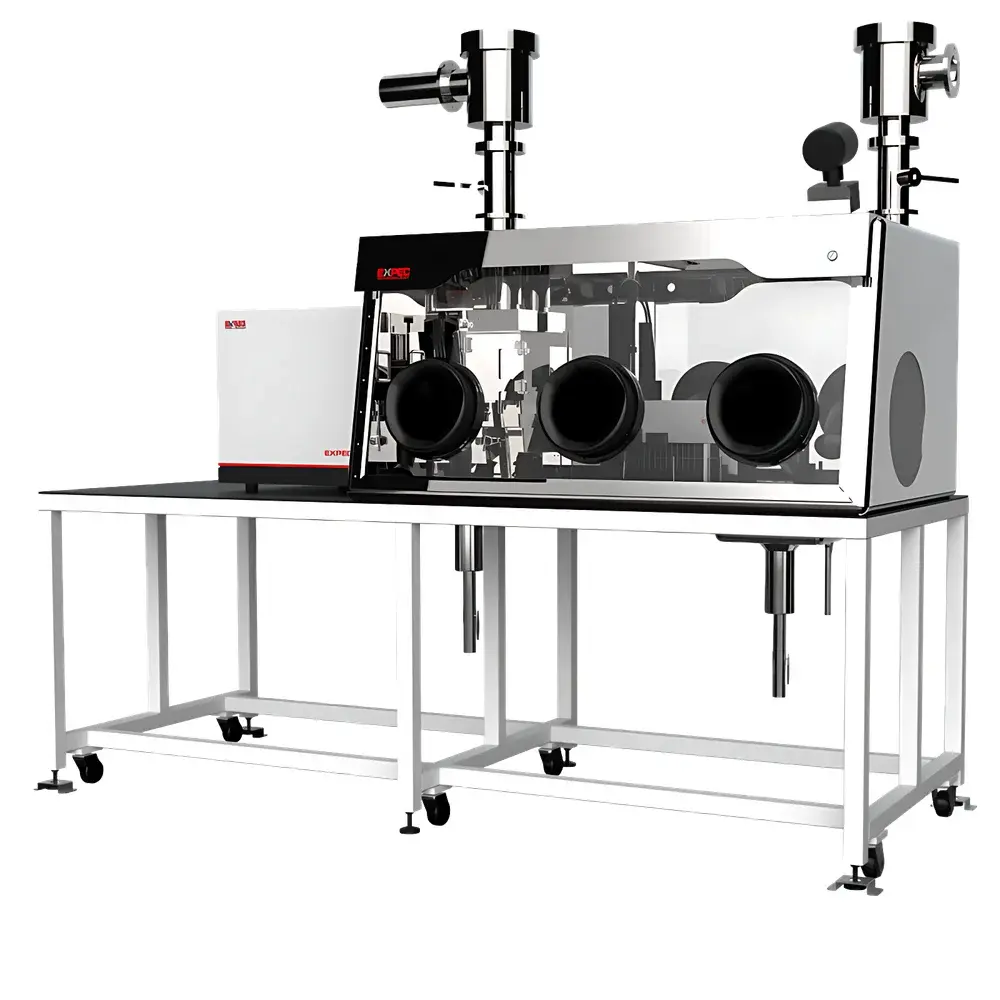
EXPEC SPEC Pro 6000 Protective Inductively Coupled Plasma Optical Emission Spectrometer
| Brand | EXPEC |
|---|---|
| Origin | Zhejiang, China |
| Manufacturer Type | Authorized Distributor |
| Regional Classification | Domestic (China) |
| Model | SPEC Pro 6000 |
| Instrument Type | Full-Spectrum Simultaneous ICP-OES |
Overview
The EXPEC SPEC Pro 6000 Protective Inductively Coupled Plasma Optical Emission Spectrometer is an engineered solution for elemental analysis of hazardous, radioactive, or highly toxic samples under controlled containment conditions. It integrates a high-performance full-spectrum simultaneous ICP-OES system with a certified inert-atmosphere glovebox—configured in a physically separated architecture. In this design, the plasma source, optical spectrometer, and detection subsystem remain external to the containment environment, while only sample introduction components—including nebulizer, spray chamber, torch assembly, and peristaltic pump—are housed inside the glovebox chamber. This separation ensures that critical analytical hardware remains isolated from contamination, thermal stress, or radiological exposure, thereby preserving long-term calibration stability, optical throughput integrity, and RF generator reliability. The instrument operates on the fundamental principle of inductively coupled plasma atomic emission spectroscopy: liquid samples are aerosolized, desolvated, atomized, and excited within a ~6,000–10,000 K argon plasma; emitted photons across the UV–Vis range (167–900 nm) are dispersed via a dual-stage echelle grating system and detected by a back-illuminated CCD sensor with anti-blooming architecture.
Key Features
- Physically decoupled glovebox–spectrometer architecture: Enables routine maintenance of plasma generator, RF matching network, and optical bench without breaching containment integrity.
- 8 mm tempered borosilicate viewing window with radiation-shielded polymer gloves (Pb-equivalent ≥ 0.5 mm): Supports safe manual manipulation of samples, consumables, and torch components under Class II or III biosafety/radiological containment protocols.
- Dual-chamber transfer lock system: Comprising independent large- and small-volume airlocks, enabling segregated transfer of samples and tools while maintaining internal overpressure or inert gas purge (N₂/Ar) during material exchange.
- Thermally stabilized echelle optical path: Enclosed spectrograph maintained at 36 ± 0.1 °C via active thermal equilibrium control, minimizing wavelength drift and ensuring <0.5 pm/h spectral stability over 8-hour operation.
- Full-digital solid-state RF generator: 700–1600 W continuously adjustable output, water-cooled, with real-time power and temperature interlock monitoring; power stability ≤ 0.1% RMS over 24 h.
- Multi-channel digital mass flow control: Precision regulation of auxiliary, nebulizer, and plasma argon streams (±0.01 L/min resolution); integrated argon fluid dynamics simulation optimizes purge efficiency for UV-sensitive elements (e.g., As, Se, P, S).
Sample Compatibility & Compliance
The SPEC Pro 6000 accommodates liquid samples (aqueous, organic, HF-digested, or high-salt matrices) introduced via a four-channel, 12-roller peristaltic pump with optional internal standard or standard addition capability. Its glovebox-integrated torch assembly supports rapid center-tube interchangeability for applications requiring alternative plasma geometries (e.g., low-flow, high-efficiency, or robust axial-view configurations). The system complies with ISO/IEC 17025:2017 requirements for testing laboratories, supports audit-ready electronic records per FDA 21 CFR Part 11 (when deployed with validated Element V software configuration), and meets structural safety standards outlined in IEC 61010-1 for electrical equipment used in laboratory environments. It is routinely deployed in facilities operating under DOE Order 440.1B (Worker Protection), NRC Regulatory Guide 8.29 (Radiological Effluent Monitoring), and ISO 15190:2020 (Medical laboratories — Requirements for safety).
Software & Data Management
Element V is a fully localized Chinese-language software platform built on a modular, object-oriented framework compliant with ASTM E1921 and ISO 11843-7 for detection limit estimation. It includes pre-validated method templates for nuclear fuel cycle materials (U/Pu isotopic ratios, fission product quantification), clinical biofluids (trace metal panels), and geological digests (REY, PGE, halogens). Key analytical algorithms include adaptive integration time adjustment, multi-point internal standard correction (e.g., Y, Sc, Rh), spectral interference modeling using reference line databases, and automated background subtraction based on adjacent pixel interpolation. All raw spectra, acquisition logs, calibration reports, and user action timestamps are stored in encrypted SQLite databases with configurable retention policies and role-based access controls.
Applications
- Nuclear industry: Quantitative determination of actinides (U, Pu, Am), fission products (Cs-137, Sr-90 surrogates), and corrosion indicators (Cr, Ni, Fe) in spent fuel reprocessing solutions and waste vitrification melts.
- Defense and aerospace: Trace element profiling of high-purity aluminum, titanium, and superalloy feedstocks exposed to neutron irradiation or chemical warfare agent simulants.
- Biosafety Level 3/4 laboratories: Elemental mapping of metalloproteins, nanoparticle biodistribution studies, and heavy metal screening in pathogen-inactivated serum or tissue homogenates.
- Geochemical research: Analysis of oxygen-sensitive ore leachates (e.g., sulfide-rich hydrothermal fluids) under nitrogen-purged glovebox conditions to prevent redox-driven speciation artifacts.
FAQ
Can the SPEC Pro 6000 analyze solid samples directly?
No—solid samples must be dissolved or laser-ablated prior to introduction; the system is configured exclusively for liquid nebulization.
Is remote operation supported for high-radiation environments?
Yes—optional Ethernet/IP-based PLC integration enables full instrument control, status monitoring, and emergency shutdown from outside the glovebox suite.
What is the typical argon consumption rate during standby vs. analysis mode?
Standby: ≤ 5 L/min (plasma off, purge maintained); Analysis: 14–18 L/min (plasma on, optimized flow distribution).
Does the system support regulatory-compliant data archiving for GLP/GMP audits?
Yes—when deployed with Element V’s audit trail module and validated file storage protocols, it fulfills ALCOA+ data integrity principles per WHO TRS 996 Annex 4 and EU GMP Annex 11.
How frequently does the torch require cleaning or replacement under continuous radioactive sample use?
Under typical nuclear lab usage (200–300 hr/year), quartz torches last ≥ 1,000 hours; center tube replacement frequency depends on matrix corrosivity and is tracked via Element V’s consumables log.





