
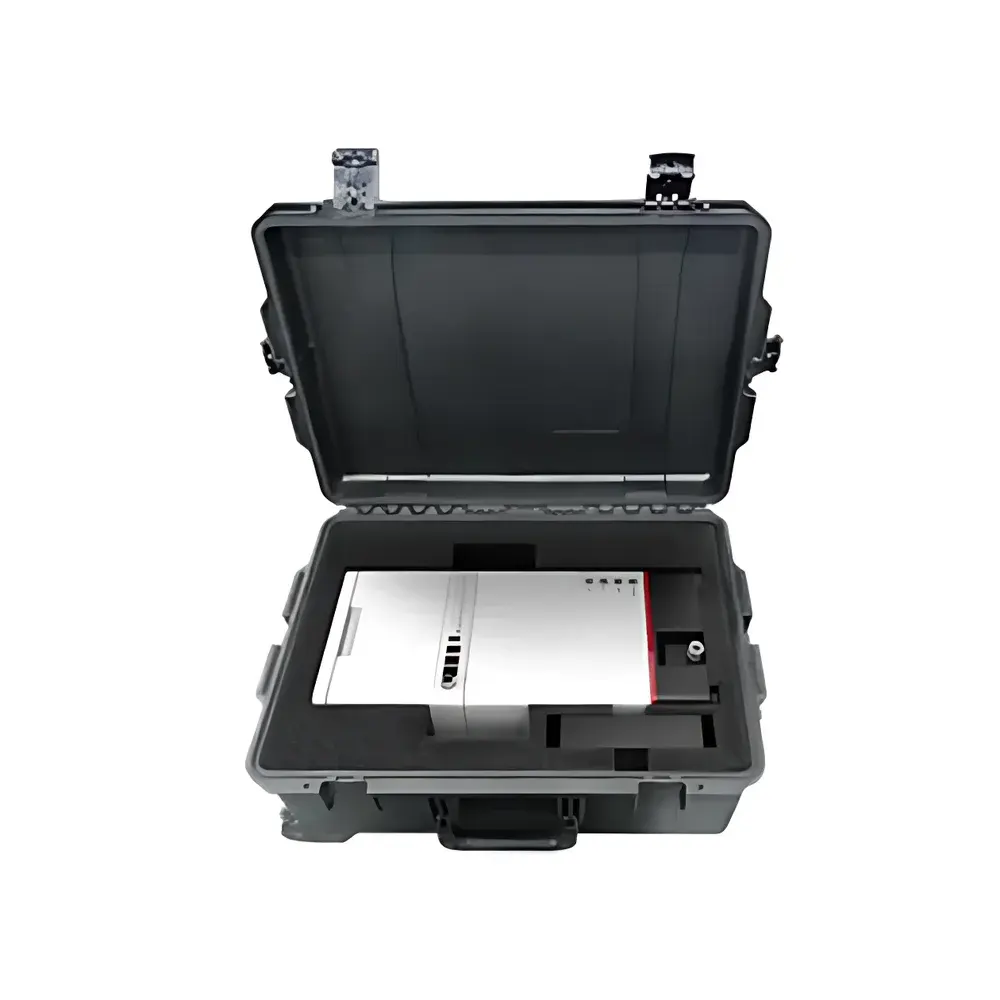
EXPEC SUPEC 5100 Portable Multi-parameter Water Quality Auto Analyzer
| Brand | EXPEC |
|---|---|
| Origin | Zhejiang, China |
| Manufacturer Type | Authorized Distributor |
| Model | SUPEC 5100 |
| Pricing | Upon Request |
Overview
The EXPEC SUPEC 5100 Portable Multi-parameter Water Quality Auto Analyzer is an integrated field-deployable analytical platform engineered for rapid, standardized, and traceable water quality assessment. It combines fully automated wet-chemistry digestion and colorimetric detection with broadband UV-Vis spectroscopy (190–1100 nm) in a single compact chassis. Unlike conventional benchtop spectrophotometers or discrete analyzers, the SUPEC 5100 implements sequential flow-through reagent delivery, temperature-controlled reaction cuvettes, and high-stability deuterium-halogen dual-source optics to enable simultaneous quantification of multiple parameters—including ammonia nitrogen (NH₃-N), total phosphorus (TP), total nitrogen (TN), permanganate index (CODMn), and chemical oxygen demand (CODCr)—within a single sample aspiration cycle. Its core measurement principle relies on Beer-Lambert law-based absorbance quantification at method-specified wavelengths, augmented by full-spectrum acquisition (1 nm resolution) to generate reference spectral fingerprints—the “Water Gene Spectral Library”—for empirical pattern matching and non-targeted contaminant screening.
Key Features
- Fully automated sample handling: Integrated peristaltic pump, auto-calibration valve manifold, and programmable reagent dispensing system eliminate manual pipetting and reduce operator-induced variability.
- UV-Vis spectral acquisition: Dual-beam optical path with thermoelectrically stabilized detector enables high signal-to-noise ratio (SNR > 3000:1) spectral scans across 190–1100 nm, supporting both targeted quantitation and untargeted spectral library generation.
- Field-rugged mechanical architecture: IP65-rated enclosure, shock-absorbing roll cage frame, and telescopic pull-handle design ensure operational integrity during transport in vehicles, on foot, or aboard mobile monitoring units.
- Regulatory-compliant methodology: All wet-chemistry protocols conform to Chinese national standards (e.g., HJ 535–2009 for NH₃-N; HJ 671–2013 for TP; HJ 636–2012 for TN) and are adaptable to ISO 6060 (COD), ISO 8467 (permanganate index), and ASTM D1253 (residual chlorine) where applicable.
- Self-documenting calibration workflow: Automatic standard series preparation, curve fitting (linear, quadratic, or cubic), audit-trail logging (including timestamp, operator ID, and environmental conditions), and secure storage of calibration history per parameter.
Sample Compatibility & Compliance
The SUPEC 5100 accepts raw water samples without pre-filtration for turbidity ≤ 100 NTU and suspended solids ≤ 50 mg/L. It supports direct analysis of surface water, groundwater, drinking water, domestic wastewater, and selected industrial effluents—provided sample matrix interference (e.g., chloride > 2000 mg/L for CODCr, heavy metal chelation for TP) falls within method-defined tolerance limits. Instrument validation follows GLP-aligned procedures, including spike recovery tests (85–115%), repeatability (RSD ≤ 5% at mid-range concentration), and inter-laboratory comparison per ISO/IEC 17043. Data integrity complies with ALCOA+ principles (Attributable, Legible, Contemporaneous, Original, Accurate, Complete, Consistent, Enduring, Available) and supports 21 CFR Part 11-ready electronic signatures when deployed with validated software configurations.
Software & Data Management
The embedded Windows-based control software provides guided workflow navigation—from system self-test and reagent priming to result export—with real-time graphical display of absorbance spectra, calibration curves, and QC charts. All spectral data (ASCII .csv and proprietary .wgs binary format), metadata (GPS coordinates, ambient temperature/humidity, operator ID), and audit logs are stored locally on encrypted internal SSD (≥128 GB capacity, supporting ≥5 years of continuous operation at 20 analyses/day). Data transmission options include Ethernet (TCP/IP), Wi-Fi 5 (802.11ac), and optional 4G LTE module. Remote access enables firmware updates, method deployment, and diagnostic telemetry via TLS 1.2-secured API endpoints compatible with centralized environmental data platforms (e.g., China’s National Surface Water Monitoring System, EU WISE).
Applications
- Rapid response to accidental spills or illegal discharges: On-site quantification and spectral fingerprinting enable preliminary source attribution within 15 minutes of sample intake.
- Mobile enforcement operations: Integration into environmental inspection vehicles allows real-time data upload to provincial regulatory dashboards during routine patrols.
- Temporary monitoring networks: Deployable at seasonal or construction-related sites where permanent stations are impractical; supports scheduled autonomous sampling every 1–24 hours.
- Reference laboratory verification: Used as a field-truthing tool to cross-validate results from central labs or online sensors (e.g., UV254, nitrate analyzers).
- Method development and training: Full-spectrum output facilitates spectral library expansion for emerging contaminants (e.g., microplastics leachates, pharmaceutical metabolites) under controlled research settings.
FAQ
Does the SUPEC 5100 require external power sources in the field?
No—it operates on integrated rechargeable Li-ion battery packs (rated for ≥8 hours continuous analysis at 25°C) and supports vehicle DC input (12–24 V) for extended deployments.
Can spectral libraries be exported and shared across instruments?
Yes—spectral datasets (.wgs) and associated metadata are exportable in open formats (.csv, .json); library templates are interoperable across EXPEC’s SUPEC series via firmware version 3.2.1 or later.
Is remote software update supported without physical access?
Yes—over-the-air (OTA) firmware and method updates are delivered via HTTPS-secured channels with SHA-256 signature verification and rollback capability.
How is calibration traceability maintained across field units?
Each instrument logs NIST-traceable reference standard IDs (e.g., CRM 111a for NH₃-N) alongside calibration events; reports include uncertainty budgets per GUM (ISO/IEC Guide 98-3).





