
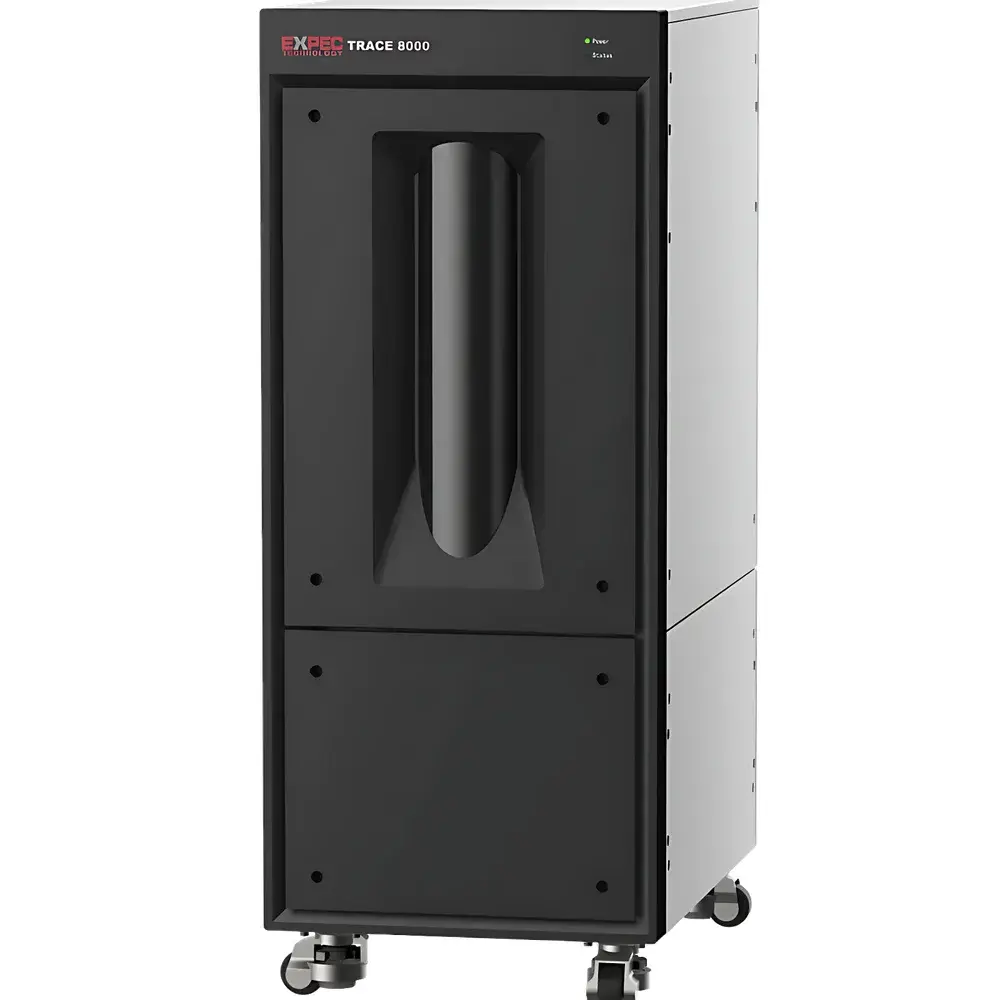
EXPEC TRACE 8000 Proton Transfer Reaction Time-of-Flight Mass Spectrometer
| Brand | EXPEC (Pubichem) |
|---|---|
| Origin | Zhejiang, China |
| Manufacturer Type | Authorized Distributor |
| Country of Origin | China |
| Model | TRACE 8000 |
| Instrument Type | Online VOC Analyzer |
| Ion Source | Dual-Anode Hollow Cathode Lamp with H₂O Reagent Ion Chemistry |
| Mass Analyzer | Vertical-Entry Reflectron Time-of-Flight (TOF) |
| Detection Mode | Soft Chemical Ionization (PCI) via H₃O⁺ Transfer |
| Typical LOD | <100 pptv (sub-ppb) for C₂–C₁₀ VOCs |
| Operating Mode | Unattended Continuous Monitoring |
| Compliance Framework | Designed for ISO 16000-22, ASTM D6196-20, and EPA Method TO-15/TO-17 compatible workflows |
Overview
The EXPEC TRACE 8000 is an online proton transfer reaction time-of-flight mass spectrometer (PTR-TOF-MS) engineered for real-time, high-sensitivity monitoring of volatile organic compounds (VOCs) in ambient air, industrial emissions, and indoor environments. It employs a dual-anode hollow cathode discharge lamp to generate stable, high-purity H₃O⁺ reagent ions from water vapor, enabling soft chemical ionization without fragmentation. Coupled with a vertically oriented reflectron TOF mass analyzer, the system delivers high mass resolution (>6,000 FWHM at m/z 100), sub-second spectral acquisition rates (<100 ms per spectrum), and precise mass accuracy (<3 ppm RMS). Unlike quadrupole or ion trap systems, the TRACE 8000 provides full-spectrum, untargeted detection—capturing all ionizable VOCs simultaneously without preselection—making it ideal for source apportionment, dynamic plume tracking, and multi-component trend analysis in regulatory and research-grade environmental monitoring applications.
Key Features
- Dual-anode hollow cathode ion source ensures long-term stability (>6 months continuous operation) and minimal reagent ion drift under variable humidity and temperature conditions.
- Vertical-entry reflectron TOF architecture minimizes flight path dispersion and enhances signal-to-noise ratio, particularly for low-abundance isobaric species (e.g., isoprene vs. methyl vinyl ketone).
- Sub-ppb (pptv-level) detection limits across >300 quantifiable VOCs—including aldehydes, aromatics, terpenes, oxygenated organics, and halogenated compounds—validated against certified reference standards.
- Integrated thermal management and active vibration damping meet IEC 60068-2-64 shock resistance requirements, enabling robust deployment on mobile platforms for drive-by mapping and boundary-layer profiling.
- Real-time mass calibration using internal lock-mass signals (e.g., H₃O⁺(H₂O)ₙ clusters) maintains mass axis fidelity over extended unattended runs—critical for GLP-compliant long-term datasets.
Sample Compatibility & Compliance
The TRACE 8000 interfaces directly with standard 1/4″ OD stainless steel or PFA sampling lines and supports flow-controlled inlet configurations (0.1–2.0 L/min) for ambient air, stack gas, or headspace analysis. No pre-concentration, cryo-trapping, or chromatographic separation is required—samples enter the drift tube as-is, preserving temporal integrity for second-scale event resolution. The instrument conforms to key regulatory frameworks: its data structure and audit trail capabilities align with FDA 21 CFR Part 11 for electronic records; raw spectral metadata (timestamp, pressure, temperature, drift field voltage) are embedded per scan to support ISO/IEC 17025 traceability; and its VOC response factors are calibrated per ISO 16017-1 for aromatic hydrocarbons and per ASTM D6196-20 for carbonyl compounds.
Software & Data Management
The proprietary EXPEC VOCView™ software provides a browser-accessible interface (HTTPS-secured) for remote configuration, real-time spectral visualization, and automated peak integration using centroided TOF spectra. It includes built-in NIST MS Search v2.4g library matching, retention index alignment (for hybrid GC-PTR-TOF setups), and customizable reporting templates compliant with local environmental authority formats (e.g., China MEP Form HJ 1019-2019, EU Air Quality Directive Annex XI). All raw .raw files are stored in HDF5 format with embedded metadata tags, enabling direct import into Python (via h5py) or MATLAB for advanced chemometric modeling (PCA, PMF, ML-based source identification). Audit logs record every parameter change, user login, calibration event, and instrument fault—retained for ≥36 months with optional SFTP backup to central LIMS.
Applications
- Fixed-site network monitoring: Deployed in urban air quality stations or industrial park perimeters to track diurnal/seasonal VOC profiles, identify outlier events (e.g., solvent releases), and feed predictive dispersion models.
- Mobile source attribution: Mounted on survey vehicles to generate georeferenced VOC concentration maps (GIS-integrated), resolve plume origins via wind-adjusted back-trajectory analysis, and prioritize enforcement actions.
- Indoor air quality assessment: Quantifies formaldehyde, acetaldehyde, and limonene in office buildings or schools with 5-minute averaging—supporting WHO IAQ guidelines and LEED v4.1 credit documentation.
- Biogenic emission studies: Captures rapid isoprene and monoterpenes flux changes during photosynthetic activity cycles—used in FLUXNET-affiliated ecosystem monitoring programs.
FAQ
Does the TRACE 8000 require external calibration gases for routine operation?
No—internal reagent ion chemistry and real-time mass calibration eliminate the need for daily gas standards. Certified multicomponent calibration kits (e.g., TO-15 mix) are recommended quarterly for quantitative method validation.
Can it distinguish structural isomers such as o-xylene and m-xylene?
Not by mass alone (both m/z 106.065), but when coupled with GC pre-separation or using collision-induced dissociation (CID) add-on modules, isomeric resolution is achievable.
What is the maximum sample humidity range supported without condensation?
The heated inlet line (maintained at 60°C ±2°C) and Nafion™ dryer option enable stable operation up to 95% RH at 25°C ambient—verified per ISO 16000-22 Annex B protocols.
Is remote firmware update capability available?
Yes—secure OTA updates are delivered via TLS 1.3 encrypted channels and require dual-factor authentication; each update package is cryptographically signed and validated prior to installation.







