
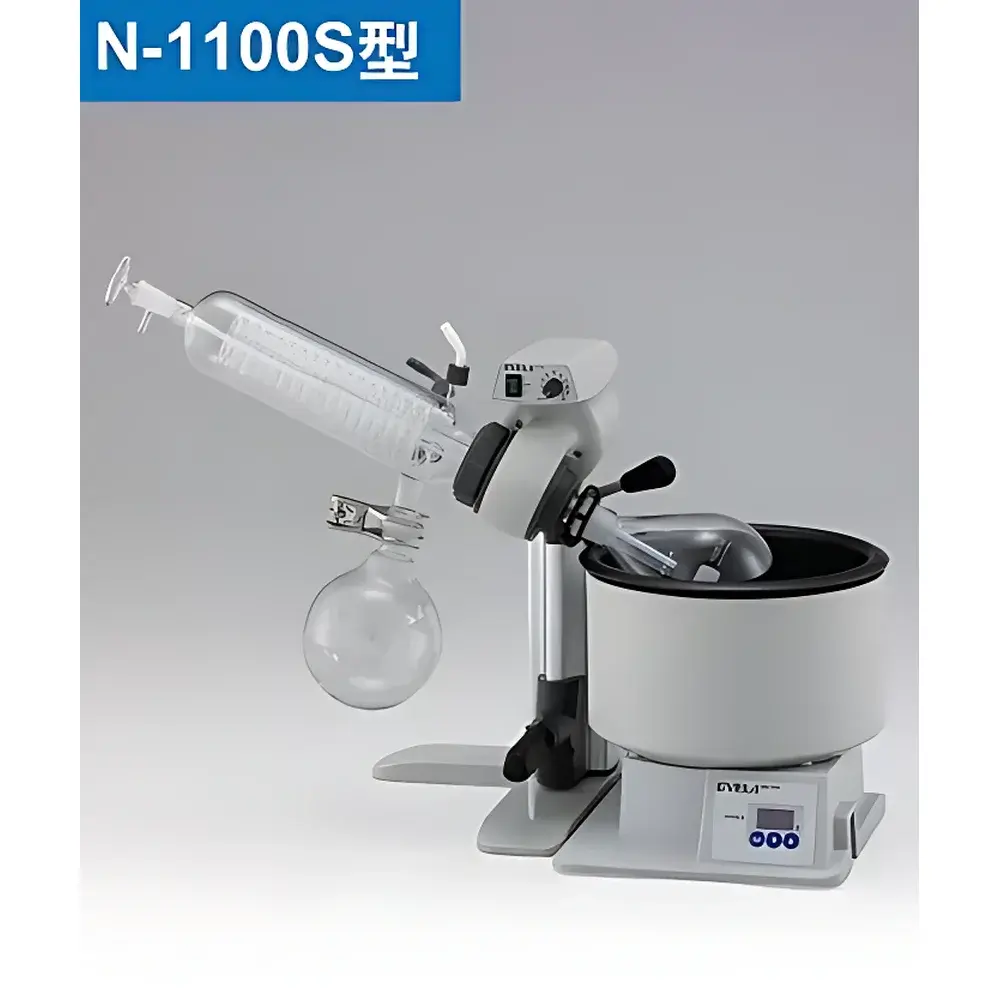
EYELA N-1100S-W Rotary Evaporator
| Brand | EYELA (Tokyo Rikakikai Co., Ltd.) |
|---|---|
| Origin | Japan |
| Model | N-1100S-W |
| Rotation Speed | 20–180 rpm |
| Max. Evaporation Rate | 18 mL/min |
| Ultimate Vacuum | <399.9 Pa (≤3 mmHg) |
| Temperature Range (Water Bath) | RT+5°C to 90°C |
| Temperature Range (Oil Bath, optional) | RT+5°C to 180°C |
| Temp. Control Accuracy | ±1.5°C (water), ±3.0°C (oil) |
| Heating Power | 1 kW |
| Condenser Type | Inclined double-layer coiled coil |
| Cooling Surface Area | 0.146 m² |
| Flask Capacity | Standard 1 L (max 3 L), Standard Taper: 29/38 |
| Collection Flask | 1 L spherical, Joint: S35/20 |
| Vertical Travel | 100 mm (manual lift) + 150 mm (auxiliary extension) |
| Bath Dimensions | Ø230×100 mm (≈3 L) or Ø240×120 mm (≈5.5 L) |
| Unit Dimensions & Weight | 710×355×510 mm, 11 kg (base config) |
| Sealing | Dual-material PTFE/fluoroelastomer vacuum seal |
| Safety Features | Thermal cut-off fuse, dry-run prevention sensor |
| Optional Integration | Compatible with DPE-1300/DPE-1400 solvent recovery units and NVC-series vacuum controllers |
Overview
The EYELA N-1100S-W is a precision-engineered inclined-type rotary evaporator designed for reliable, scalable solvent removal under controlled reduced-pressure conditions. It operates on the fundamental principle of lowering the boiling point of solvents via vacuum application while simultaneously rotating the sample flask to increase surface area and promote uniform thin-film evaporation. Its inclined configuration—distinct from vertical or horizontal designs—optimizes condensate flow dynamics and minimizes backflow risk during high-throughput or viscous-sample processing. Developed by Tokyo Rikakikai (EYELA), a globally recognized manufacturer of laboratory evaporation systems, the N-1100S-W meets stringent Japanese industrial standards (JIS B 7970) and aligns with international good laboratory practice (GLP) requirements for reproducible concentration, fractionation, and purification workflows in synthetic chemistry, natural product isolation, pharmaceutical development, and environmental analysis laboratories.
Key Features
- Inclined S-type architecture with optimized vapor path geometry for enhanced condensation efficiency and reduced bumping incidents.
- VF-series explosion-resistant coated glassware—including condenser, collection flask, and four-way adapter—retains optical clarity and mechanical strength while containing fragmentation upon accidental breakage, significantly improving operator safety.
- Two-stage manual elevation system: primary 100 mm lift via ergonomic handle with positive mechanical lock; secondary 150 mm auxiliary extension via telescoping upper column for fine positioning of small-volume or custom flasks (e.g., micro-receivers or air-sensitive vessels).
- Integrated dual-seal vacuum interface using PTFE and fluoroelastomer gaskets ensures long-term leak integrity across wide pressure ranges (down to <400 Pa) and compatibility with aggressive organic solvents including chlorinated and aromatic compounds.
- Modular heating bath options: SB-1100 (3 L water-only bath, max 90°C) or OSB-2100 (5.5 L water/oil bath, max 180°C), both featuring fully recessed heaters for easy cleaning and thermal stability.
- Microprocessor-based ON-OFF temperature control with digital setpoint input and real-time display; ±1.5°C accuracy in water mode supports precise thermal management for thermolabile compounds.
- Standardized ground-glass joints (29/38 taper on rotating shaft and flask; S35/20 on collection vessel) ensure interchangeability with EYELA’s broader ecosystem of accessories, including cold traps, vacuum regulators, and inert gas purging kits.
Sample Compatibility & Compliance
The N-1100S-W accommodates standard 1 L pear-shaped flasks (expandable to 3 L with optional holders) and is routinely deployed for aqueous, alcoholic, ethereal, and halogenated solvent systems. Its construction complies with IEC 61010-1:2010 for electrical safety in laboratory equipment and incorporates fail-safes per JIS C 0920:2017—specifically, a thermal fuse and dry-run detection sensor that deactivates heating if bath fluid level falls below operational threshold. When paired with the DPE-1300/DPE-1400 solvent recovery module, the system enables closed-loop organic solvent capture, satisfying local VOC emission regulations (e.g., U.S. EPA Method 25A, EU Directive 2010/75/EU) and supporting sustainability objectives in regulated QC/QA environments. For dioxin-class analyte work, the related N-1100SD variant—featuring transparent non-ground-joint flask mounting and 0.2 µm particulate/sterile-grade air inlet filtration—is recommended to prevent cross-contamination during vacuum release.
Software & Data Management
While the N-1100S-W operates as a standalone analog-digital hybrid instrument (no embedded data logging), it is fully compatible with EYELA’s NVC-series vacuum controllers—such as the NVC-2100—which provide programmable vacuum ramping, real-time pressure profiling, and RS-232/USB output for external acquisition. When integrated into validated laboratory networks, the unit supports 21 CFR Part 11-compliant audit trails when used with compliant third-party SCADA or LIMS platforms. All temperature and rotation parameters are manually logged per batch record requirements, and the system’s mechanical repeatability (±2 rpm at setpoint, ±0.5°C thermal drift over 4-h run) facilitates straightforward IQ/OQ documentation per ISO/IEC 17025:2017 Annex A.2 guidelines.
Applications
- Concentration of crude extracts in phytochemistry and nutraceutical R&D.
- Removal of reaction solvents (e.g., THF, DMF, dichloromethane) post-Suzuki coupling or Grignard synthesis.
- Preparative-scale purification of heat-sensitive APIs prior to lyophilization or crystallization.
- Environmental sample prep: EPA Method 1664B (n-hexane extractable material) and ASTM D7087 (diesel fuel distillate recovery).
- Academic teaching labs: Demonstrating Raoult’s law, vapor pressure depression, and thin-film heat transfer principles.
FAQ
What vacuum level can the N-1100S-W achieve, and which pump is recommended?
The system reaches ≤399.9 Pa (≤3 mmHg) with a suitable two-stage rotary vane pump (e.g., EYELA CA-1111 or equivalent). For solvent-sensitive applications, a diaphragm pump with chemical resistance (e.g., KNF N840.3FT.18) is advised.
Is the N-1100S-W compatible with inert gas purging?
Yes—via optional gas inlet valve (EYELA GIV-100) installed on the vapor duct, enabling nitrogen or argon sparging during evaporation to protect oxygen-sensitive compounds.
Can the unit be upgraded to automatic lift or digital vacuum control?
No—the N-1100S-W is a manually operated platform. For automated elevation and vacuum regulation, consider the N-1100SW series or the fully integrated N-1110SW model.
What maintenance intervals are recommended for long-term reliability?
Vacuum seal inspection every 6 months; condenser coil cleaning after each 50 h of operation; annual calibration verification of temperature sensor and tachometer per ISO/IEC 17025 internal procedures.
Does EYELA provide installation qualification (IQ) documentation?
Yes—factory-issued IQ templates and performance verification checklists are available upon request for GMP-regulated facilities, aligned with Annex 15 of the EU Guidelines to Good Manufacturing Practice.



