
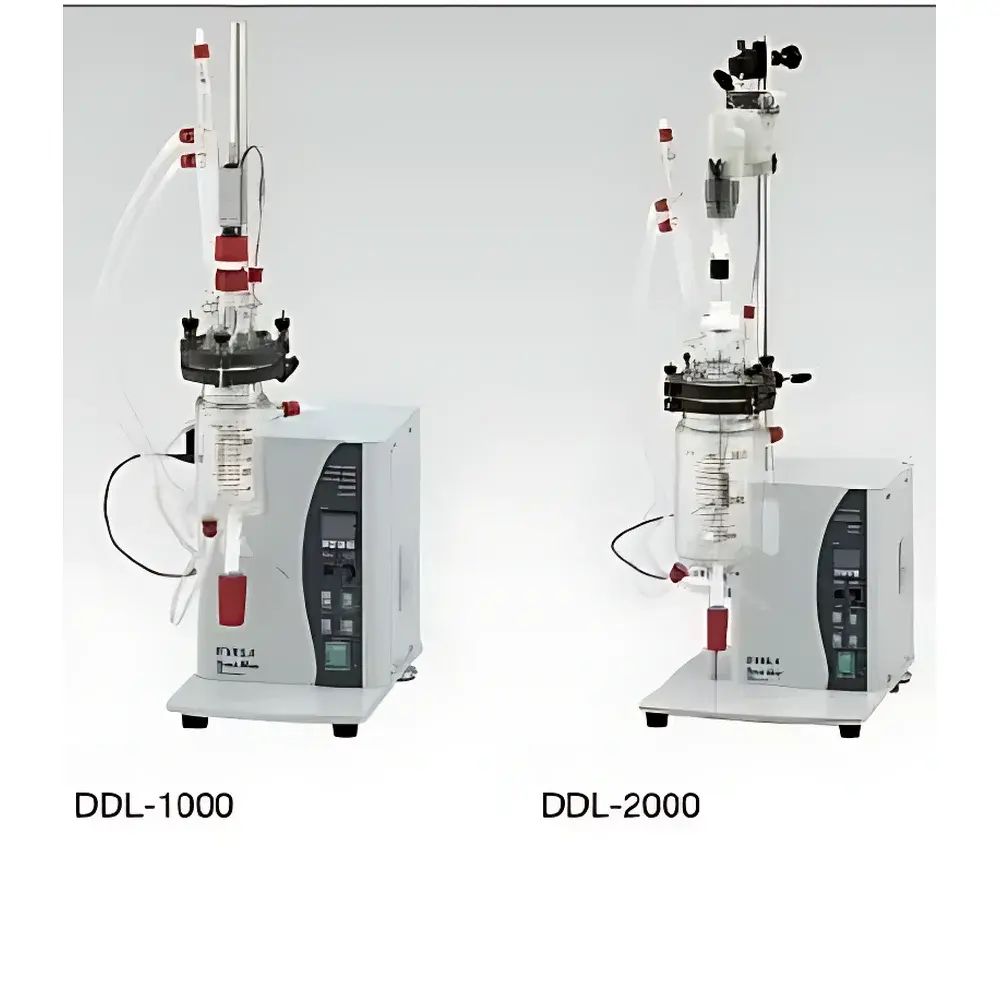
EYELA DDL Series Process Screening Reactor System
| Brand | EYELA (Tokyo Rikakikai Co., Ltd.) |
|---|---|
| Origin | Japan |
| Model | DDL-1000 / DDL-2000 |
| Reactor Type | Jacketed Laboratory Reactor System |
| Temperature Control Modes | Reaction Mass Control, Jacket Control, Isothermal Mode, Gradient Ramp Mode |
| Stirring | Mechanical Agitation (PTFE or SUS304 Impeller) |
| Temp. Range | 10–80 °C (Jacket) |
| Temp. Stability | ±0.1 °C |
| Stirring Speed | 10–1059 rpm |
| Max. Torque | 19.6 N·m (DDL-1000), 0.49 N·m (DDL-2000) |
| Cooling Rate (Jacket) | up to 30 K/min |
| Heating Rate (Jacket) | up to 7.0 K/min |
| Safety Systems | Independent Over-Temperature Protection, Leakage Current Breaker, Low-Coolant-Level Alarm, Emergency Rapid-Cooling Function, SSR Failure Detection, Dual Temperature Limit Alarms |
| Power Supply | AC 100 V, 50/60 Hz (7 A / 700 VA for DDL-1000 |
| Dimensions & Weight | 290×380×790 mm, 20 kg (DDL-1000) |
Overview
The EYELA DDL Series Process Screening Reactor System is a precision-engineered, jacketed laboratory-scale reactor platform designed specifically for reaction process development, scalability assessment, and chemical route optimization in pre-pilot and early-stage process engineering. Built upon EYELA’s decades of expertise in thermal control and reaction instrumentation, the DDL system implements a dual-temperature-control architecture—simultaneously monitoring and regulating both the reaction mass temperature (via internal Pt100 sensor) and the thermal fluid temperature within the jacket. This architecture enables rigorous replication of industrially relevant heat transfer dynamics, particularly during highly exothermic or endothermic transformations where precise thermal management directly impacts selectivity, yield, and safety margins. Unlike simple heated-stirred vessels, the DDL series integrates programmable thermal profiles (ramp-hold-cool), real-time torque feedback, and on-demand sampling via integrated drain valves—making it a foundational tool for Quality by Design (QbD) workflows compliant with ICH Q5, Q8, and Q11 frameworks.
Key Features
- Two scalable configurations: DDL-1000 (250 mL jacketed vessel, 100–250 mL working volume) and DDL-2000 (1 L jacketed vessel with drain valve, 300–1000 mL working volume)
- Dual-mode temperature control: independent regulation of reaction mass temperature (direct immersion sensing) and jacket fluid temperature—enabling comparative kinetic analysis under controlled heat-transfer boundary conditions
- Programmable thermal profiles: isothermal holds, linear ramps (heating/cooling), and multi-step gradients—all reproducible within ±0.1 °C stability
- Emergency rapid-cooling function: activates automatic high-flow coolant circulation upon detection of thermal excursion, mitigating runaway reaction risk during scale-down studies
- High-fidelity mechanical agitation: PTFE-blade impellers (DDL-1000) and SUS304 four-blade turbines (DDL-2000), each matched to torque and shear requirements for viscous or heterogeneous systems
- Integrated safety architecture: redundant over-temperature protection (independent hardware limiter), SSR failure monitoring, low-level coolant alarm, and dual upper/lower temperature limit alerts
Sample Compatibility & Compliance
The DDL system accommodates a broad range of chemistries—including Grignard additions, nitration, hydrogenation precursors, crystallization seeding studies, and catalytic cross-coupling reactions—where thermal history and mixing efficiency critically influence nucleation kinetics and polymorph selection. Vessels are constructed from borosilicate glass (jacketed configuration) with chemically resistant PTFE or stainless steel (SUS304) wetted components. All electronic modules comply with IEC 61010-1 for laboratory electrical safety and meet EMC requirements per CISPR 11. The system supports GLP-compliant data integrity when paired with validated third-party acquisition software; full audit trails, electronic signatures, and 21 CFR Part 11–ready metadata logging are achievable via optional integration with EYELA’s ReactMaster™ control interface.
Software & Data Management
While the DDL series operates natively via intuitive front-panel controls (membrane keypad for temperature setpoints, rotary encoder for stir speed), it is fully compatible with EYELA’s ReactMaster™ PC-based control and data acquisition suite. This software enables synchronized logging of temperature (jacket + reaction mass), stir speed, torque, and time-stamped event markers (e.g., reagent addition, sampling). Raw data exports in CSV or Excel-compatible formats support statistical process modeling (e.g., DoE in JMP or Minitab) and kinetic parameter estimation (e.g., Arrhenius activation energy via isoconversional methods). All logged parameters are timestamped with millisecond resolution and include instrument ID, operator ID, and method version—facilitating traceability in regulated environments.
Applications
- Reaction calorimetry screening: quantifying heat flow profiles during reagent addition under controlled isothermal conditions
- Process safety evaluation: determining adiabatic temperature rise (ΔTad) and time-to-maximum-rate (TMRad) via controlled semi-adiabatic experiments
- Crystallization process mapping: studying supersaturation generation rate, nucleation onset, and crystal habit evolution under defined cooling profiles
- Scale-up correlation studies: correlating mixing time, heat transfer coefficient (U-value), and local shear rate between lab and pilot scale using dimensionless numbers (Re, Fr, Nu)
- Continuous flow chemistry development: serving as a batch analog for residence time distribution (RTD) validation and thermal inertia benchmarking
FAQ
What distinguishes the DDL series from standard jacketed reactors?
The DDL integrates dual independent temperature sensors (reaction mass + jacket), programmable multi-segment thermal profiles, emergency rapid-cooling logic, and torque-synchronized stirring—features engineered explicitly for reaction mechanism elucidation and process robustness testing.
Is the system suitable for reactions requiring inert atmosphere control?
Yes—both DDL-1000 and DDL-2000 accept standard ground-glass joints (e.g., ISO 29/32) and can be coupled with nitrogen/vacuum manifolds, pressure-rated caps, and reflux condensers without modification.
Can the DDL be integrated into a larger automated synthesis platform?
Via RS-232 or optional Ethernet module, the DDL supports Modbus RTU/TCP communication protocols, enabling bidirectional control and data streaming within centralized Lab Automation Systems (LAS) or MES environments.
Does the system meet regulatory requirements for GMP documentation?
When operated with validated ReactMaster™ software and appropriate SOPs, the DDL satisfies ALCOA+ principles for raw data integrity, including attributable, legible, contemporaneous, original, and accurate recordkeeping—essential for FDA or EMA inspection readiness.
What maintenance is required for long-term reliability?
Annual calibration of Pt100 sensors and verification of SSR output linearity are recommended; no routine lubrication or impeller replacement is needed under normal operation due to sealed magnetic drive coupling and corrosion-resistant wetted materials.



