
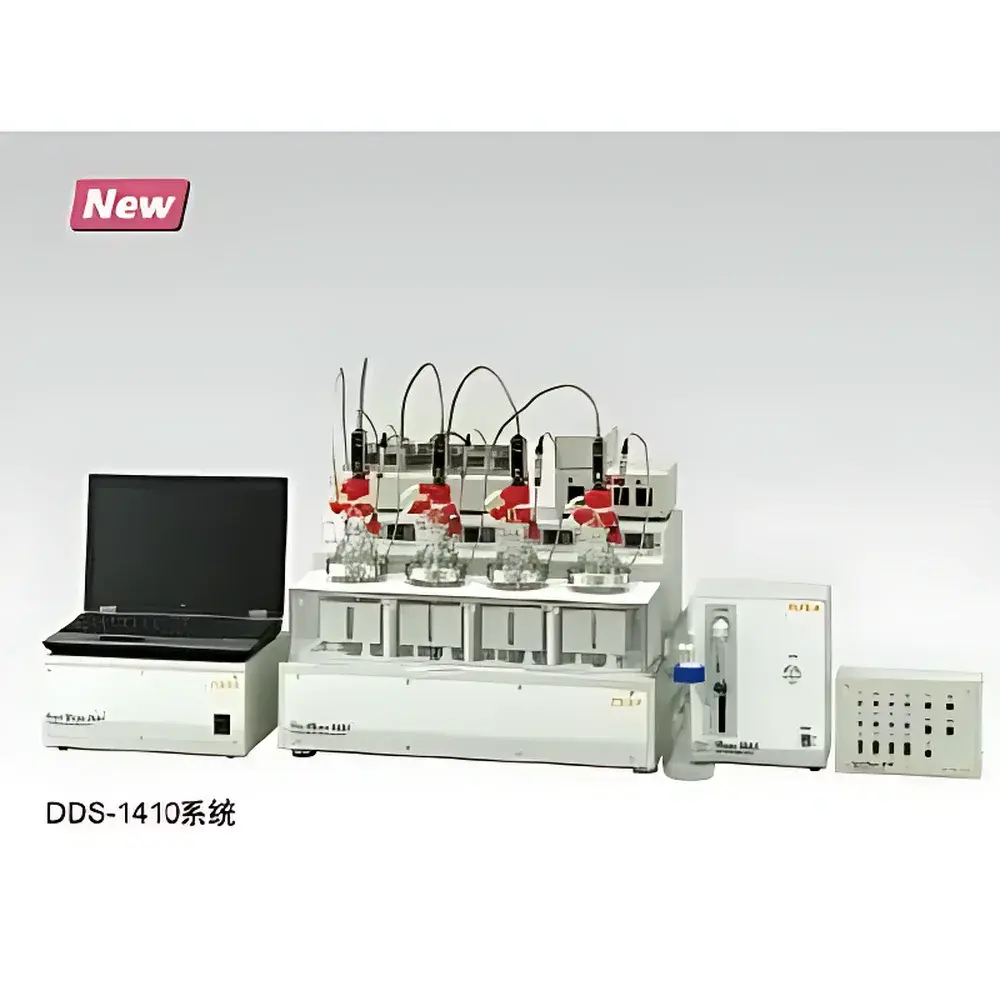
EYELA DDS Series Parallel Reaction Calorimeter System
| Brand | EYELA (Tokyo Rikakikai Co., Ltd.) |
|---|---|
| Origin | Japan |
| Model | DDS |
| Reactor Capacity | 4 × (50 / 100 / 250 mL, independent) |
| Temperature Control Range | −50 to 250 °C (requires external chiller) |
| Temperature Accuracy | ±0.5 K (−20–100 °C, aluminum block), ±1 K (100–180 °C, aluminum block) |
| Stirring Speed | 125–1000 rpm |
| Max. Heating Rate | Tr < 5.3 K/min, Tj < 19.3 K/min (250 mL water in glass reactor) |
| Max. Cooling Rate | Tr < 7.2 K/min, Tj < 29.6 K/min (250 mL water) |
| Max. Heat Removal Capacity | 0.74–1.1 W/g (200 mL water) |
| Heat Flow Measurement Resolution | 0.1 W, ±5% error (standard conditions) |
| Control Modes | Reactor temperature, aluminum block temperature, gradient, isothermal |
| Control Method | PID heating/cooling + cascade control |
| Liquid Addition | 8-channel volumetric dosing |
| Agitation Type | Propeller stirring |
| Optional pH Control | 0–14, acid/base titration |
| Heat Measurement Principle | Thermal conductivity-based calorimetry with calibration |
| Data Visualization | Real-time & historical trend graphs |
| Safety Systems | Leakage current protection, independent overtemperature cutoff, motor overload protection, software self-diagnosis |
| Flask Ports | Rodaviss 24, NS 14/23 (×3), GL 14 (×1) |
| Vessels | Borosilicate glass, round-bottom, graduated (50 mL or 250 mL) |
| Wetted Materials | Glass, PTFE, PPS, Karlez®, SUS316 |
| Dimensions (W×D×H) | 650 × 490 × 380 mm |
| Weight | ~59 kg |
| Power Supply | AC 100 V, 50 Hz, 2000 VA, 20 A |
Overview
The EYELA DDS Series Parallel Reaction Calorimeter System is an engineered platform for high-precision, multi-channel reaction monitoring and thermal analysis in synthetic organic chemistry, process development, and chemical engineering laboratories. Based on the principle of thermal conductivity calorimetry, the DDS system enables real-time, quantitative measurement of heat flow during exothermic or endothermic reactions—without requiring assumptions about reaction enthalpy or system heat capacity. Its four independently controlled reaction zones operate simultaneously under identical or divergent experimental conditions, supporting parallel screening, kinetic profiling, and calorimetric validation across multiple variables (e.g., temperature ramp, reagent addition rate, catalyst loading). The aluminum heating/cooling block—designed with optimized thermal mass and fluid channel geometry—delivers oil-bath-equivalent uniformity and responsiveness, while integrated cascade PID control ensures stable regulation of both reactor contents (Tr) and block temperature (Tj) across the full operational range from −50 °C to 250 °C.
Key Features
- Four independent reaction stations with individual PID-controlled temperature, stirring (125–1000 rpm), and volumetric liquid addition (8 channels total)
- Thermal conductivity-based calorimetry with 0.1 W resolution and ±5% accuracy under standard calibration conditions
- Cascade temperature control architecture enabling simultaneous Tr (reaction mixture) and Tj (aluminum block) regulation
- Dual-rate thermal response: max heating rate up to 19.3 K/min (Tj) and 5.3 K/min (Tr); max cooling rate up to 29.6 K/min (Tj) and 7.2 K/min (Tr)
- Modular wetted-path construction using borosilicate glass, PTFE, PPS, Karlez®, and SUS316 for compatibility with aggressive reagents and elevated temperatures
- Integrated LED illumination behind reactors for direct visual observation through inter-block gaps—enabling real-time assessment of phase behavior, precipitation, or gas evolution
- Comprehensive safety architecture including hardware-based overtemperature cutoff, motor overload protection, earth leakage detection, and software-driven self-diagnostics
Sample Compatibility & Compliance
The DDS system accommodates standard laboratory glassware—including graduated 50 mL and 250 mL round-bottom reactors—with sealing via Rodaviss 24 and NS/GL standardized ports. Its materials of construction comply with ISO 8536-1 for pharmaceutical glass containers and meet USP Class VI biocompatibility requirements for PTFE and PPS components. While not certified as a GMP manufacturing device, the system supports GLP-compliant data acquisition when used with validated software configurations. All thermal and dosing control parameters are logged with timestamps and user identifiers, satisfying traceability requirements under FDA 21 CFR Part 11 when paired with appropriate electronic signature protocols. The system is routinely deployed in environments adhering to ASTM E2874 (Standard Guide for Reaction Calorimetry) and ICH Q5C (stability testing guidelines).
Software & Data Management
EYELA’s proprietary DDS control software provides synchronized management of temperature profiles, stirring dynamics, multi-channel reagent addition, optional pH titration, and real-time calorimetric output. All parameters are recorded at configurable intervals (down to 1 s) into timestamped binary files with ASCII export capability. Trend visualization includes overlayable Tr/Tj curves, heat flow vs. time plots, cumulative enthalpy integration, and derivative analysis for onset detection. Audit trails log operator actions, parameter changes, and system alerts. Data files support post-processing in MATLAB, Python (NumPy/Pandas), or commercial kinetics platforms such as Kinetics Neo or Thermo-Calc. Export formats include CSV, XML, and PDF reports compliant with internal SOPs or regulatory submissions.
Applications
- Process safety evaluation: determination of adiabatic temperature rise (ΔTad), time-to-maximum-rate (TMR), and thermal accumulation behavior
- Kinetic modeling: extraction of activation energy, reaction order, and heat of reaction via isoconversional methods
- Reaction optimization: parallel screening of catalysts, solvents, stoichiometries, and addition protocols under controlled thermal boundary conditions
- Scale-up support: correlation of lab-scale calorimetric data with pilot-plant thermal models using dimensionless numbers (e.g., Graetz, Biot)
- Crystallization studies: monitoring of dissolution enthalpy, supersaturation profiles, and nucleation onset under controlled cooling gradients
- API synthesis development: verification of batch consistency, impurity formation thresholds, and quench point validation
FAQ
Does the DDS system require external cooling equipment?
Yes—the specified −50 °C to 250 °C temperature range necessitates connection to a recirculating chiller capable of sub-ambient operation and sufficient heat rejection capacity (≥1.5 kW at −40 °C outlet). EYELA recommends compatible models with RS-485 communication for integrated control.
Can the system perform isothermal calorimetry at elevated temperatures?
Yes—via aluminum block temperature control mode, the DDS maintains isothermal conditions up to 250 °C with stability better than ±1 K above 100 °C, provided thermal load remains within the system’s maximum heat removal capacity.
Is pH control included as standard equipment?
No—pH titration functionality is available only as an optional module, comprising a calibrated pH electrode, peristaltic acid/base dosing pump, and software integration for feedback-controlled neutralization or pH-stat experiments.
How is calorimetric calibration performed?
Calibration uses electrical resistance heaters embedded in reference reactors, applying known power inputs (e.g., 1–10 W steps) to establish the thermal conductivity transfer function between measured voltage and actual heat flow—valid across the entire temperature and stirring range.
What data integrity features support regulatory submissions?
The system logs all control parameters, sensor readings, operator inputs, and system status flags with cryptographic hashing and sequential numbering. When operated under validated software configuration and access-controlled user accounts, it meets ALCOA+ principles for raw data retention and audit trail completeness.



