
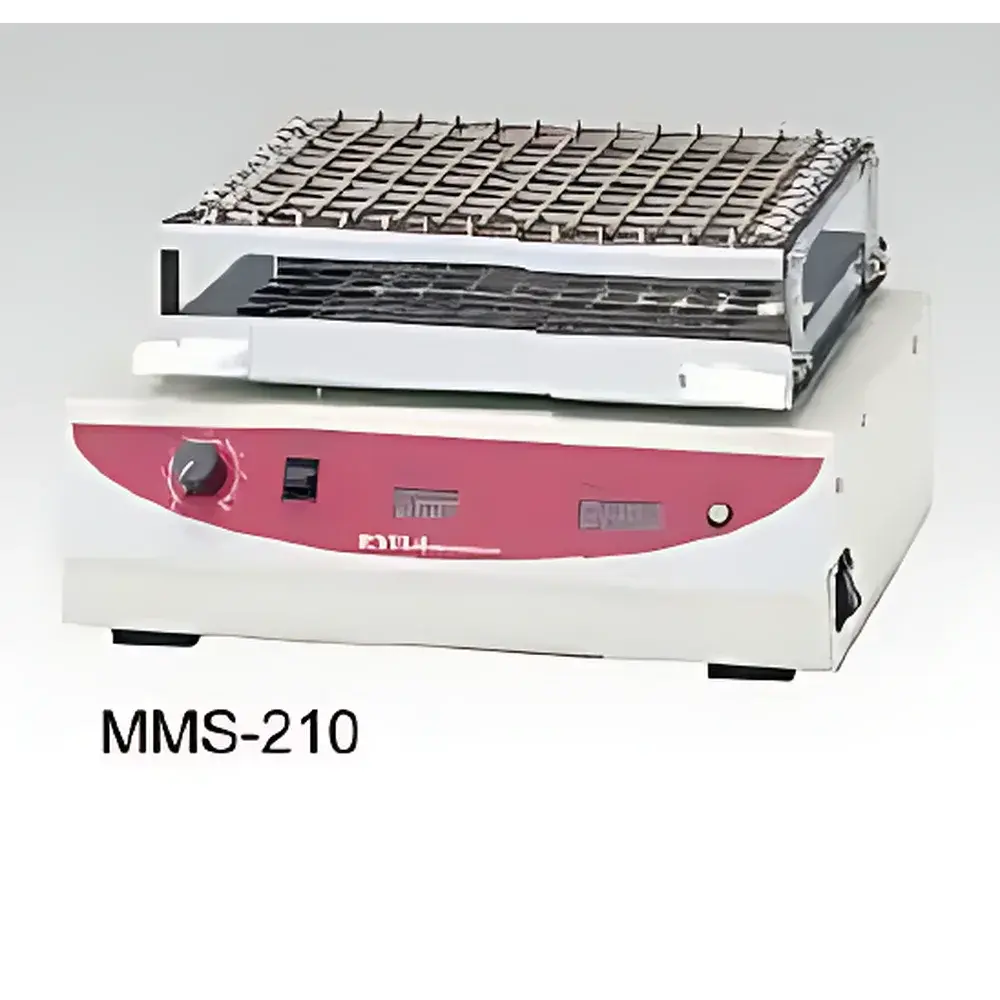
EYELA MMS-110 / MMS-210 / MMS-310 / MMS-3010 Orbital and Reciprocal Shaker Series
| Brand | EYELA (Tokyo Rikakikai Co., Ltd.) |
|---|---|
| Origin | Japan |
| Model | MMS-110 / MMS-210 / MMS-310 / MMS-3010 |
| Oscillation Mode | Reciprocal (MMS-110), Orbital (MMS-210), Dual-Mode Reciprocal/Orbital (MMS-310 & MMS-3010) |
| Speed Range | 20–250 rpm |
| Amplitude | 25 mm |
| Speed Control & Display | Analog Knob + Digital LED Display |
| Safety Features | Fuse Protection + Motor Overload Circuit |
| Time Accumulation Function | 0.1–999.9 h (digital display) |
| Motor Type | Brushless DC Motor |
| Operating Ambient Temperature Range | 4–50 °C |
| Noise Reduction | ≥5 dB(A) vs. previous generation |
| Enclosure Compatibility | Compatible with EYELA FMS/FMC environmental chambers |
Overview
The EYELA MMS-Series shakers are precision-engineered benchtop orbital and reciprocal shaking platforms designed for reproducible, low-maintenance cell culture, microbial propagation, and biochemical incubation workflows. Built upon a robust brushless DC motor architecture, the series comprises four distinct models—MMS-110 (reciprocal only), MMS-210 (orbital only), MMS-310 (dual-mode selectable), and MMS-3010 (dual-mode with enhanced chamber integration)—each optimized for specific mixing dynamics required across upstream bioprocessing stages. The shakers operate on the principle of controlled mechanical agitation to ensure uniform suspension, gas exchange, and nutrient distribution in liquid-phase cultures. Their ability to maintain stable rotational or linear oscillation across a broad speed range (20–250 rpm) enables precise tuning for delicate applications such as yeast pre-culture, stress-induced phenotypic adaptation studies, and post-transformation bacterial recovery—all while operating reliably within environmental chambers at temperatures as low as 4 °C.
Key Features
- Brushless DC motor design ensures consistent torque delivery, extended service life (>20,000 h MTBF), and zero carbon brush wear—eliminating maintenance downtime and particulate contamination risks critical in sterile lab environments.
- Low-noise mechanical architecture achieves ≥5 dB(A) noise reduction versus prior-generation units, supporting placement in shared laboratories or laminar flow hood-adjacent workspaces without acoustic interference.
- Digital time accumulation function (0.1–999.9 h) provides traceable, non-volatile record of cumulative oscillation exposure—essential for GLP-compliant process documentation and protocol standardization.
- Wide ambient operating range (4–50 °C) permits uninterrupted operation inside refrigerated incubators, cold rooms, or temperature-controlled enclosures—including seamless integration with EYELA’s FMS (forced-air cooling) and FMC (refrigerated/heating) environmental chambers.
- Intuitive analog speed adjustment paired with high-contrast LED digital display enables rapid, repeatable parameter setting without software dependency—reducing training overhead and minimizing operator error.
Sample Compatibility & Compliance
The MMS-Series accommodates standard microbiological and cell culture vessels including Erlenmeyer flasks (50–2000 mL), test tubes, multi-well plates (with optional platform adapters), and custom-sized containers up to 5 kg total load. All models comply with IEC 61010-1:2010 safety standards for laboratory electrical equipment and meet EMC requirements per CISPR 11 Group 1, Class B. While not certified for ISO 5 cleanroom use out-of-box, their brushless motor and sealed drive mechanism minimize airborne particulates—making them suitable for ISO 7–8 environments when used with appropriate containment accessories. Units support audit-ready workflows under FDA 21 CFR Part 11 when integrated with validated LIMS or ELN systems via external data logging interfaces (RS-232 optional).
Software & Data Management
The MMS-Series operates as a stand-alone instrument with no embedded firmware or proprietary software stack. Speed and accumulated time values are displayed locally via LED readout; no USB, Ethernet, or Bluetooth connectivity is provided. For regulatory traceability, users may connect external data loggers (e.g., Omega OM-DAQPRO or Testo 176 T4) to the analog output port (0–5 V DC proportional to rpm) or utilize programmable PLC triggers based on time-accumulation thresholds. This architecture aligns with ALCOA+ principles—ensuring attributable, legible, contemporaneous, original, accurate, complete, consistent, enduring, and available records when implemented with documented SOPs.
Applications
- Microbial culture expansion: optimization of Saccharomyces cerevisiae pre-inoculum growth kinetics and stress-response induction in E. coli post-transformation recovery phases.
- Protein expression systems: maintaining homogeneous aeration during IPTG-inducible expression in BL21(DE3) derivatives under sub-ambient conditions (e.g., 15 °C).
- Cell line adaptation: gradual ramping of shear stress in CHO or HEK293 suspension cultures via controlled amplitude/speed modulation.
- Enzyme assay preparation: uniform reagent mixing prior to spectrophotometric or HPLC analysis without introducing foaming or denaturation artifacts.
- Environmental simulation: long-term stability testing of biologics or diagnostic reagents under oscillatory thermal stress within FMC-series chambers.
FAQ
Can the MMS-3010 be operated inside a CO₂ incubator?
No—CO₂ incubators require gas-tight seals and humidity control incompatible with the MMS-Series’ open-frame design and ventilation requirements. Use only in dry, temperature-controlled enclosures rated for mechanical vibration.
Is the 25 mm amplitude adjustable?
No—the amplitude is fixed at 25 mm across all models to ensure mechanical stability and consistent fluid dynamics across the specified speed range.
Does the time accumulation function reset automatically after power loss?
Yes—the unit retains accumulated time in non-volatile memory and resumes counting upon power restoration, ensuring continuity for multi-shift or unattended overnight protocols.
Are platform adapters for microplates available from EYELA?
Yes—optional universal clamping platforms (Part No. MMS-APL) accommodate 96-well and 384-well plates with secure retention up to 250 rpm.
What is the maximum flask size supported on the MMS-210 orbital platform?
The standard platform supports up to two 2 L Erlenmeyer flasks (total load ≤5 kg); larger configurations require custom balancing and are not covered under warranty.





