
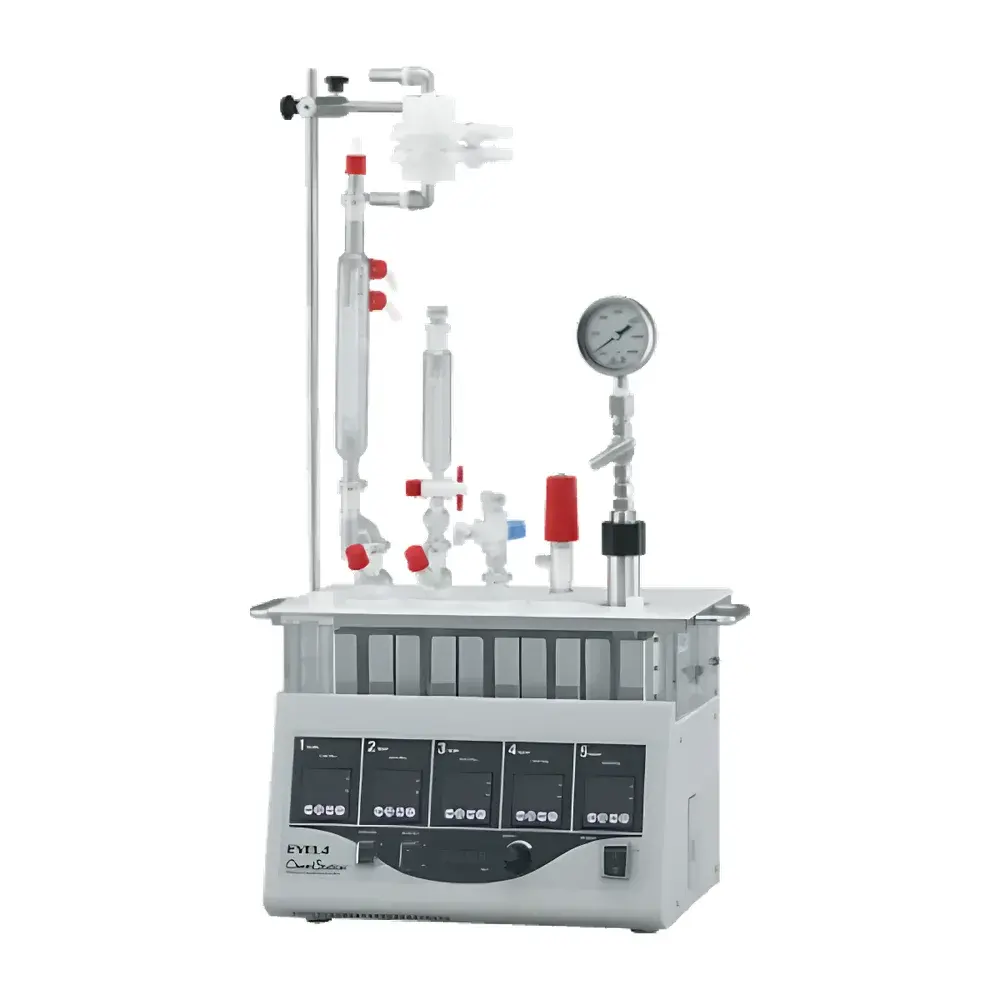
EYELA PPS-5511 Parallel Organic Synthesis Platform
| Brand | EYELA (Tokyo Rikakikai Co., Ltd.) |
|---|---|
| Origin | Japan |
| Model | PPS-5511 |
| Temperature Control Range | −23 to 160 °C (independent per module) |
| Temp. Accuracy | ±0.5 °C |
| Stirring Speed | 100–2000 rpm (load-dependent) |
| Reaction Volume per Vessel | 0.5–60 mL |
| Number of Simultaneous Reaction Vessels | 1–5 (expandable to 20 with optional tube rack configuration) |
| Tube Diameter Compatibility | Φ12–Φ35 mm (14 standard sizes) |
| Gas Handling | Vacuum evacuation & inert gas (N₂/Ar) purging capability (requires compatible sealed vessels) |
| Safety Systems | Dual-layer acrylic shield, motor overheat protection, leakage/overcurrent breaker, thermal fuse, real-time sensor diagnostics, user-configurable upper/lower temperature limits |
| External Dimensions | 465 W × 335 D × 390 H mm (main unit) |
| Weight | ~23 kg |
Overview
The EYELA PPS-5511 Parallel Organic Synthesis Platform is an engineered laboratory system designed for high-efficiency, temperature-precise, and atmospherically controlled small-scale reaction screening. Built upon a modular architecture, it integrates five independently programmable heating/cooling modules—each capable of maintaining stable setpoints from −23 °C to 160 °C—enabling true parallel reaction optimization under divergent thermal conditions. Unlike conventional single-zone reactors, the PPS-5511 employs Peltier-based thermoelectric elements combined with forced-air circulation and precision PID feedback control to deliver ±0.5 °C thermal stability across all modules, even during dynamic ramping or prolonged hold periods. Its core application domain includes catalyst screening, solvent effect studies, kinetic profiling, and route scouting in pharmaceutical process R&D, fine chemical synthesis, and academic methodology development. The system operates on the principle of simultaneous multi-vessel thermal management, where each reaction tube functions as an isolated micro-reactor with dedicated temperature regulation, stirring, and environmental control—eliminating cross-module thermal crosstalk and supporting statistically robust DoE (Design of Experiments) workflows.
Key Features
- Five independent thermoelectric modules with real-time digital temperature monitoring and adjustable ramp rates (0.1–10 °C/min)
- High-torque magnetic stirring (100–2000 rpm), calibrated for viscosity ranges up to 10,000 cP using standard aqueous loads; performance maintained across 0.5–60 mL volumes via adaptive torque compensation
- Integrated front-access observation window with anti-fog dual-layer acrylic shield, enabling continuous visual monitoring without compromising inert atmosphere integrity
- Modular gas handling interface supporting vacuum evacuation (<10 mbar) followed by inert gas (N₂ or Ar) backfilling—compatible with septum-sealed vials, pressure-rated tubes, and reflux-capable vessels
- Flexible reagent addition system accommodating syringe, dropping funnel, and positive-displacement pipette inputs—all operable under maintained inert conditions
- Comprehensive safety architecture: hardware-level thermal fuses, ground-fault circuit interrupters (GFCI), motor thermal cutoffs, and firmware-driven self-diagnostics for sensor drift, open-circuit detection, and out-of-range deviation alerts
Sample Compatibility & Compliance
The PPS-5511 accommodates a wide range of reaction vessels—including standard borosilicate glass test tubes (Φ12–Φ35 mm), custom jacketed reactors, and commercially available parallel synthesis vials—via interchangeable tube holders (14 standard diameters supported). Vessel selection directly influences operational limits: maximum temperature drops to 130 °C when using 50–60 mL capacity tubes due to thermal mass constraints. The platform complies with IEC 61010-1:2010 for electrical safety in laboratory equipment and meets CE marking requirements for EMC and low-voltage directives. While not intrinsically rated for Class I Division 1 environments, its inert gas compatibility supports GLP-compliant synthesis under nitrogen or argon blankets—commonly referenced in USP , ASTM E2656, and ISO 17025-accredited laboratories conducting method validation for API intermediates.
Software & Data Management
The PPS-5511 operates via embedded firmware with local control only—no proprietary PC software required. All parameters (temperature setpoints, stir speed, ramp profiles, alarm thresholds) are configured through a membrane keypad with LED digit display and rotary encoder for analog-style input. Temperature and stir speed values are logged internally at 1-second intervals and retained for up to 72 hours (non-volatile memory). Data export is performed via USB-C port in CSV format, supporting traceability for audit-ready documentation. The system supports 21 CFR Part 11–aligned practices through configurable user access levels (operator/admin), electronic signature prompts for critical parameter changes, and immutable timestamped event logs—including thermal excursions, power interruptions, and safety interlock triggers.
Applications
- High-throughput optimization of cross-coupling reactions (Suzuki, Heck, Buchwald–Hartwig) under varied temperature and stoichiometric conditions
- Accelerated stability testing of novel active pharmaceutical ingredients (APIs) in solution-phase degradation studies
- Development of asymmetric catalysis protocols requiring precise cryogenic control (e.g., −20 °C enantioselective aldol additions)
- Green chemistry screening using low-boiling solvents (e.g., Et₂O, CH₂Cl₂) with integrated reflux condensation and coolant loop integration
- Moisture- and oxygen-sensitive organometallic syntheses (e.g., Grignard, lithiation) conducted under sustained inert atmosphere with sequential reagent dosing
FAQ
Can the PPS-5511 be used for exothermic reactions requiring active cooling below ambient?
Yes—the Peltier modules provide active cooling down to −23 °C, enabling precise control of highly exothermic transformations without external chiller dependency.
Is remote monitoring or network connectivity supported?
No—this is a standalone instrument with no Ethernet, Wi-Fi, or cloud interface. All operation and data retrieval occur locally via front-panel controls and USB export.
What vessel types are validated for vacuum/inert gas operation?
EYELA recommends their proprietary PPS-series sealed vials with PTFE-lined caps or third-party vessels certified to ISO 8536-1 for pressure resistance up to 2 bar gauge.
Does the system meet GMP documentation requirements for regulated environments?
It supports ALCOA+ principles (Attributable, Legible, Contemporaneous, Original, Accurate, Complete, Consistent, Enduring, Available) through time-stamped internal logging and CSV audit trails—but requires lab-specific SOPs for full GMP alignment.
How is temperature uniformity verified across modules during qualification?
Users perform IQ/OQ using NIST-traceable PT100 probes placed at geometric centers of representative vessels; EYELA provides a qualification template compliant with ASTM E2500-13 for thermal mapping.



