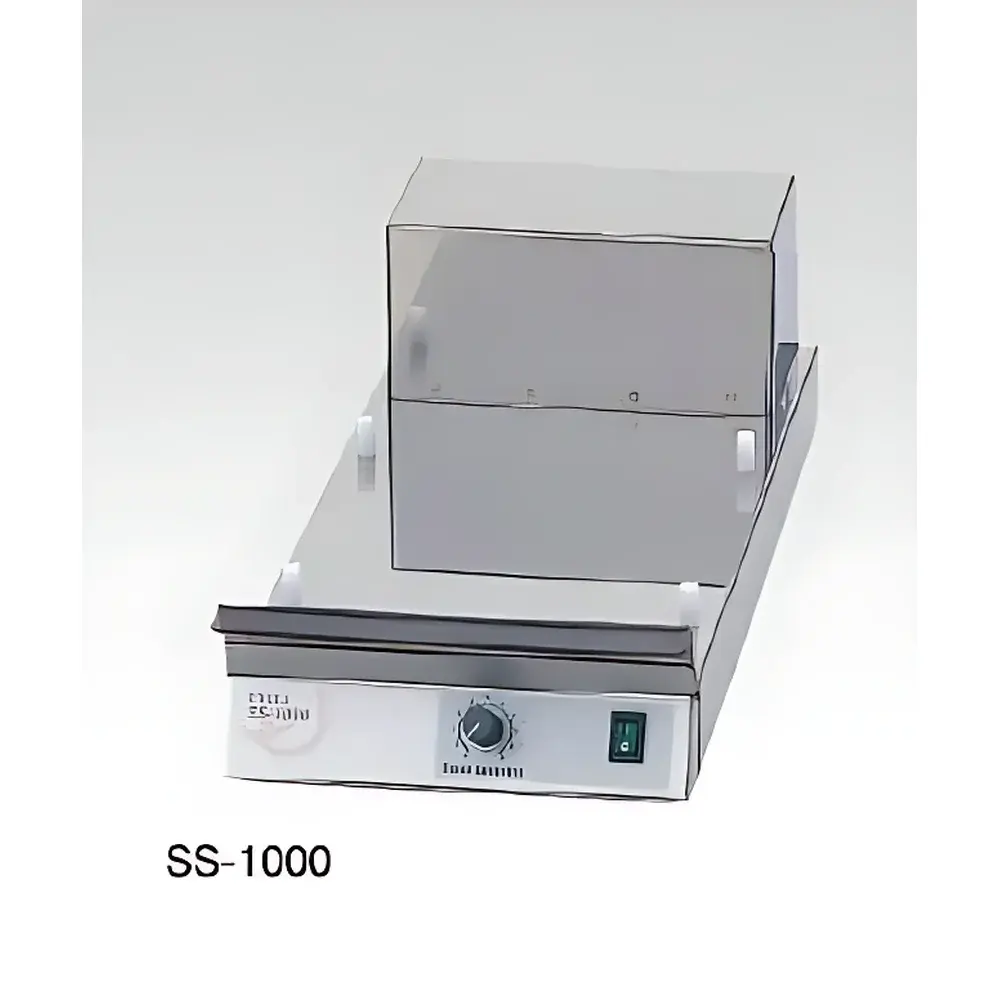
EYELA SS-1000 Compact Thermostatic Water Bath Shaker
| Brand | EYELA (Tokyo Rikakikai Co., Ltd.) |
|---|---|
| Origin | Japan |
| Model | SS-1000 |
| Oscillation Mode | Reciprocating (Electromagnetic Induction) |
| Speed Range | 0–200 rpm |
| Stroke Amplitude | 25 mm |
| Operating Ambient Temperature | 5–35 °C |
| External Dimensions (W×D×H) | 200 × 469 × 135 mm |
| Weight | Approx. 6.6 kg |
| Power Supply | AC 100 V, 50/60 Hz |
| Current Draw | 0.4 A |
| Input Power | 40 VA |
Overview
The EYELA SS-1000 Compact Thermostatic Water Bath Shaker is an engineered solution for precise, low-volume sample agitation within temperature-controlled aqueous environments. Designed exclusively for integration with EYELA’s NTT-2000 series compact thermostatic water baths, this shaker operates on electromagnetic induction—eliminating mechanical drive components from the water bath chamber. This architecture ensures contamination-free operation, simplified maintenance, and full compatibility with sterile or sensitive biological workflows. Unlike conventional orbital or rotary shakers mounted externally or submerged with motors, the SS-1000 delivers controlled reciprocating motion (linear back-and-forth oscillation) directly to the platform via non-contact magnetic coupling. Its design adheres to core principles of thermal stability and mechanical reproducibility, making it suitable for applications requiring consistent kinetic energy input under tightly regulated temperature conditions (±0.1 °C typical when paired with NTT-2000).
Key Features
- Electromagnetic induction drive system — no internal motor, shafts, or seals in contact with water; enables full submersion cleaning and eliminates lubricant contamination risks.
- Adjustable reciprocating oscillation at 0–200 rpm with fixed 25 mm stroke amplitude — optimized for uniform mixing of small-volume samples (e.g., microcentrifuge tubes, PCR strips, multiwell plates up to 96-well format).
- Compact footprint (200 × 469 × 135 mm) and lightweight construction (6.6 kg) — facilitates benchtop integration and minimizes spatial demand in crowded lab environments.
- Low-power operation (40 VA, 0.4 A @ 100 V AC) — compatible with standard laboratory circuits and supports continuous unattended operation under GLP-compliant monitoring protocols.
- Thermally isolated control electronics — housed outside the bath interface to prevent heat leakage and ensure long-term stability of both drive performance and bath temperature setpoint.
Sample Compatibility & Compliance
The SS-1000 is validated for use with EYELA NTT-2000 thermostatic water baths, forming a certified integrated system for temperature-regulated shaking. It accommodates common low-profile labware including 1.5–2.0 mL microtubes, 0.2 mL PCR tube strips, 8- and 12-tube racks, and shallow-format microplates (up to 96-well, max height ≤ 15 mm). The absence of submerged moving parts meets ISO 13485-aligned cleanliness requirements for device manufacturing support labs and satisfies general Good Laboratory Practice (GLP) criteria for auditability of agitation parameters. While not intrinsically rated for IEC 61000-6-3 EMC compliance as a standalone unit, its electromagnetic design inherently limits radiated emissions—facilitating co-location with sensitive analytical instrumentation.
Software & Data Management
The SS-1000 operates as a manually controlled analog device with front-panel speed adjustment and on/off toggle; it does not incorporate digital interfaces, firmware, or data logging capabilities. This intentional design prioritizes operational reliability, electromagnetic compatibility, and regulatory simplicity—particularly advantageous in FDA-regulated QC laboratories where validation of electronic controls (e.g., 21 CFR Part 11 compliance) would otherwise require extensive documentation. Users integrate the SS-1000 into broader data ecosystems via external environmental monitoring systems (e.g., calibrated Pt100 probes linked to validated dataloggers) that record bath temperature and runtime—ensuring traceable, time-stamped process records aligned with ISO/IEC 17025 documentation standards.
Applications
- Enzyme kinetics assays requiring simultaneous temperature control and gentle linear agitation to prevent protein denaturation at air–liquid interfaces.
- Cell suspension culture of anchorage-independent lines (e.g., hybridomas, lymphocytes) in small-volume formats during viability assessment or cryopreservation protocol development.
- Antibody-antigen binding studies using microtiter plate-based ELISA setups where uniform mixing without splashing or foaming is critical.
- DNA hybridization and probe annealing steps in molecular diagnostics workflows, especially when combined with EYELA’s NTT-2000’s rapid thermal equilibration (<15 min to reach ±0.2 °C at 37 °C).
- Calibration verification of temperature-sensitive biosensors immersed in buffer solutions under dynamic flow-equivalent conditions.
FAQ
Can the SS-1000 be used independently of the NTT-2000 water bath?
No—it is mechanically and thermally engineered only for direct mounting onto the NTT-2000 series bath platform. Standalone operation is neither supported nor recommended due to lack of integrated temperature regulation or structural support.
Is the oscillation speed digitally controllable or programmable?
Speed is adjusted via a calibrated analog dial; no digital interface, memory presets, or ramping profiles are provided.
What is the maximum load capacity for stable operation?
Rated for uniform agitation of up to 1.5 kg distributed mass—equivalent to twelve 1.5 mL tubes filled with aqueous solution or one standard 96-well plate with lid.
Does the unit include safety certifications for international markets?
The SS-1000 carries PSE marking for the Japanese market; CE or UKCA declarations are not applicable as it is classified as a component—not a stand-alone electrical appliance—under EU/UK regulatory frameworks.
How often does preventive maintenance require intervention?
No scheduled maintenance is specified; periodic visual inspection of the electromagnetic coupling surface and cleaning of the platform with 70% ethanol is sufficient under normal use conditions.