
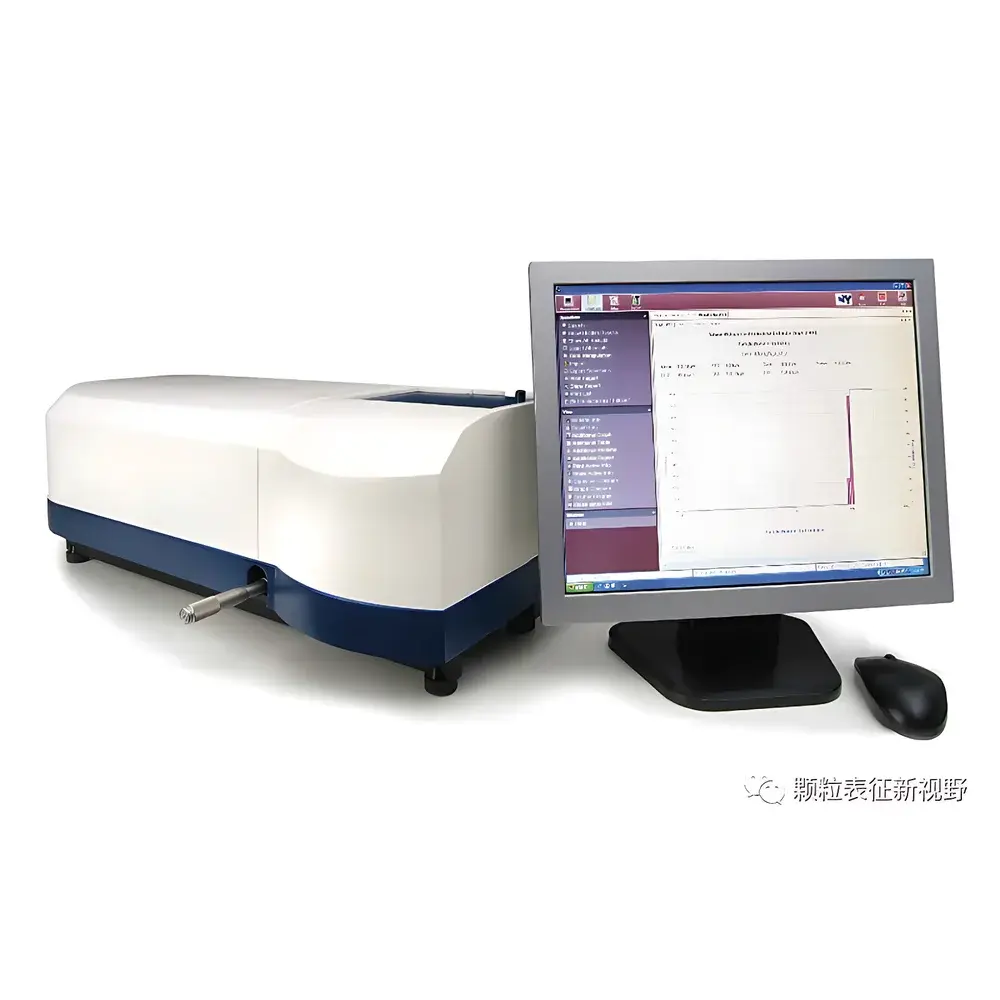
EyeTech Laser Obscuration and Time-of-Flight Particle Size and Shape Analyzer
| Origin | Netherlands |
|---|---|
| Manufacturer Type | Authorized Distributor |
| Origin Category | Imported |
| Model | EyeTech |
| Price Range | USD 110,000–138,000 |
| Dispersion Method | Dry & Wet |
| Measurement Range | 0.01–3600 µm |
| Repeatability | <1% RSD |
| Measurement Time | 10–60 s |
| Concentration Range | ~10⁹ particles/mL |
| Light Source | Stabilized He–Ne Laser (632.8 nm) |
| Laser Resolution | 0.33% of full scale |
| Detector | Silicon PIN Photodiode |
| Stroboscopic Illumination | Adjustable intensity & pulse duration |
| Camera | High-resolution monochrome CCD |
| Shape Parameters | 40 ISO-compliant morphological descriptors |
| Sample Introduction | Liquid suspension, dry powder, microscope slide-mounted |
| Software Compliance | FDA 21 CFR Part 11 (audit trail, user roles, electronic signatures) |
Overview
The EyeTech Laser Obscuration and Time-of-Flight (LOT) Particle Size and Shape Analyzer is a modular, high-fidelity instrumentation platform engineered for absolute, calibration-free characterization of individual particles in suspension or dry state. Unlike ensemble-averaging techniques such as laser diffraction or dynamic light scattering, the EyeTech system employs single-particle detection via laser obscuration coupled with synchronized high-speed video imaging. As each particle traverses the collimated laser beam, its projected area and transit time are recorded simultaneously—enabling direct calculation of equivalent circular diameter (ECD), length, width, aspect ratio, convexity, solidity, and over 40 standardized ISO shape descriptors. This dual-sensor architecture ensures metrological independence from particle refractive index, density, or dispersion medium optical properties—eliminating the need for Mie theory assumptions, empirical calibration standards, or iterative inversion algorithms.
Key Features
- True absolute measurement principle: No calibration required; no dependency on optical or physical properties of particles or dispersants.
- Modular design supports rapid interchange of sample modules—including wet-flow cells, dry dispersion units, aerosol inlets, heated liquid cells, and slide-based static imaging stages.
- Integrated high-stability He–Ne laser (632.8 nm) and silicon PIN photodiode detector deliver sub-micron resolution across the full 0.01–3600 µm dynamic range.
- Synchronized stroboscopic illumination (up to 30 Hz) and monochrome CCD camera capture high-contrast silhouette images at frame rates optimized for particle velocity and morphology fidelity.
- Post-acquisition reprocessing capability: All raw image sequences and obscuration waveforms are stored losslessly, enabling retrospective analysis with updated algorithms or classification criteria.
- Independent optical core and dispersion subsystems minimize cross-contamination risk and allow parallel method development for diverse sample types—including magnetic powders, fibrous materials, emulsions, and thermally sensitive suspensions.
- FDA 21 CFR Part 11-compliant software architecture with role-based access control, full audit trail, electronic signature support, and secure data archiving.
Sample Compatibility & Compliance
The EyeTech system accommodates heterogeneous particulate systems without modification to fundamental measurement physics. It routinely characterizes geological sediments (clays, sands, kaolins), pharmaceutical formulations (injectables, microcarriers, syrups), industrial pigments and resins, metallic and ceramic powders (including oxide nanoparticles), coal and biomass-derived fuels, food-grade milled products (coffee grounds, cocoa powder, flour), and biological entities (bacteria, yeast, erythrocytes). All hardware and firmware comply with IEC 61000-6-3 (EMC) and IEC 61010-1 (safety). The instrument meets GLP/GMP environmental monitoring requirements when deployed with validated SOPs and periodic performance verification per ISO 13322-2 (static image analysis) and ISO 13320 (laser diffraction—where comparative validation is performed).
Software & Data Management
EyeTech Control Suite v5.x provides an integrated environment for acquisition, real-time visualization, batch processing, statistical reporting, and database export. The software implements hierarchical user permissions (Administrator, Analyst, Reviewer), time-stamped audit logs for all parameter changes and report generations, and encrypted local storage compliant with HIPAA and GDPR data sovereignty requirements. Data exports support ASTM E2917, ISO 9276, and USP reporting formats. Raw image datasets (.tiff sequence + .csv waveform) are preserved alongside processed results, ensuring full traceability and enabling third-party algorithm validation. Optional LIMS integration is available via ASTM E1482-compliant API.
Applications
- Geosciences: Quantitative grain-size distribution and shape evolution in sediment transport studies; clay mineral aspect ratio mapping for rheological modeling.
- Pharmaceuticals: Subvisible particle enumeration in parenteral biologics per USP ; shape-driven dissolution profiling of crystalline APIs; microcarrier uniformity assessment for cell therapy manufacturing.
- Chemicals & Coatings: Pigment aspect ratio correlation with film opacity and gloss; emulsion droplet deformation analysis under shear.
- Metallurgy & Additive Manufacturing: Sphericity and surface roughness quantification of metal powders per ASTM F3049; satellite detection in gas-atomized Inconel 718.
- Energy: Fly ash particle morphology classification for pozzolanic activity prediction; coal pulverization efficiency monitoring via angularity index.
- Food Science: Grinding endpoint control via fractal dimension analysis of chocolate liquor particles; agglomeration detection in instant coffee powders.
- Life Sciences: Morphometric classification of bacterial morphotypes under antibiotic stress; red blood cell echinocyte transformation kinetics.
FAQ
Does the EyeTech require refractive index input for accurate sizing?
No. The LOT principle measures geometric obscuration and transit time—both independent of optical properties. No Mie or Fraunhofer assumptions are applied.
Can the system analyze opaque or highly absorbing particles?
Yes. Because measurement relies on shadow casting rather than scattered light intensity, carbon black, metal oxides, and other non-scattering materials are fully supported.
Is method transfer possible between different EyeTech modules?
Yes. The core optical engine and software processing pipeline remain identical across wet, dry, and static modules—ensuring inter-method comparability when validated per ISO 21501-4.
What validation documentation is provided?
Each system ships with Factory Acceptance Test (FAT) report, Installation Qualification (IQ), and Operational Qualification (OQ) templates aligned with ASTM E2917 and EU Annex 11 expectations.
How is data integrity ensured during long-term deployment?
All acquisitions include cryptographic hash checksums; software enforces write-once-read-many (WORM) archive policies; audit trails record operator ID, timestamp, and action context for every data manipulation event.



